
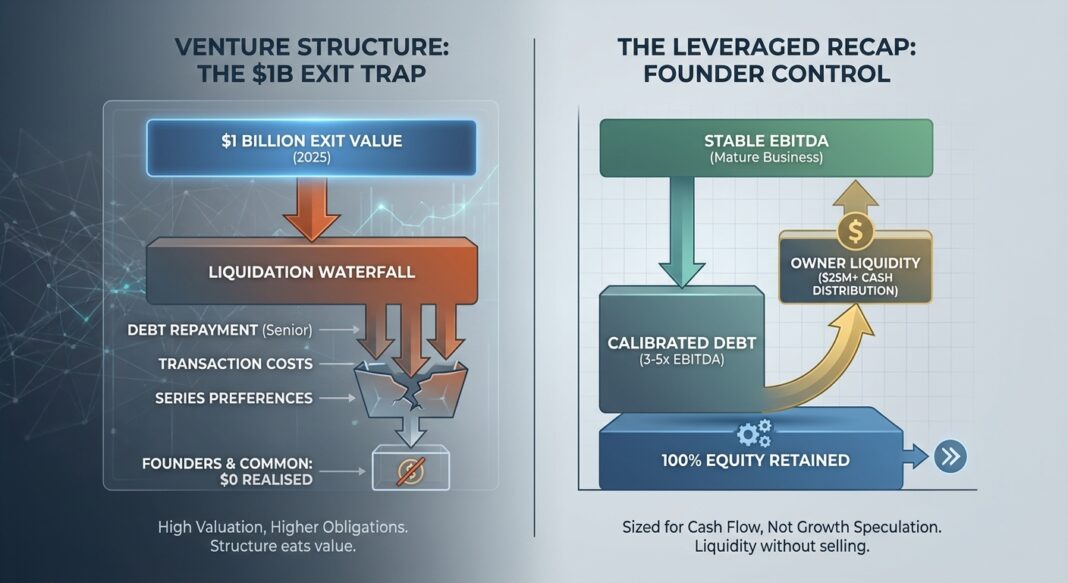
The Story: A Billion-Dollar Exit With a Zero-Dollar Payout
In January 2025, Divvy Homes sold to Brookfield Properties for approximately $1 billion. By any headline measure, that sounds like a success story: a venture-backed proptech startup finding its exit, a unicorn returning capital, a market chapter closed. Then the letter went out.
Divvy CEO and co-founder Adena Hefets wrote to shareholders confirming what the cap table math had already decided: after repaying outstanding indebtedness, transaction costs, and liquidation preferences to preferred shareholders, neither common shareholders nor founders' preferred stock would receive any consideration. The builders of a company that had helped over 15,000 residents begin their path to homeownership walked away with nothing.
This was not a failure story. The company had real customers, real mission, real scale: a property portfolio that once included 7,000 homes across 20 cities, backed by Andreessen Horowitz, GIC Singapore, Tiger Global, and GGV Capital. It was a capital structure story. And specifically, it was a story about what happens when debt is placed at the wrong moment in a company's lifecycle, stacked beneath the wrong equity terms, and deployed without a clear picture of what the exit waterfall would look like if the market turned.
To understand why it happened (and how a different capital decision would have produced a different outcome) you have to walk through the numbers.
The Decision: $735 Million in Debt on Top of $400 Million in Equity
Divvy's model was capital-intensive by design. The company purchased homes on behalf of renters working toward ownership, which meant it needed large, ongoing capital to acquire and hold residential real estate inventory. That structurally required leverage.
The problem was sequencing and scale. Divvy had already raised over $400 million in venture equity across multiple rounds, each carrying its own liquidation preferences. Then, in October 2021, Divvy layered on approximately $735 million in debt financing, bringing total capital raised to over $1.2 billion. The timing was peak-market: valuations were high, rates were near zero, and the company was valued at $2.3 billion.
In this structure, the debt wasn't the villain in isolation. Debt is senior in every capital stack; it gets repaid first. The problem was the combined weight of the obligations relative to what the business could ultimately exit for when conditions changed. When interest rates climbed sharply in 2022, Divvy endured three rounds of layoffs. The model that depended on cheap, accessible capital to acquire homes fractured under a higher-rate regime. By the time Brookfield made its $1 billion offer in early 2025, the math was already closed.
The waterfall looked like this: $735 million in debt repayment first. Then transaction costs, estimated conservatively in the range of $20–40 million. Then liquidation preferences for multiple rounds of preferred equity investors. The $1 billion exit price was exhausted before it ever reached founders or common shareholders.
As one analysis of the deal put it, this wasn't a rounding error; it was structural. The capital architecture had been designed in a bull market for a best-case outcome, with no stress-tested floor.
The Contrast: A Leveraged Recapitalization Done Right (Hypothetical Scenario)
The following is a clearly labeled hypothetical scenario constructed to illustrate a contrasting capital structure approach. It is not based on a specific real company.
Consider a founder-owned industrial services business generating $8 million in EBITDA annually: steady, cash-flow positive, not venture-scale, not a unicorn. The founder has spent twelve years building it. She is 54 years old. Her net worth is almost entirely tied up in the equity of the business. She wants personal liquidity but has no desire to sell: not to a strategic buyer, not to a PE firm, and certainly not under terms that would hand control of something she built to an external clock.
A VC raise is not on the table. It was never on the table. She runs a profitable business, not a growth story requiring narrative capital. What is on the table is a leveraged recapitalization structured through a private credit lender.
According to the Pepperdine Private Capital Markets Report (2024), lower middle market leveraged recapitalizations typically close at 3x to 5x EBITDA in total debt. At 3.5x EBITDA, her company can support $28 million in new senior secured debt. After estimated transaction costs, she receives approximately $25–26 million in cash as a special dividend distributed to herself as the 100% equity owner. Her ownership stake does not change. Her board composition does not change. Her timeline does not change. She has no reporting obligations to a preference stack. There is no VC clock forcing a liquidity event in year five or seven.
Her annual debt service at prevailing direct lending rates (call it SOFR plus a margin, roughly 8.5–9.5% all-in in a 2024–2025 market) runs approximately $2.7–3.0 million per year on a senior secured facility. On $8 million in EBITDA, her fixed charge coverage ratio remains healthy above 2.0x, within norms for this type of transaction.
She has taken $25 million off the table. She still owns 100% of a business that continues to compound. When she eventually sells (in five years, in ten years, on her own terms) she will not be negotiating against a preference stack. There is no liquidation waterfall to survive. Whatever enterprise value the buyer pays flows directly to her.
The Outcome: What the Comparison Actually Shows
The Divvy Homes story and the hypothetical recap above are not direct comparisons: one is a venture-backed, asset-heavy consumer business operating in a rate-sensitive market; the other is a stable, cash-flow-positive services company with no external equity holders. That's the point.
The capital structure that destroys value is not debt per se. It is the wrong kind of debt, placed at the wrong point in the capital stack, on top of equity terms that compound the damage when exit values compress. Divvy's $735 million in debt would have been serviceable in a zero-rate environment with continued home price appreciation. It became a structural trap the moment macroeconomic conditions shifted.
The leveraged recap structure, by contrast, works precisely because it is calibrated to the business's actual cash flow capacity, not to an optimistic growth projection. According to the Pepperdine data, this sizing discipline, 3x to 5x EBITDA, is the standard precisely because it keeps coverage ratios intact across cycles. The founder does not need the market to cooperate. She needs her business to keep generating the cash flows it already generates.
The private credit market has made this tool more accessible than ever. The private credit market reached roughly $1.8 trillion in 2025, with non-sponsor direct lending growing as founders increasingly access institutional capital without a PE sponsor as intermediary. Recapitalization activity more than doubled in Q4 2025 relative to earlier quarters, with the resurgence providing incremental owner liquidity without requiring a full exit process.
The contrast is not debt versus no debt. It is leveraged recapitalization calibrated to cash flow coverage versus venture debt and equity stacked beyond what any reasonable exit could unwind.
The Lessons: A Framework for Capital Structure Decisions
The Divvy Homes outcome is a rare public window into a dynamic that plays out privately across thousands of cap tables every year. Most founders never see the waterfall math until it is too late to restructure it. Here is what the story teaches:
1. Debt placement matters as much as debt amount
Senior secured debt sits above all equity in a liquidation waterfall, always. When a founder or operator takes on debt, they are making debt holders the first-priority claimants on every future dollar the business generates in a sale. That is not inherently a problem. It is a problem when the debt load, combined with equity preferences already on the cap table, exceeds what a realistic range of exit outcomes can service.
2. The preference stack is the real risk in venture-backed capital structures
Founders are correctly warned about dilution. They are less frequently warned about liquidation preferences. Median dilution from a seed round in 2025 sits at approximately 19.5%, and Series A at approximately 18%, according to Carta data. After seed, Series A, and an employee option pool, founders typically retain around 50% of a company. But percentage ownership is meaningless if liquidation preferences (particularly non-participating preferred with 2x or 3x multiples) consume the entire exit before common ever sees a dollar.
3. The leveraged recap is the structurally cleanest liquidity tool for profitable, founder-controlled businesses
For a founder-owned company with stable EBITDA and no external equity holders, a leveraged recapitalization is simply a loan against the value of your own business, paid back to yourself. There is no dilution, no control transfer, no board seats granted, and no forced timeline to exit. The business borrows, distributes cash to the owner as a dividend, and continues operating. Sixty-two percent of PE firms worldwide now use private credit solutions for refinancings and recapitalizations, a signal of how mainstream this structure has become.
4. Size the debt to what the business can service, not what the market will lend
Markets will lend more than a business can safely service, particularly in low-rate environments. The discipline is in the coverage ratio: can the business service the debt at 1.5x–2.0x EBITDA coverage even if revenue contracts 10–15%? If the answer is yes, the structure is defensible across cycles. If the model requires growth to stay current, the debt is speculative financing dressed as leverage.
5. Not all debt is created equal: operational debt and financial engineering debt are different animals
Divvy's debt was used to purchase real estate assets, productive capital in a business that needed inventory to operate. That is different from a dividend recap or a leveraged buyout. The failure was not in using debt; it was in deploying $735 million of it in October 2021 on a rate-sensitive model, at peak valuations, into a market that would reverse within months. Operational context always governs whether leverage creates or destroys value.
Key Insights
- A $1 billion exit can return zero to founders. Divvy Homes sold to Brookfield Properties in January 2025 for approximately $1 billion. After $735 million in debt repayment, transaction costs, and liquidation preferences, founders, employees, and many equity investors received nothing. Capital structure, not company performance, determined the outcome.
- The preference stack is the hidden risk in every VC-backed cap table. Multiple rounds of preferred equity with liquidation preferences compound quietly until exit math makes them visible. By the time a letter goes out to shareholders, there is nothing left to restructure.
- Leveraged recapitalizations let profitable founders take chips off the table without selling anything. At 3x–5x EBITDA in senior secured debt, the prevailing lower-middle-market standard per Pepperdine's 2024 research, a founder-owned business can distribute significant liquidity to its owner while maintaining full ownership and control.
- The private credit market has made founder-controlled recaps more accessible than ever. With the private credit market at roughly $1.8 trillion in 2025 and non-sponsor direct lending growing, founders no longer need a PE intermediary to access institutional debt capital. The tool is available directly.
- Debt sizing discipline is the entire game. Debt calibrated to 1.5x–2.0x fixed charge coverage on current EBITDA is defensible across cycles. Debt calibrated to projected growth in a peak-rate environment is a structural bet that the macro will cooperate. In 2022, for Divvy, it didn't.


