
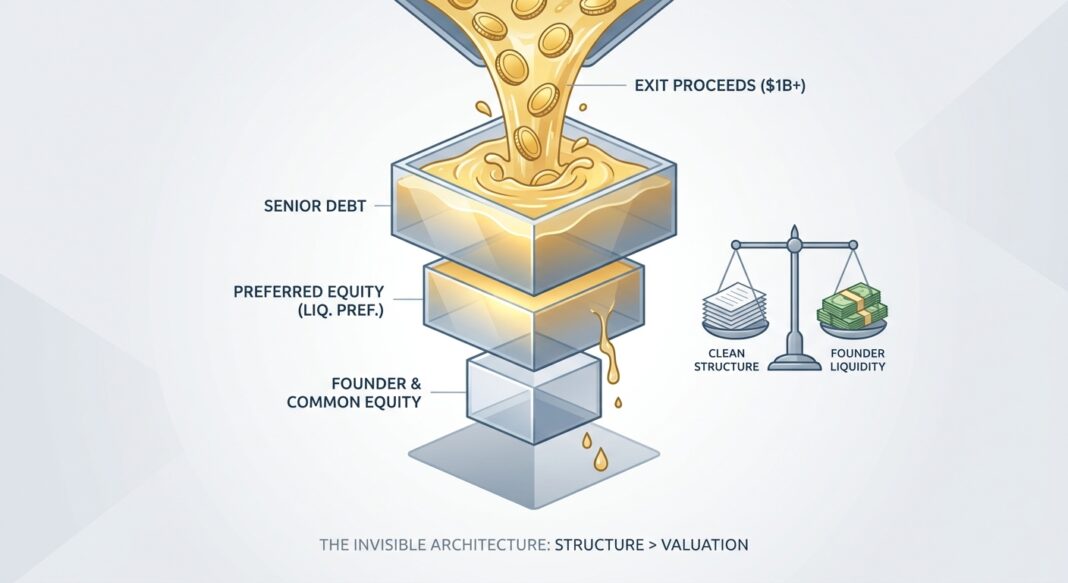
The Story: A Billion-Dollar Headline, a Zero-Dollar Payday
In January 2025, Adena Hefets (co-founder and CEO of Divvy Homes) wrote one of the most quietly devastating letters in recent startup history. Her rent-to-own real estate company had just agreed to be acquired by Brookfield Properties’ Maymont Homes division for approximately $1 billion. On the surface, it sounded like a triumph. A unicorn exit. A decade of grinding, rewarded.
Then came the paragraph that mattered.
After repaying outstanding debt, covering transaction costs, and satisfying liquidation preferences owed to preferred shareholders, Hefets wrote that the company estimated neither common shareholders nor holders of founder-designated preferred stock would receive any consideration. According to TechCrunch, which reviewed the letter, one source described equity holders as having been “zero’d”: founders, employees, and venture investors alike walking away with nothing from a billion-dollar sale.
Divvy had once been valued at $2.3 billion. It raised from Andreessen Horowitz, Tiger Global, and GGV Capital. It had helped more than 2,000 families become homeowners. It was, by almost any measure, a company that worked, until the capital structure it was built on stopped working for the people who built it.
This is not primarily a story about real estate, or interest rates, or the misfortune of timing. It is a story about the invisible architecture of money, and what happens when founders hand over the top of the payout waterfall before the business ever reaches its destination.
The Decision: When Growth Capital Becomes a Trap
Divvy’s model was capital-intensive by design. To scale a rent-to-own portfolio, the company needed to purchase homes, thousands of them. Equity rounds funded the early growth, and the logic of venture capital demanded aggressive expansion. By October 2021, at the peak of the market, Divvy took on approximately $735 million in debt financing to scale its property portfolio, layered on top of multiple rounds of preferred equity from its venture backers.
The capital structure that emerged looked like this, in rough terms:
- Senior debt: ~$735 million, first in line, unconditional repayment rights
- Preferred equity (Series A through D): multiple tranches, each carrying liquidation preferences that required full repayment before common stockholders saw a cent
- Common equity / founder shares: last in line, fully subordinated
When interest rates surged in 2022, the model fractured. Carrying costs on a large residential portfolio ballooned. New home acquisitions were paused. Three rounds of layoffs followed. The $1 billion Brookfield bid in early 2025 was the best available outcome, but the waterfall had been set years earlier, and it flowed entirely away from the founders.
The lesson buried in the structure: Divvy’s founders had diluted themselves and subordinated themselves simultaneously (across years and rounds) until there was no mathematical path to a meaningful payout at any realistic exit price. They had stacked debt on top of preferred equity on top of more preferred equity, each layer adding another priority claim ahead of their own.
It was not one bad decision. It was the compounding logic of conventional VC financing, applied to a capital-intensive business in a rate-sensitive environment, without ever stress-testing the waterfall.
The Other Path: Debt as a Precision Instrument, Not a Growth Crutch
Around the same period, a different kind of debt story was unfolding, one that ended very differently for its owners.
Cohesity, the enterprise data security and management company founded by Mohit Aron in 2013, had raised venture equity over the years from Sequoia, SoftBank Vision Fund, and others, ultimately reaching a $7 billion valuation. But when it came time to fund its largest growth move, the combination with Veritas’ data protection business in December 2024, Cohesity structured approximately $2 billion in debt financing to power the transaction, rather than issuing new equity to fund the deal. The move was highlighted by Runway Growth Capital and PitchBook in their 2024–2025 Venture Debt Review as a prominent example of how debt can power ambitious growth plans without forcing founders to surrender additional equity.
The distinction is architectural. Cohesity used debt to acquire and expand, not to fund operations or paper over a broken unit economics model. The debt was matched to a specific strategic outcome, collateralized against durable subscription-based enterprise cash flows, and structured to preserve existing equity ownership rather than dilute it.
Compare that to the QSR franchisee case published by CapitalSpring, a real case study involving a 60-unit quick-service restaurant operator who wanted personal liquidity for estate planning purposes, but was unwilling to sell his business or bring in a private equity partner to do it. His solution was a dividend recapitalization using a unitranche loan structured at 6.0x leverage. The lender consolidated his existing, fragmented debt relationships into a single flexible facility and used the available debt capacity to issue a special dividend to the owner of approximately $30 million, while leaving him with 100% ownership of his business and room on the facility to fund future acquisitions.
No VC board seat. No preferred equity waterfall. No liquidation preference stacked above him. Just cash in his pocket, a clean capital structure, and a company he still owned entirely.
That is what a deliberate capital decision looks like.
The Outcome: A Market That Has Validated the Approach, With Caveats
The dividend recap market exploded in 2024 and surged further into 2025, validating the strategy at scale. Leveraged loan issuance tied to sponsored dividend recapitalizations grew 11% year-over-year to $74.3 billion in 2025, itself following a 326% year-over-year increase in 2024, according to PitchBook data cited by Capstone Partners. By mid-2025, the average dividend recapitalization transaction had reached $350 million, with a total of $21 billion distributed through the strategy, according to Julius Bär’s Head of Private Markets Strategy Cyril Demaria-Bengochea.
The underlying driver was straightforward: the traditional PE exit market had stalled. Global PE exit activity in 2025 reached $905 billion, but 78% was concentrated in mega exits, leaving mid-market portfolio companies effectively stranded. Alternative liquidity tools (dividend recaps, GP-led secondaries, continuation vehicles) evolved from opportunistic to essential. Private credit, with its ability to provide capital structure flexibility, dominated refinancings and recapitalizations precisely when the M&A window was narrowest.
But the market heading into 2026 has introduced a critical nuance: not all borrowers are equally positioned to execute. Q1 2026 saw dividend recap volume drop sharply amid geopolitical uncertainty and wider credit spreads. Lenders became more selective, particularly around software-heavy portfolios facing AI-disruption risk. The runway that was wide open in 2024 and 2025 has narrowed, which means the quality of the business and the precision of the structure matters more than ever.
The lesson from Divvy is not that debt is dangerous. Divvy’s $735 million in debt was used to buy homes, an appropriate use of leverage for a real asset. The lesson is that stacking misaligned capital structures (debt on top of multiple preferred equity tranches, each with independent liquidation rights) eliminates the founder’s equity in all but the most optimistic exit scenarios. Meanwhile, the operators who used the dividend recap or strategic venture debt as a precision tool (matched to their cash flows, timed to their business cycle, and structured to preserve their ownership) walked away wealthy at every turn.
The Lessons: A Framework for Founders Facing the Same Choice
These stories share a common thread that goes beyond hindsight. They reveal a principle that every owner (whether running a tech startup, a franchisee network, or a mid-market services business) should anchor their capital decisions to before signing anything:
The Waterfall Test
Before taking any capital, map your payout waterfall in the worst-case exit scenario. If your business sells for 40% of its current valuation (a scenario that has happened to well-funded, well-run companies) who gets paid first, and how much is left for you? If the honest answer is "nothing," the structure is wrong regardless of the headline terms.
Match Capital Type to Business Type
Dividend recaps and strategic debt work best for businesses with strong, predictable, recurring cash flows: what lenders call "durable EBITDA." They are a poor fit for pre-profit companies, capital-intensive models at the mercy of interest rate cycles, or businesses that require continuous equity injections to fund operations. The franchisee operator and the enterprise SaaS company both passed this test. Divvy, at a moment of peak leverage in a rising-rate environment, did not.
Liquidity Without Loss of Control Is a Solvable Problem
One of the most persistent myths in the founder community is that the only way to take money off the table is to sell equity, and that selling equity means surrendering control. The dividend recap directly refutes this. A mature, cash-generating business with clean existing debt can often access $20 million to $50 million or more in owner liquidity through a unitranche facility, without giving up a single percentage point of ownership, without adding a board seat, and without resetting a liquidation preference clock.
The Venture Debt Market Has Matured: Use It Accordingly
Venture debt reached a record $62.4 billion in 2025, surpassing the previous record set in 2024. But deal count has dropped to decade lows, meaning lenders are concentrating capital in larger, more selective transactions with higher-quality borrowers. This is not a signal to avoid the market. It is a signal to approach it with precision: use debt for defined strategic outcomes, not as a bridge to a financing round you hope will come.
Key Insights
- Valuation is vanity; the waterfall is reality. Divvy sold for $1 billion and its founders received nothing. The capital structure, not the exit price, determined the outcome.
- Dividend recapitalizations are a proven liquidity tool for founder-owned businesses. Leveraged loan issuance for dividend recaps reached $74.3 billion in 2025, and a properly structured recap can return tens of millions to an owner without changing their ownership percentage.
- Strategic debt matched to cash flows preserves equity; mismatched debt destroys it. Cohesity used ~$2 billion in debt to fund a transformative acquisition and preserve existing equity. Divvy used $735 million in debt to fund homes in a rising-rate environment and it consumed the entire capital stack on exit.
- The private credit market provides flexibility that equity cannot, especially in a stalled M&A environment. With 78% of PE exit value in 2025 concentrated in mega deals, mid-market owners who can generate liquidity through recaps and refinancings without waiting for a favorable exit window hold a structural advantage.
- The right question is never "how much can I raise?"; it is "what does my cap table look like on the day I get paid?" Answering that question before signing term sheets is the single most important capital decision most founders will ever make.


