
Leverage Stories & Insights
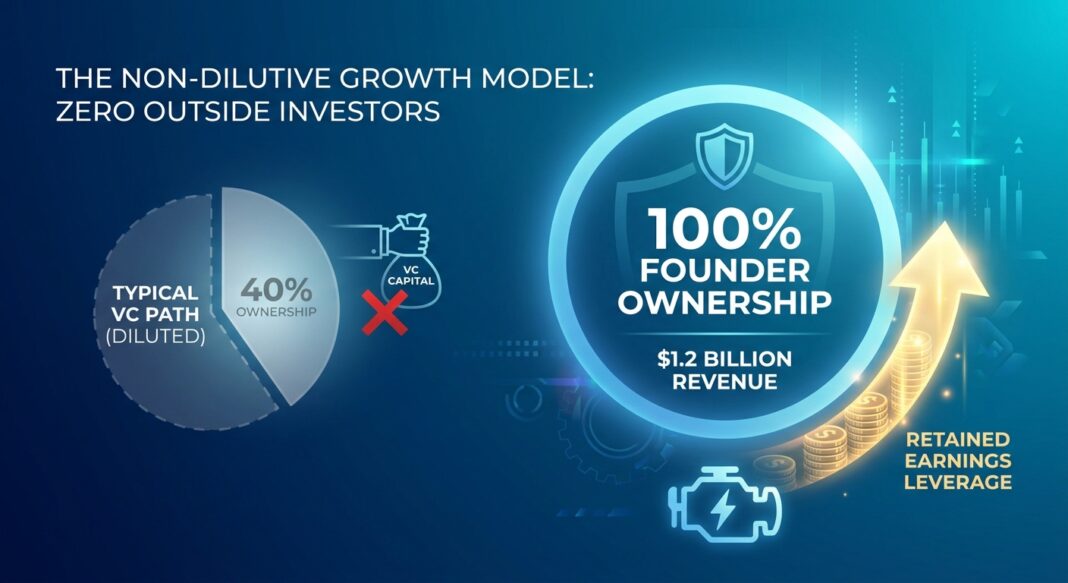
The $1.2 Billion Proof Point: How One Founder Rejected VC Dilution, Chose Retained-Earnings Leverage, and Kept 100% of His Company
Gurhan Kiziloz built Nexus International into a $1.2 billion revenue gaming group without a single outside investor. His story, set against a record-breaking shift toward non-dilutive capital, is the clearest argument yet for why the most consequential capital decision a founder makes is often the one that costs the least equity.
The Story: Five Bankruptcies, Zero Outside Investors
The conventional script for building a high-growth technology company goes something like this: find product-market fit, pitch a Series A, dilute 20%, grow fast, raise a Series B, dilute another 15%, hire a CFO who will manage the preferred liquidation waterfall you barely understand anymore, and then, if everything goes right, discover that the company you built is worth a great deal of money, but the portion you own has quietly shrunk to something modest.
Gurhan Kiziloz wrote a different script. The Turkish-British entrepreneur had failed five times before he built Nexus International. He had no institutional backers, no venture capital accelerators, and no private equity board guiding the roadmap. What he had was the discipline that repeated bankruptcy instills and a structural conviction: if the cash flows are real, the company should fund itself.
The results are now a matter of public record. Nexus International closed 2025 with $1.2 billion in revenue, tripling its full-year 2024 performance of $400 million, and delivering $87 million in net profit and $124 million in EBITDA. The company processed $1.44 billion in betting volume. Kiziloz, who owns 100% of the company, had accumulated a personal fortune estimated at $1.7 billion. Not one cent of that value was shared with a preferred shareholder, a liquidation waterfall, or a carried interest structure.
In an industry where scale is typically equated with institutional backing, Nexus International is a counter-example that is difficult to dismiss. The gaming sector is capital-intensive, deeply competitive, and regularly dominated by PE-backed platforms. Kiziloz built a credible challenger inside it, without surrendering a single basis point of equity.
The Decision: What He Chose and What He Walked Away From
To understand what Kiziloz chose, it helps to understand what he rejected, and why the rejection was structural rather than symbolic.
Venture capital in gaming and fintech platforms operates on a familiar logic. A VC firm acquires 20–30% of a company at an early stage, typically through preferred shares with a liquidation preference. In exchange, the founder gets capital, network access, and a valuation that signals credibility. What the founder gives up is harder to see at the term sheet stage: board control, timeline control, the right to optimize for long-term cash generation rather than growth-at-all-costs, and, in many cases, their majority economic position by the time multiple rounds have stacked up.
Kiziloz’s alternative was retention and reinvestment. He reinvested $200 million internally into Spartans.com, the crypto-native casino that became his primary revenue engine, without any external financing. Every dollar of platform development, market expansion, and team building came from earnings the business had already generated. Growth proceeded at the pace cash flows allowed. That pace, as it turned out, was fast enough to triple revenue in a single year.
The structural tradeoff is explicit: the debt-funded or self-funded founder accepts slower early-stage growth in exchange for owning all of the upside when scale arrives. The VC-funded founder accepts faster early growth in exchange for a permanently smaller claim on that upside. Which path wins depends entirely on the magnitude of the eventual scale, and who captures it.
At $1.2 billion in revenue with a 47% EBITDA margin, the math is unambiguous. A founder who raised three conventional VC rounds to reach that scale might own 30–40% of the outcome. Kiziloz owns 100%.
The Outcome: $1.7 Billion and a Counterfactual Worth Running
Let’s run the numbers that the press release version of entrepreneurship rarely discusses.
Assume Nexus had followed the standard venture playbook: a $5 million seed round at a $15 million post-money valuation (33% dilution), a $20 million Series A at a $60 million post-money (25% dilution after the seed), and a $50 million Series B at a $200 million post-money (20% dilution across rounds). By Series B close, a founder who started at 100% ownership might realistically hold 45–55% of the company on a fully diluted basis, and that is before accounting for option pools, pro-rata rights, and the structural preferences embedded in each class of preferred stock.
At a $1.7 billion personal valuation under full ownership, the VC-path founder would have seen that figure compress to roughly $765 million to $935 million, before accounting for any liquidation preference overhang that favors preferred shareholders in a sale scenario short of an IPO. The delta is $765 million to $935 million. That is the cost of the venture capital.
The broader market is now internalizing this arithmetic. U.S. venture debt deal value hit a record $53 billion in 2024, up 94% from 2023, as founders increasingly turned to non-dilutive financing to extend runway and preserve ownership. The 2025-2026 Venture Debt Review, published by Runway Growth Capital in partnership with PitchBook, reported that U.S. venture debt soared further to $68.8 billion in 2025. Founders are not abandoning capital; they are choosing capital that comes with a repayment schedule, not a seat at the board table and a preferred liquidation waterfall.
Critically, repeat debt financings more than doubled from $4.7 billion across 129 deals in 2024 to $12.3 billion across 156 deals in 2025: a signal that founders who use debt once are returning for more, embedding non-dilutive capital as a permanent feature of their financial architecture, not a one-time bridge.
The Lessons: A Framework for Founders Facing the Same Decision
The Nexus International story is not a template that every founder can replicate. Kiziloz had prior ventures that generated starting capital. He operated in a business with structurally strong cash margins: online gaming, when well-run, generates substantial free cash flow relative to revenue. And he possessed the operational discipline that self-funded growth demands from day one, because there is no VC runway to absorb mistakes while the model matures.
But the principles are extractable and broadly applicable. Here is the framework that the story implies:
1. Identify Your Business’s Natural Financing Profile
Businesses with recurring, predictable cash flows (SaaS, gaming, media subscriptions, B2B services) are natural candidates for debt financing. The venture debt market now recognizes this explicitly: nearly 60% of venture debt financings in 2024 occurred at the late or venture-growth stage, where cash generation has de-risked the credit profile enough to make non-dilutive terms genuinely competitive with equity.
2. Understand the True Cost of Equity Before You Price It
A VC term sheet does not show you the cost of capital in percentage terms because the cost is not expressed in interest; it is expressed in perpetual ownership dilution. The rising cost of equity has made venture debt a more attractive option for founders looking to minimize dilution and maintain control, according to analysis from PitchBook’s NVCA Venture Monitor. Model both paths. Then decide with full information.
3. Use Leverage Strategically, Not Reactively
The founders winning with debt right now are treating it as a planned financial tool, not a fallback when the VC market tightens. A majority of survey participants in the 2024-2025 Venture Debt Review viewed venture debt as a flexible, founder-friendly alternative to equity that supports growth without dilution, rather than a last resort. The shift in framing matters: debt deployed offensively preserves equity at the moment it is most valuable to preserve it.
4. Match Debt Structure to Business Reality
The reason venture debt works for cash-generative businesses (and fails for pre-revenue ones) is that debt requires repayment. Kiziloz’s model worked because Nexus generated enough operating cash flow to reinvest $200 million back into platform development while remaining debt-free. For founders whose businesses cannot yet service debt, the non-dilutive path requires a different instrument: revenue-based financing, asset-backed lending, or a hybrid structure that defers principal until milestones are reached.
5. Recognize When the Venture Market Is Not Your Market
The VC ecosystem has become structurally concentrated. According to Silicon Valley Bank, 33% of all U.S. venture dollars in the first half of 2026 went to the top 1% of companies by valuation, up from 12% in 2022. For founders outside that elite cohort, raising equity from institutional VCs means competing for increasingly scarce, increasingly expensive capital. Non-dilutive alternatives (venture debt, private credit, leveraged recapitalization, revenue-based financing) are not consolation prizes. They are the superior capital structure for most businesses at most stages.
Key Insights
- Ownership compounds quietly. Kiziloz’s $1.7 billion net worth is not a function of a high valuation multiple alone; it is a function of owning 100% of the asset that generated it. Every point of dilution avoided in the early stages compounds into outsized economic difference at exit or IPO.
- The venture debt market has hit structural escape velocity. U.S. venture debt climbed from $53 billion in 2024 to $68.8 billion in 2025, a record in consecutive years. The asset class is no longer an alternative channel; it is a primary one, with institutional infrastructure, competitive pricing, and proven deal structures across sectors.
- Repeat usage is the strongest signal of strategic intent. Repeat debt financings more than doubled year-over-year in 2025. Founders using debt multiple times are treating it as a capital architecture choice, not a bridge. That behavioral shift is durable.
- Self-funded growth demands cash margin discipline from day one. The Nexus model works because online gaming generates strong operating cash flows at scale. Founders in low-margin, capital-intensive verticals need debt structures (asset-based lending, delayed-draw facilities) designed around their specific cash conversion cycle, not a one-size-fits-all term loan.
- The counterfactual is the clearest analytical tool. Before signing any equity round, run the fully diluted ownership model to a realistic exit scenario. The gap between your ownership percentage with and without each equity raise is the real price of that capital. Kiziloz ran that math early. The $1.7 billion is the answer.


