
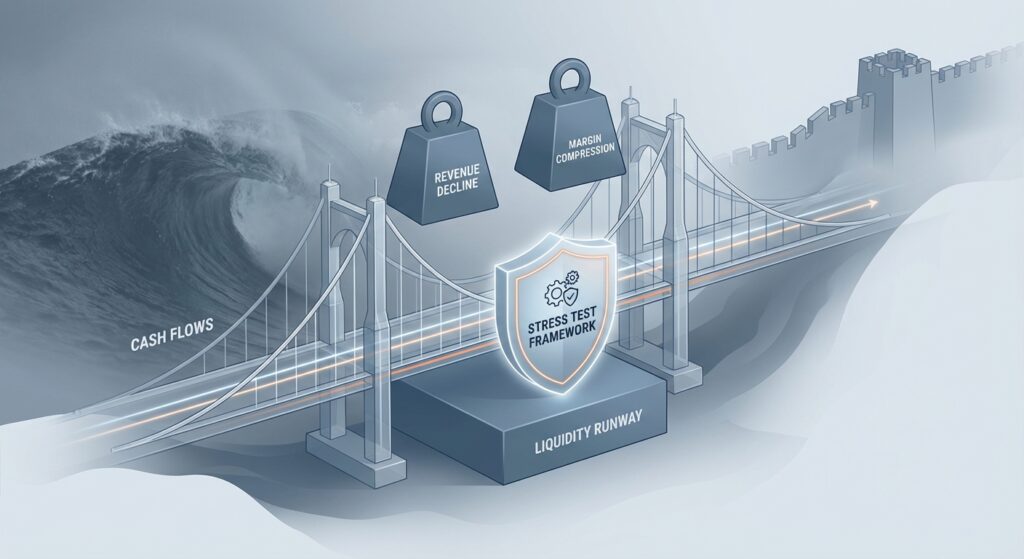
The Underwriting Challenge: Survival in the Downside
In credit underwriting, the base case financial model serves a specific purpose: it justifies the deal structure and supports the loan origination. However, risk management professionals know that the base case rarely materializes exactly as predicted. The true test of a credit facility is not how well the borrower performs when the economy is growing, but whether the capital structure can survive a contraction.
Developing a rigorous stress testing framework is the primary defense against default. Effective underwriting identifies the break-even points: the specific level of revenue decline, margin compression, or interest rate expansion that triggers a payment default or covenant breach. As noted in the 2025 Principles for the Management of Credit Risk by the Basel Committee on Banking Supervision, a sound credit-granting process must include an assessment of the borrower’s ability to withstand \”adverse economic environment and financial conditions.\” [bis.org].
The Framework: Multivariable Stress Testing
A common error in lower-middle-market underwriting is linear sensitivity analysis, simply reducing revenue by 10% while holding margins constant. This approach fails to capture operating leverage. In a true downside scenario, revenue declines are almost invariably accompanied by margin compression because fixed costs cannot be shed quickly enough.
To build a robust stress test, underwriters should apply a \”scenario analysis\” rather than simple sensitivity. This involves three key variables:
- Top Line Contraction: Assessing volume vs. price declines.
- Operating Leverage (Margin Compression): Modeling the stickiness of SG&A and fixed COGS.
- Working Capital Cycles: Determining if a slowdown releases cash (inventory liquidation) or consumes it (extended receivables).
Institutional lenders often target a Fixed Charge Coverage Ratio (FCCR) of at least 1.0x under a \”Reasonable Downside Case\” (typically defined as a mild recession scenario). If the FCCR drops below 1.0x, the analysis shifts to liquidity: does the borrower have sufficient cash on balance sheet or revolver availability to fund the burn?
The Analysis: Stressing a Manufacturing Borrower
Consider a hypothetical manufacturing company with \$50 million in senior debt at an 8% interest rate. The base case financials appear healthy, but the stress test reveals structural fragility.
Base Case Parameters:
- Revenue: \$100M
- EBITDA Margin: 15% (\$15M)
- Capital Expenditures (Maintenance): \$2M
- Cash Taxes: \$3M
- Debt Service (Interest + Amort): \$7M
Base Case FCCR Calculation:
(\$15M EBITDA – \$3M Taxes – \$2M Capex) / \$7M Debt Service = 1.43x (Healthy)
The Stress Scenario:
We apply a 15% revenue decline. Crucially, we assume 40% of COGS and SG&A are fixed. When revenue drops, costs do not fall proportionately, causing margins to compress from 15% to 10%.
Stress Case Parameters:
- Revenue: \$85M (-15%)
- EBITDA Margin: 10% (\$8.5M)
- Cash Taxes: \$1.5M (lower due to lower earnings)
- Capex: \$2M (cannot be cut)
Stress Case FCCR Calculation:
(\$8.5M EBITDA – \$1.5M Taxes – \$2M Capex) / \$7M Debt Service = 0.71x (Default)
The Insight: A manageable 15% revenue drop caused a catastrophic 50% drop in Free Cash Flow due to operating leverage. Without a stress test, this credit looks safe; with it, the lender sees that the company cannot service debt in a recession without burning liquidity.
Industry Standards & Covenant Design
Sophisticated lenders use stress testing results to calibrate financial covenants. According to the CFA Institute’s refresher on Credit Analysis Models, understanding the \”exposure to default loss\” is critical for pricing risk [cfainstitute.org].
Red Flags in Diligence:
- Incurrence vs. Maintenance Covenants: As highlighted in guides to leveraged finance, bank debt typically relies on maintenance covenants (tested quarterly), whereas bonds often rely on incurrence covenants (tested only upon specific actions like taking on more debt). Detailed in A Pragmatist’s Guide to Leveraged Finance, relying solely on incurrence covenants removes the \”early warning system\” that allows lenders to intervene before cash runs out [pdf.thepeoplespension.co.uk].
- EBITDA Add-Backs: Aggressive add-backs (e.g., \”synergies\” or \”pro forma cost savings\”) should be removed in the stress case. A company in distress rarely achieves projected synergies.
Underwriting Checklist: The Stress Test
Before issuing a term sheet, the underwriting team must validate the downside variables:
- Isolate Uncontrollable Variables: separate volume (demand) from price (market power). Stress them independently.
- Audit Fixed Costs: verify which expenses are truly variable. Do not assume SG&A scales down linearly with revenue.
- Test the Capex Floor: distinguish between growth capex (which can be cut) and maintenance capex (which is required to keep the lights on).
- Stress the Balance Sheet: in a downturn, receivables often stretch out. Add 10–15 days to DSO (Days Sales Outstanding) in the model to see the impact on liquidity.
- Check the Revolver: Ensure the borrowing base availability doesn’t disappear exactly when the company needs it (e.g., if the borrowing base is tied to eligible receivables, and receivables drop, availability shrinks).
Key Takeaways for Risk Management
- Leverage Kills, Operating Leverage Buries: High fixed costs are as dangerous as high debt loads in a downturn.
- Cash Flow before EBITDA: Debt is serviced with cash, not adjusted earnings. Focus on Pre-Tax Free Cash Flow.
- Covenants as Safety Valves: Set covenants tight enough to trigger a conversation before the cash runs out, but loose enough to avoid technical foot-faults.
- Liquidity is King: In a stress scenario below 1.0x FCCR, the only metric that matters is the number of months of liquidity runway.
- Correlation Matters: Assume bad things happen together. Revenue declines usually correlate with slower customer payments and inventory build-ups.


