
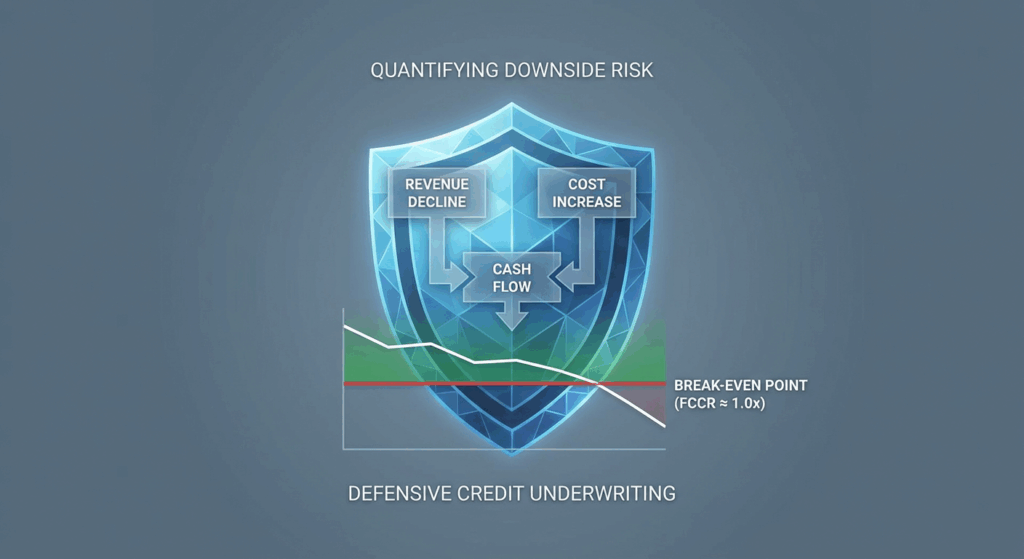
The Underwriting Challenge: Beyond the Base Case
In credit underwriting, the “Base Case” model provided by a borrower or sponsor rarely tells the full story. While management projections typically assume growth, operational efficiencies, and margin expansion, the primary duty of a credit underwriter is to assess survivability. The discipline of underwriting relies not on hoping for the upside, but on rigorously quantifying the downside. Can the capital structure withstand a cyclical downturn, a supply chain shock, or a customer concentration issue?
Effective risk assessment requires moving beyond static ratios like “Closing Leverage” or “LTM EBITDA.” Instead, it demands dynamic stress testing, mechanically breaking the P&L to find the exact point where cash flow fails to service debt. As emphasized in recent real estate and corporate credit guides, underwriting metrics such as yield and coverage must be sequenced correctly to interpret risk, rather than viewed in isolation as standalone verdicts.
The Framework: Designing the Downside
A rigorous stress testing framework isolates key variables (volume, price, variable costs, and fixed overhead) to determine the elasticity of cash flow. The goal is to calculate the Break-Even EBITDA and Maximum Revenue Decline before a default occurs.
Key methodologies include:
- Variable Sensitivity Analysis: Adjusting one input (e.g., raw material costs) while holding others constant to measure impact on margins.
- Covenant Headroom Analysis: Determining how much EBITDA can erode before tripping maintenance covenants (e.g., Max Leverage or Min Fixed Charge Coverage).
- Fixed Charge Coverage (FCCR) Stress: Calculating the precise level of cash flow required to cover rigid obligations: Cash Interest + Scheduled Amortization + Unfinanced Capex.
Underwriters should prioritize Unlevered Free Cash Flow (UFCF) as a primary indicator of debt capacity, as it represents the cash generated after capital expenditures but before financing costs.
The Analysis: Break-Even Methodology
Consider a manufacturing borrower with the following profile:
- LTM Revenue: $50,000,000
- LTM EBITDA: $10,000,000 (20% margin)
- Total Debt: $40,000,000 (4.0x Leverage)
- Fixed Charges: $4,000,000 (Interest + Amortization)
To stress test this credit, we calculate the Break-Even EBITDA for a Fixed Charge Coverage Ratio (FCCR) of 1.0x.
Calculation:
Current FCCR = $10M / $4M = 2.5x
Break-Even EBITDA = Fixed Charges / 1.0 = $4,000,000
This implies the company has a 60% EBITDA cushion ($6M decline allowed). However, the critical question is: How much revenue loss causes a $6M EBITDA decline?
If the company has high operating leverage (high fixed costs), a small revenue drop could wipe out that cushion. If variable contribution margins are 40%, a $15M drop in revenue (30%) would translate to a $6M drop in gross profit (assuming fixed costs remain constant). The underwriter effectively converts abstract “leverage” into a tangible operational boundary: “The deal works unless revenue drops by more than 30%.”
Industry Standards & Benchmarks
Institutional lenders and rating agencies have tightened standards regarding debt capacity. Current market observations suggest that total leverage in leveraged buyouts (LBOs) has trended toward 4.0x to 5.0x EBITDA, a contraction from previous highs exceeding 6.0x, driven by the higher interest rate environment. This compels underwriters to focus heavily on cash flow dynamics rather than asset coverage.
Common Red Flags in Stress Testing:
- Add-Back Reliance: Models that only pass stress tests when “Pro Forma Synergies” or non-recurring add-backs are included in EBITDA.
- Capex Compression: Assuming Maintenance Capex can be cut to zero in a downside case, which often leads to long-term asset deterioration.
- Working Capital Ignorance: Failing to model the liquidity trap where shrinking revenues might release cash (inventory unwind) but rapid recovery burns cash (receivables build).
Global banking principles reinforce that a sound credit-granting process must include an assessment of the borrower’s sensitivity to economic stress, ensuring that credit limits are not based solely on optimistic forecasts.
Underwriting Checklist: The Stress Test
To ensure a robust risk assessment, underwriters should complete the following diligence specific to cash flow resilience:
- Define the Cash Flow Proxy: Are you stressing Adjusted EBITDA, EBITDA minus Capex, or Operating Cash Flow? (Preference: EBITDA minus Maintenance Capex).
- Quantify Sensitivity: What is the impact of a 10% price reduction vs. a 10% volume reduction?
- Assess Cost Rigidity: Verify which expenses are truly variable. In a downturn, can SG&A actually be reduced, or is it fixed?
- Check Covenant Toggles: Does the credit agreement allow the borrower to “cure” breaches with equity, masking the deterioration?
- Validate Liquidity Run-Way: In the stress scenario, how many months of liquidity (Revolver availability + Cash) does the borrower have before hitting a wall?
Key Takeaways
- Cash Flow is Sovereign: Debt capacity is driven by cash flow stability, not just asset values or pro forma earnings.
- Know the Break-Point: Calculate the exact revenue or margin decline required to breach FCCR of 1.0x.
- Operating Leverage Matters: High fixed-cost businesses break faster in a downturn; they require lower closing leverage.
- Sequence Metrics Correctly: Analyze metrics in concert, Debt Yield and DSCR provide different signals than LTV or EBITDA multiples.
- Stress the “Unstressed”: Always run a scenario where management’s “one-time” adjustments become recurring costs.


