
The Underwriting Question Every Lender Must Answer First
Before a single term sheet is signed, every private credit underwriter faces the same foundational question: Can this borrower service its debt through an economic downturn, not just in the base case? That question is harder to answer today than it was five years ago. Total leverage in most middle-market deals now ranges from 4.0x to 5.0x EBITDA, down from levels exceeding 6.0x common in prior cycles, according to ibinterviewquestions.com. Yet structural risks have not disappeared; they have migrated. The share of “bad PIKs”, retroactive conversions of cash interest to payment-in-kind, surged from 36.7% in Q4 2021 to 57.2% in Q3 2025, according to ainvest.com, a signal that many borrowers are quietly struggling to service obligations in real cash. When PIK conversions are rising and covenant packages are thinning, stress testing cash flows is not a supplemental exercise; it is the core of the underwriting mandate.
The Analytical Framework: Cash Flow Drives Everything
Sound credit underwriting begins with a disciplined rejection of asset-value thinking. As the Basel Committee on Banking Supervision reaffirmed in its April 2025 updated Principles for the Management of Credit Risk, lenders must maintain a sound credit-granting process built on rigorous cash flow analysis, not collateral dependency, collateral is a recovery mechanism, not an underwriting substitute. The primary repayment source is always operating cash flow. bis.org
The stress testing framework for middle-market cash flows operates across four layers:
- Normalized EBITDA Baseline: Strip out one-time items, owner compensation adjustments, and pro forma add-backs to arrive at a defensible trailing-twelve-month EBITDA figure.
- Free Cash Flow Bridge: Move from EBITDA to unlevered free cash flow by subtracting maintenance capex, cash taxes, and changes in working capital. This is the number that actually services debt.
- Debt Service Waterfall: Model the full interest burden (including any PIK toggles), required amortization, and revolver usage under each scenario.
- Scenario Matrix: Apply at minimum three scenarios: Base, Moderate Stress, and Severe Stress, with explicit revenue and margin assumptions for each.
Example: A $10M EBITDA manufacturing company at 4.5x leverage ($45M total debt)
Assume a senior secured floating-rate loan at SOFR + 550bps. With SOFR at approximately 4.3% (as of mid-2026), the all-in rate is roughly 9.8%. Annual cash interest on $45M is approximately $4.4M. If the borrower carries $1.5M in mandatory amortization and $800K in maintenance capex, the minimum annual cash requirement before distributions is $6.7M. That leaves a cushion of only $3.3M against $10M EBITDA in the base case, a debt service coverage ratio (DSCR) of approximately 1.49x. Thin, but manageable, until you stress it.
Running the Stress: Metrics, Calculations, and Where Deals Break
Key Credit Metrics to Monitor
- Total Debt / EBITDA (Leverage Multiple): Entry point of 4.5x; stress target should not exceed 6.0x at severe scenario peak.
- Interest Coverage Ratio (ICR): EBITDA ÷ Cash Interest Expense. Minimum institutional threshold is generally 1.5x–2.0x in base case.
- Debt Service Coverage Ratio (DSCR): Free Cash Flow ÷ Total Debt Service. Lenders typically require a minimum of 1.10x–1.25x even in moderate stress.
- Fixed Charge Coverage Ratio (FCCR): (EBITDA − Capex − Cash Taxes) ÷ (Interest + Scheduled Principal). This is the covenant metric most frequently tested.
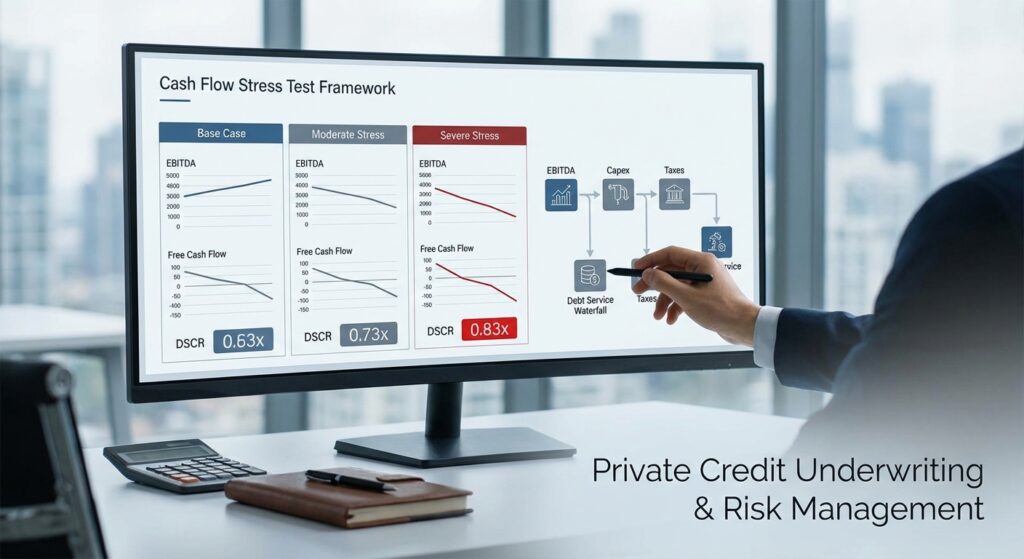
Three-Scenario Stress Matrix (Same $10M EBITDA Manufacturer)
| Scenario | Revenue Decline | EBITDA | Free Cash Flow | DSCR |
|---|---|---|---|---|
| Base Case | – | $10.0M | $7.2M | 1.49x |
| Moderate Stress | −10% | $8.3M | $5.5M | 1.14x |
| Severe Stress | −20% | $6.8M | $4.0M | 0.83x |
The severe stress case produces a DSCR below 1.0x: meaning the company cannot cover its debt service from operations. This is a structural underwriting problem, not a pricing problem. A higher spread does not fix a broken cash flow waterfall.
What Institutional Lenders Look For, And Where Underwriting Breaks Down
Private credit has outperformed broadly syndicated leveraged loans on a net return basis, approximately 8.6% net IRR versus 1.1% loss rates for leveraged loans, according to market data cited by ainvest.com. But that track record was built in a lower-rate environment. As competition for middle-market deals intensifies (with platforms like Citigroup-Apollo ($25B partnership) and Wells Fargo-Centerbridge ($5B initiative) entering the space) underwriting standards face direct pressure from deal flow competition.
Institutional lenders benchmark against the following standards in stress testing reviews:
- Minimum 1.10x DSCR in a moderate stress scenario (10–15% EBITDA decline)
- Leverage ceiling of 5.5x on senior secured debt for most non-recurring revenue businesses
- FCCR covenant set at 1.10x–1.20x with quarterly testing and cure provisions
- Liquidity runway of at least 12 months modeled under the moderate stress case
- Bad PIK share of private credit transactions: 57.2% in Q3 2025, up from 36.7% in Q4 2021, ainvest.com
- Private credit market AUM: $1.67 trillion in 2025, projected to reach $2.9 trillion by 2030, ainvest.com
- Typical LBO leverage range (2025–2026): 4.0x–5.0x EBITDA, down from 6.0x+ in prior cycles, ibinterviewquestions.com
- Private credit net IRR (institutional benchmark): approximately 8.6% with 0.4% loss rate vs. 1.1% for leveraged loans, ainvest.com
Red Flags That Stress Testing Surfaces
- Aggressive add-backs: Pro forma EBITDA adjustments exceeding 15–20% of reported EBITDA warrant deep scrutiny. Unrealized synergies and cost-save projections are particularly suspect.
- Working capital manipulation: A borrower that shows strong EBITDA but consistently negative free cash flow conversion (below 70%) may be hiding cash burn in the working capital cycle.
- PIK toggle provisions as a core feature: Structural PIK that was negotiated upfront is different from a retroactive PIK conversion, but both compress actual cash debt service coverage and should be modeled explicitly. The surge in bad PIKs to 57.2% is a systemic warning sign for the asset class.
- Covenant-lite structures: Deals with incurrence-only covenants offer no early warning system. Maintenance covenants with quarterly FCCR and leverage tests remain the gold standard for lender protection.
Cash Flow Stress Testing: Underwriting Checklist
- Normalize EBITDA: Remove non-recurring items, verify add-backs with documentation (contracts, board minutes, audited financials). Cap pro forma adjustments at a defensible ceiling.
- Build the Free Cash Flow Bridge: Confirm maintenance capex with management and independent engineering review; validate cash tax rate; model working capital seasonality.
- Map the Full Debt Service Waterfall: Include revolver commitment fees, PIK accruals, any seller notes, and earn-out obligations that may require cash at maturity.
- Run Three Scenarios Minimum: Base, Moderate Stress (−10–15% revenue), Severe Stress (−20–25% revenue with margin compression). Document assumptions explicitly.
- Test Covenant Headroom: At what EBITDA level does the borrower breach its FCCR or leverage covenant? How many quarters of deterioration does the cushion absorb?
- Assess Liquidity Sources: Revolver availability, undrawn commitments, and asset liquidation timelines under stress. Is there a 12-month cash runway in the moderate scenario?
- Document Trigger Points: Identify the exact revenue or EBITDA decline that causes covenant breach, cash shortfall, or PIK conversion; these become your ongoing monitoring thresholds post-close.
Key Questions to Ask Management During Diligence
- What is the largest single customer as a percentage of revenue, and what are the contract renewal terms?
- Has the company ever drawn its revolver to fund operations (vs. seasonal working capital)? When and why?
- What is the fixed vs. variable cost split? At what revenue level does the business reach cash flow breakeven?
- Are there any deferred maintenance capex items that management has been deferring to improve short-term FCF?
Key Takeaways for Credit Underwriters
- Cash flow is the only primary repayment source. Collateral and guarantees are recovery tools, stress testing must focus on operating cash generation under adverse conditions, consistent with the Basel Committee’s 2025 credit risk principles.
- The surge in bad PIKs is a structural warning sign. A 57.2% bad PIK rate in Q3 2025 signals that a meaningful share of private credit borrowers are already struggling to service cash obligations, underwriters must model PIK conversion scenarios explicitly.
- DSCR below 1.0x in a moderate stress scenario is a structural problem, not a pricing problem. No yield premium compensates for a fundamentally broken cash flow waterfall at origination.
- Covenant architecture is your early warning system. Maintenance covenants with quarterly testing and tight FCCR thresholds (1.10x–1.20x) give lenders meaningful intervention rights before a borrower reaches distress.
- Competition compresses standards, discipline must be deliberate. As the private credit market approaches $1.67 trillion in AUM and bank-affiliated platforms aggressively enter middle-market lending, the pressure to loosen underwriting assumptions is structural. Rigorous stress testing is the practitioner’s primary defense against vintage risk.


