
The Underwriting Question Every Direct Lender Must Answer
A sponsor brings you a tightly packaged CIM: a $10M EBITDA specialty manufacturer, 4.0x total leverage, strong historical margins, and a clean audit. On paper, the credit looks serviceable. But here is the question every experienced underwriter should ask before term sheet: What does this credit look like when revenue falls 15%, input costs spike, and the refinancing window closes?
Cash flow stress testing is not a box-checking exercise. It is the single most important analytical discipline that separates disciplined direct lenders from those who discover risk only after a covenant breach. According to S&P Global Ratings’ 2023 Leveraged Finance Default and Recovery Update, default rates in leveraged loans spiked sharply in 2023 as rising base rates compressed interest coverage, exposing credits that had been underwritten on static EBITDA assumptions rather than dynamic cash flow resilience. The lesson is structural: underwriting must account for how cash flows behave under pressure, not just how they appear at close.
The Analytical Framework: Three-Scenario Cash Flow Stress Model
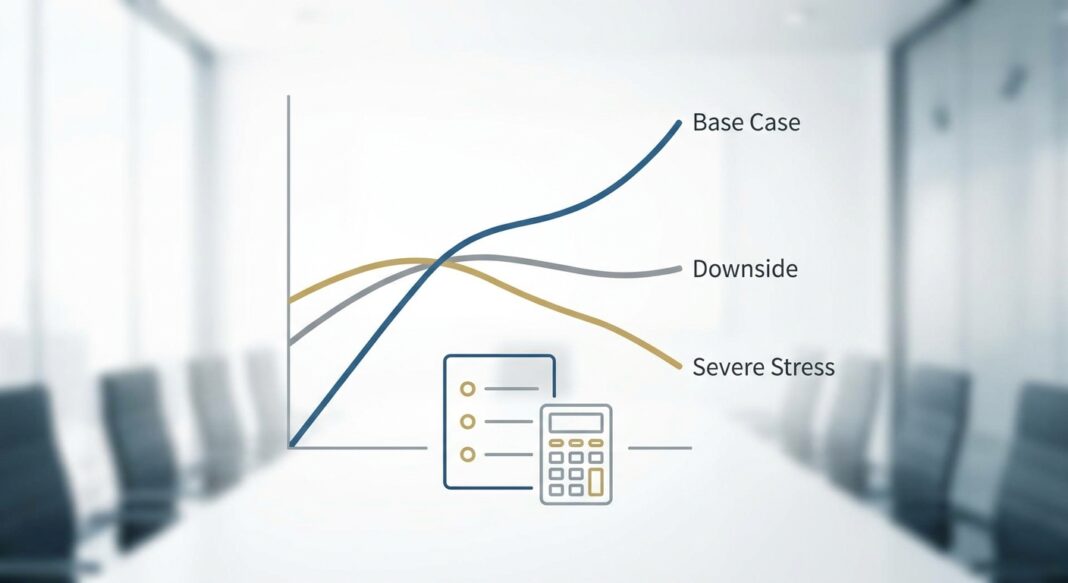
A robust stress testing framework is built on three parallel scenarios (Base, Downside, and Severe Stress) each with a distinct set of assumptions applied to revenue, margins, working capital, capex, and debt service. The goal is not to predict the future but to define the envelope of outcomes and identify the conditions under which the credit breaks.
Core Metrics Under Stress
- Debt Service Coverage Ratio (DSCR): (EBITDA – Capex – Taxes – Working Capital Changes) ÷ Total Debt Service. Institutional lenders typically require a minimum DSCR of 1.10x–1.20x under base case, with a floor of 1.00x in downside scenarios.
- Total Leverage (Net Debt / EBITDA): Tracks how leverage expands as EBITDA compresses. A 4.0x entry multiple can become 5.5x–6.0x under a 20% EBITDA decline, a critical threshold for most credit agreements.
- Interest Coverage Ratio (ICR): EBITDA ÷ Cash Interest Expense. With SOFR-linked floating rate debt, a 200bps rate move materially erodes ICR. This is a live issue: Moody’s Investors Service flagged ICR compression as a primary driver of speculative-grade credit deterioration through 2023–2024.
- Free Cash Flow Yield: Unlevered Free Cash Flow ÷ Enterprise Value. This contextualizes how much cash buffer exists relative to valuation assumptions at entry.
Example: $10M EBITDA Specialty Manufacturer
Assume: $10M LTM EBITDA, $40M total debt (4.0x leverage), $2M capex (maintenance), $1M cash taxes, $3.5M annual cash interest at SOFR + 550bps (~10.8% all-in as of mid-2026 market levels), zero amortization in Year 1 (PIK toggle structure).
Base Case Free Cash Flow: $10M – $2M – $1M – $3.5M = $3.5M FCF. DSCR = $3.5M ÷ $3.5M = 1.00x (tight, but serviceable). Note: this already leaves no cushion before stress is applied.
Walking Through the Stress Scenarios
Downside Case: Revenue –15%, Margin Compression –200bps
If revenue declines 15% and gross margins compress by 200bps due to fixed-cost absorption and input cost inflation, EBITDA falls to approximately $7.8M (–22% from base). Applying the same cost structure:
- FCF: $7.8M – $2M – $0.8M (lower taxes) – $3.5M = $1.5M
- DSCR: 1.5M ÷ 3.5M = 0.43x: the credit is cash flow negative after debt service
- Leverage: $40M ÷ $7.8M = 5.1x: likely triggers a leverage covenant if set at 5.0x
This scenario exposes the structural flaw: the base case DSCR of 1.00x carries no stress buffer. A well-underwritten credit should target 1.25x–1.35x base DSCR so that downside still clears 1.00x coverage.
Severe Stress: Revenue –25%, Rate Shock +200bps
EBITDA falls to ~$6.5M. Cash interest rises to $4.2M. FCF turns deeply negative. The company either draws the revolver, triggers a default, or seeks an amendment. This is precisely the scenario where recovery analysis (collateral coverage, enterprise value support) becomes the critical underwriting backstop. Cliffwater’s Direct Lending Index research consistently shows that middle market loans with strong collateral packages and tighter covenant structures exhibit meaningfully higher recovery rates than broadly syndicated covenant-lite structures.
What Institutional Lenders Require, and Where Deals Break Down
Experienced direct lenders use stress testing not just to size risk but to structure around it. The findings from scenario analysis directly inform covenant design, pricing, amortization schedules, and equity cushion requirements.
- Middle market direct lending loans have historically achieved recovery rates of 60%–75% for senior secured credits, compared to 40%–55% for broadly syndicated leveraged loans, according to Moody’s recovery rate studies.
- The U.S. speculative-grade default rate reached 4.9% at its 2024 peak before moderating, per S&P Global Ratings.
- Cliffwater’s CDLI data shows annualized loss rates for direct lending averaging approximately 0.3%–0.7% over the 2015–2024 period, underscoring how disciplined underwriting, not market beta, drives credit outcomes.
- Covenant-lite loans represented over 85% of new leveraged loan issuance in 2024, per LSTA market data, elevating the importance of stress testing for direct lenders who can still negotiate maintenance covenants.
Common Red Flags in Cash Flow Stress Analysis
- Single-scenario underwriting: Presenting only a base case without downside sensitivity is the most common analytical failure in submitted CIMs.
- Static capex assumptions: Borrowers often understate maintenance capex or defer it in projections. Always rebuild capex from asset age, depreciation schedules, and industry benchmarks.
- Working capital as an afterthought: Seasonal or growth-driven working capital needs can consume $1M–$3M of FCF annually in manufacturing or distribution credits, destroying apparent coverage ratios.
- EBITDA that doesn’t convert to cash: High EBITDA with low cash conversion (below 70%–75%) is a structural warning sign requiring deep investigation into accrual accounting, customer payment terms, and inventory dynamics.
Underwriting Checklist: Cash Flow Stress Testing
- Rebuild EBITDA from scratch. Do not accept sponsor-adjusted EBITDA without reconciling every add-back to supporting documentation (payroll records, one-time invoices, audit workpapers).
- Construct three independent scenarios. Base, Downside (–15% to –20% EBITDA), and Severe Stress (–25%+ with rate shock). Each must flow through a fully integrated three-statement model.
- Calculate DSCR, ICR, and leverage in each scenario. Map outcomes against covenant thresholds. Identify the exact EBITDA level at which the first covenant is breached.
- Normalize working capital and capex. Use 3–5 year historical averages, not LTM figures that may reflect deferred spend or favorable timing.
- Stress interest rates independently. On floating-rate debt, model a +150bps and +300bps rate move on top of revenue stress to capture compounded coverage erosion.
- Assess revolver capacity and liquidity runway. In downside, how many months of cash burn does available liquidity cover? Is the revolver springing or committed?
- Document the credit break-even. Every underwriting memo should state: “This credit remains viable at X% revenue decline and Y% margin compression.” That is the risk anchor.
Key Takeaways
- A 1.00x base case DSCR is not underwriting; it is optimism. Target 1.25x–1.35x at entry so downside scenarios clear the minimum coverage threshold without amendment.
- Cash flow stress testing is the primary tool for covenant calibration. Covenants should be set at levels that provide early warning, triggered at 15%–20% EBITDA decline, not after the business is already in distress.
- Floating-rate debt requires interest rate stress as a standalone scenario, not just a footnote. A 200bps move on a $40M facility adds $800K in annual cash interest, material at tight coverage levels.
- Middle market direct lenders have a structural advantage: the ability to negotiate maintenance covenants. Use stress testing to set them tightly and monitor them actively. Covenant-lite structures eliminate your early warning system.
- The purpose of stress testing is not to reject credits; it is to structure around risk. A credit that fails stress testing at 4.0x may be lendable at 3.5x with a PIK toggle, additional amortization, or enhanced collateral. Stress analysis drives structure, not just approval or decline.


