
The Underwriting Question Every Lender Must Answer Before Closing
A $10 million EBITDA manufacturing company approaches Bond Capital seeking a $35 million senior secured term loan, 3.5x leverage at close. The sponsor presents three years of clean financials, a compelling growth narrative, and a CIM that projects 12% revenue growth over the hold period. On paper, the credit looks serviceable. But the fundamental underwriting question is not whether this borrower can service debt in management’s base case. The question is: how much EBITDA erosion can this business absorb before it can no longer cover its debt service obligations, and what happens to our recovery if it cannot?
Cash flow stress testing is the analytical discipline that answers that question with precision. It is not a regulatory exercise or a back-office formality. It is the core of sound credit underwriting, and it separates lenders who understand risk from those who only understand yield.
The Analytical Framework: Three Scenarios, One Discipline
Institutional credit underwriting, anchored in the rating methodologies published by agencies such as fitchratings.com and the portfolio modeling frameworks described by moodys.com, centers on projecting credit performance across a range of scenarios that span at least one full economic cycle. Fitch’s Corporate Rating Criteria explicitly calls for a three-to-five-year projection horizon combined with at least three years of historical operating data. That structure is a blueprint for stress testing.
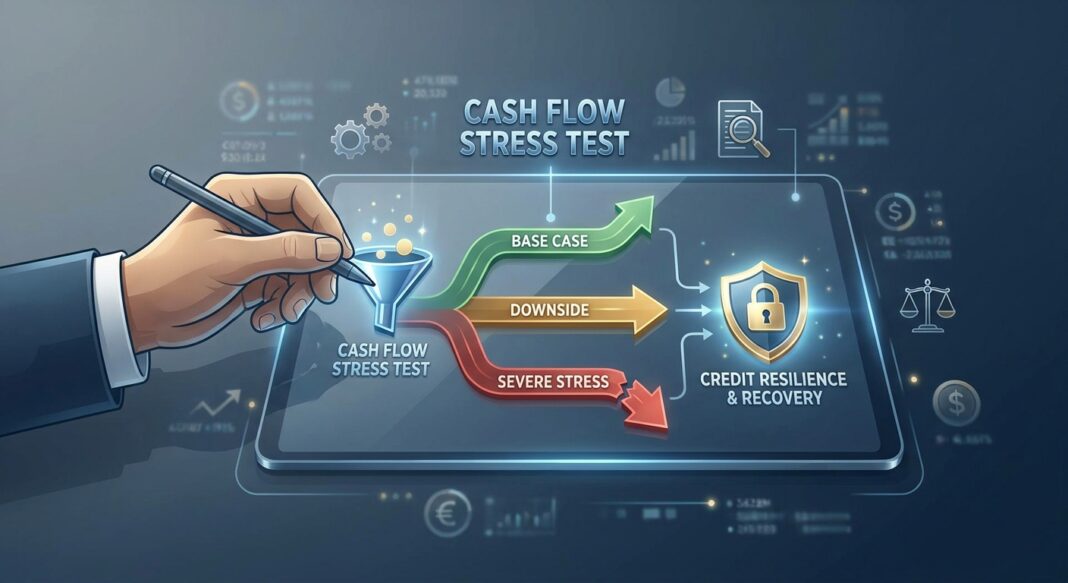
A rigorous stress testing framework for middle market credit requires three distinct scenarios built from the bottom up:
- Base Case: Management projections with modest haircuts applied to revenue growth and margin assumptions. This is the lender’s expected case, not the sponsor’s optimistic case.
- Downside Case: A cyclical revenue contraction of 10%–20%, combined with margin compression reflecting fixed cost de-leverage. This scenario should approximate a mild recession or sector-specific disruption.
- Severe Stress Case: A 25%–35% revenue decline with simultaneous working capital deterioration and capex demands that cannot be deferred. This approximates a structural demand shock or a credit event at a key customer.
The critical discipline is that each scenario must flow through a fully integrated model: revenue assumptions drive gross profit, which drives EBITDA, which funds debt service after mandatory capex (maintenance capex is never optional in a stress scenario). Free cash flow available for debt service, not EBITDA alone, is the underwriting anchor.
Working Example: $10M EBITDA Manufacturing Borrower
| Metric | Base Case | Downside (−20%) | Severe Stress (−30%) |
|---|---|---|---|
| Revenue | $65M | $52M | $45.5M |
| EBITDA Margin | 15.4% | 12.5% | 9.8% |
| EBITDA | $10M | $6.5M | $4.5M |
| Maintenance Capex | ($1.2M) | ($1.2M) | ($1.2M) |
| Annual Debt Service | ($3.5M) | ($3.5M) | ($3.5M) |
| DSCR | 2.51x | 1.51x | 0.94x |
| Net Leverage | 3.5x | 5.4x | 7.8x |
Illustrative underwriting scenario. Debt service reflects a blended interest and amortization obligation on a $35M senior secured term loan at approximately 10% all-in cost.
The stress table immediately identifies the risk inflection point: a 20% revenue decline compresses DSCR to 1.51x, still solvent but dangerously thin, while a 30% shock pushes DSCR below 1.0x, meaning the borrower cannot cover debt service from operations. This is where covenant design and collateral recovery become the last line of defense.
What the Numbers Reveal: Identifying Issues Before They Become Losses
Three analytical outputs from the stress table above should drive underwriting decisions directly:
- The EBITDA cushion to covenant trip: If the maintenance covenant is set at 6.0x net leverage, the borrower trips that covenant when EBITDA falls below approximately $5.8M, a decline of just 42% from the base case. That is a relatively tight cushion for a cyclical manufacturer with concentrated customer exposure.
- The break-even EBITDA for debt service: At $3.5M annual debt service and $1.2M in mandatory capex, the borrower needs a minimum of $4.7M in EBITDA to avoid a cash shortfall. That is a 53% EBITDA decline tolerance, but only if no working capital deterioration occurs simultaneously.
- The fixed cost structure: Margin compression from 15.4% to 9.8% on a 30% revenue decline reflects a high fixed-cost operating model. Fixed cost de-leverage is the multiplier that turns a revenue problem into a liquidity crisis. Lenders must decompose EBITDA into its variable and fixed cost components and understand what minimum revenue level keeps the business cash flow positive.
Quantitative metrics alone, however, are insufficient. As Fitch’s rating criteria highlight, the weighting of individual risk factors varies by issuer, and the weakest factor tends to attract the greatest analytical weight. For a concentrated manufacturer, customer concentration risk and input cost volatility may deserve more weight than the headline leverage ratio at close.
Industry Standards: What Institutional Lenders Require
Large-cap private credit lenders with established underwriting platforms, such as those described in PGIM’s analysis of its large cap private credit strategy, consistently target borrowers with larger scale, more resilient margins, and experienced management teams, noting that larger-scale private credit borrowers have historically demonstrated lower defaults and higher recovery rates. That insight carries a direct underwriting implication: size, margin resilience, and management depth are underwriting variables, not just qualitative footnotes.
Across institutional credit markets, experienced lenders apply several benchmarks that stress test results must clear before a credit committee will approve a commitment:
- Minimum DSCR in downside case: Most senior secured lenders require a stressed DSCR of at least 1.10x–1.25x in a defined downside scenario before covenant relief is triggered.
- Net leverage ceiling in stress: Deals that breach 7.0x net leverage in a downside scenario, without a credible de-leveraging path, typically require additional credit enhancement (equity cushion, PIK toggle, or a structured equity co-investment).
- Fixed charge coverage ratio (FCCR): The FCCR, defined as (EBITDA − Capex − Taxes) ÷ (Interest + Scheduled Amortization), is the most complete measure of cash debt service capacity and is the metric most commonly used as a maintenance covenant trigger.
- Liquidity runway: Stressed free cash flow should fund at least 12 months of debt service without drawing on a revolving credit facility. If it does not, the revolver becomes a liquidity crutch, and its availability is not guaranteed in a stress environment.
Credit Performance Reference Points
- Fitch’s Corporate Rating Criteria framework evaluates financial profile across profitability, financial structure, and financial flexibility, with leverage and coverage metrics assessed across a full economic cycle, not at a single point in time. (fitchratings.com)
- Moody’s Analytics RiskFrontier modeling methodology explicitly accounts for variation in loss given default (LGD) and probability of default (PD) at the instrument level, noting that even in the aggregate, loss variability cannot be eliminated through diversification alone. (moodys.com)
- Moody’s SME ABS methodology requires historical performance data covering at least one full economic cycle before a cumulative default rate assumption can be treated as representative of a securitized pool. (moodys.com)
- PGIM’s large cap private credit analysis concludes that larger-scale borrowers (with stronger revenue growth and more resilient margins) have historically demonstrated lower default rates and higher recovery rates relative to smaller middle market credits. (pgim.com)
Underwriting Stress Test Checklist: Before Credit Committee
Every stress test submitted to a credit committee at Bond Capital must address the following diligence points. Incomplete answers are not acceptable at the term sheet stage.
- EBITDA Normalization Complete? Have all non-recurring items, management add-backs, and pro forma adjustments been independently verified? Stressed EBITDA must start from an audited, normalized baseline, not a sponsor-adjusted figure.
- Fixed vs. Variable Cost Decomposition? Has the cost structure been mapped to determine the minimum revenue level at which EBITDA turns negative? What percentage of COGS and SG&A is fixed?
- Maintenance Capex Properly Isolated? Total capex from the cash flow statement must be split between maintenance (non-deferrable) and growth (deferrable). Growth capex is zero in a stress scenario.
- Three Scenarios Modeled with Explicit Revenue Assumptions? Each scenario must state the revenue decline driver (volume, pricing, or both) and the recovery timeline. Scenarios without explicit triggers are not stress tests; they are guesses.
- Covenant Trip Points Mapped to Scenarios? At what EBITDA level does the borrower breach each maintenance covenant? Is there sufficient time between the trip point and a liquidity crisis for the lender to take protective action?
- Liquidity Sources Identified in Stress? What is the available revolver capacity in a downside scenario? Is the borrowing base (for ABL facilities) also stressed for receivables and inventory degradation?
- Recovery Analysis Completed? In the severe stress case, what is the estimated enterprise value at default (using a distressed EBITDA multiple), and does the senior secured recovery rate exceed 70%? What is the first-lien lender’s position in the capital structure waterfall?
- Customer and Counterparty Concentration Assessed? If the top three customers represent more than 30% of revenue, a single-customer loss scenario must be modeled explicitly.
Key Takeaways for Credit Underwriters
- DSCR, not EBITDA, is the underwriting anchor. EBITDA is an input. Debt service coverage after mandatory capex and taxes is the output that determines whether a borrower can survive a stress event without requiring lender intervention.
- The downside scenario must be operationally credible. A 20% EBITDA decline driven by volume loss, fixed-cost de-leverage, and simultaneous working capital deterioration is more analytically honest than a uniform percentage haircut applied to management’s base case.
- Covenant trip points are early warning systems, not penalties. Maintenance covenants designed to trip 12–18 months before a liquidity crisis give lenders meaningful time to negotiate amendments, accelerate amortization, or require additional equity. Covenants set too loosely eliminate that window entirely.
- Fixed cost structure is the multiplier of revenue risk. Two borrowers with identical EBITDA margins can have radically different stress profiles if their fixed-to-variable cost ratios differ. Decompose the cost structure before building any scenario.
- Portfolio-level stress testing must complement deal-level analysis. Concentration in a single sector, geography, or borrower type amplifies correlated default risk across the portfolio. As Moody’s Analytics notes, loss variability cannot be eliminated through diversification alone, but it can be meaningfully reduced through deliberate portfolio construction and concentration limits.


