
The Underwriting Question Every Lender Must Answer First
Before a term sheet is issued, before covenants are negotiated, and before a credit committee votes, one foundational question must be answered with precision: at what point does this borrower’s cash flow fail to cover its debt service?
This is not a theoretical exercise. It is the structural spine of every defensible credit decision. In the current environment, where all-in interest costs on quality mid-market credits range from 9% to 11% and total leverage has compressed to 4.0x–5.0x EBITDA from the 6.0x+ levels common in 2018–2019, the margin for analytical error has narrowed considerably. Higher rates mechanically increase debt service burdens, compressing debt service coverage ratios even at identical leverage multiples. The lender who cannot identify a borrower’s cash flow breaking point before closing is not underwriting; they are hoping.
This article presents the step-by-step stress testing framework that institutional credit teams apply to middle-market borrowers, with worked calculations and the red flags that separate disciplined underwriting from deal-driven optimism.
The Framework: Building a Downside Cash Flow Architecture
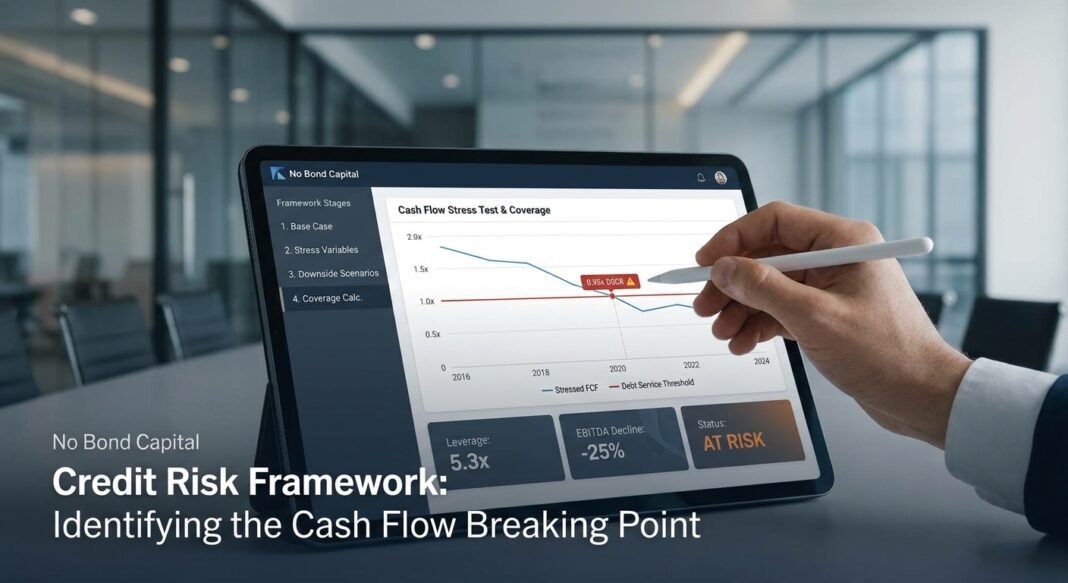
Stress testing cash flows is not the same as modeling a bad scenario. It is a structured methodology that reverse-engineers the conditions under which a borrower defaults, and then measures how far the base case sits from those conditions. The framework has four stages:
- Establish the Base Case FCF Bridge: from EBITDA to cash available for debt service
- Identify the Primary Stress Variables: the two or three levers most likely to compress cash flow for this specific business
- Run Downside Scenarios: apply severity assumptions grounded in industry history
- Calculate Coverage at Each Scenario Level: determine where DSCR and FCCR breach minimum thresholds
The guiding principle throughout is articulated clearly in institutional credit frameworks: cash flow, not assets, drives debt capacity in leveraged lending. As the ibinterviewquestions.com debt capacity guide notes, the fundamental lender question is whether the company can reliably generate enough free cash flow to meet debt service obligations across different economic scenarios, not just in the base case.
Example: $10M EBITDA Manufacturing Company at 4.5x Leverage
Consider a mid-market industrial manufacturer with the following base case profile:
- LTM EBITDA: $10.0M
- Total Debt: $45.0M (4.5x leverage)
- Interest Rate (floating, SOFR + 550bps): 10.2% all-in → annual interest expense ~$4.6M
- Mandatory Amortization (1% TLB): $450K/year
- Maintenance CapEx: $1.8M (18% of EBITDA, moderate capital intensity)
- Cash Taxes: $900K
Base Case FCF Available for Debt Service:
$10.0M EBITDA − $1.8M CapEx − $0.9M Taxes = $7.3M
Total Debt Service: $4.6M Interest + $0.45M Amortization = $5.05M
Base Case DSCR: 1.45x | FCCR: 1.45x
This appears serviceable. But the stress test is where the real underwriting begins.
The Analysis: Walking Through Downside Scenarios
For this manufacturer, the primary stress variables are: (1) revenue volume tied to industrial end-market cyclicality, and (2) raw material input cost inflation compressing gross margins. Cyclical industrial businesses are well-documented to experience EBITDA declines of 25%–45% in recession troughs. The stress test applies three severity levels:
| Scenario | EBITDA Decline | Stressed EBITDA | FCF Available | DSCR | Leverage Multiple |
|---|---|---|---|---|---|
| Base Case | – | $10.0M | $7.3M | 1.45x | 4.5x |
| Mild Stress (−15%) | −$1.5M | $8.5M | $5.8M | 1.15x | 5.3x |
| Moderate Stress (−25%) | −$2.5M | $7.5M | $4.8M | 0.95x ⚠ | 6.0x |
| Severe Stress (−35%) | −$3.5M | $6.5M | $3.8M | 0.75x ✗ | 6.9x |
The breaking point emerges at a 25% EBITDA decline: a level that is entirely plausible for an industrial manufacturer in a moderate downturn. This tells the underwriter three things: the current leverage sizing is aggressive for a cyclical business; the DSCR covenant trigger (typically set at 1.10x–1.20x) would be breached before a severe scenario; and either leverage must be reduced or structural protections (sweep mechanics, cash reserves, covenant step-downs) must be negotiated to manage the gap.
This approach aligns with cfainstitute.org credit analysis principles, where the probability of default, loss given default, and expected exposure must be modeled together, not evaluated independently in a single-scenario base case.
What Institutional Lenders Require: Standards, Data, and Red Flags
Leading institutional credit managers have published frameworks that reinforce disciplined stress testing as a non-negotiable underwriting pillar. Oak Hill Advisors (OHA), in its February 2026 Credit Investor’s Checklist, documents that since 1995, borrowers with EBITDA ≥ $100M have experienced a 32% lower default rate than smaller borrowers, a structural argument for size as a proxy for resilience. The same analysis demonstrates that when default rates rise, recovery rates tend to fall simultaneously, compounding realized losses in ways that nominal spread analysis does not capture. OHA frames this as "protection alpha", the incremental return generated through loss avoidance, not spread maximization. (troweprice.com)
Fitch Ratings’ published methodology confirms the hierarchy of quantitative metrics that stress tests must address: EBITDA-based profitability, leverage ratios, interest and debt service coverage, and sustainable internal cash flow generation. Importantly, Fitch distinguishes liquidity analysis from year-end cash balances, the focus is on recurring, operational cash generation across a forecast period under stress. (fitchratings.com)
Moody’s Analytics portfolio modeling framework adds the concentration dimension: even well-underwritten individual credits can generate correlated losses at the portfolio level during macro dislocations. Their RiskFrontier methodology uses Monte Carlo simulation across probability of default, loss given default, and inter-asset correlations: a reminder that single-name stress testing, while essential, must be paired with portfolio-level concentration monitoring. (moodys.com)
📊 Credit Performance Data Points
- Borrowers with EBITDA ≥ $100M show 32% lower default rates vs. smaller borrowers (1995–2025, Pitchbook LCD via OHA/T. Rowe Price, Dec 2025)
- Total leverage in current mid-market LBOs: 4.0x–5.0x EBITDA, down from 6.0x+ pre-2022 (ibinterviewquestions.com LBO Debt Capacity Guide)
- All-in interest costs for quality mid-market credits: 9%–11% in the current rate environment
- Sponsor equity contributions have increased to 45%–55% of purchase price vs. 35%–40% in the prior rate cycle
- Minimum DSCR requirements among institutional lenders: 1.25x floor, with 2.0x+ preferred for quality credits
Red Flags That Invalidate a Stress Test
- EBITDA add-backs exceeding 20–25% of reported EBITDA: adjusted EBITDA that bears little resemblance to actual cash generation understates leverage and overstates coverage at every scenario level
- CapEx classified as "growth" when it is operationally necessary: misclassifying maintenance spend inflates FCF available for debt service across all scenarios
- A single customer representing 25%+ of revenue: customer concentration risk is not a stress scenario; it is a binary event that can instantly impair coverage ratios
- Stress scenarios that assume margin recovery during volume declines: in cyclical businesses, margins and volumes typically compress together
- Loose covenant definitions that allow EBITDA manipulation: OHA’s 2026 checklist specifically flags "loose definitions of EBITDA and leverage" as tactics borrowers use to obscure true leverage and limit lender recourse during restructurings
Underwriting Checklist: Cash Flow Stress Testing
- ☐ Build the FCF Bridge: document each step from EBITDA to cash available for debt service; challenge every add-back with a supporting schedule
- ☐ Identify the Top Two Stress Variables specific to the borrower’s industry, customer mix, and cost structure
- ☐ Source Historical Stress Severity: use public company comps, industry reports, and rating agency sector studies to anchor scenario severity assumptions
- ☐ Run Three Scenario Levels (Mild / Moderate / Severe) and calculate DSCR and FCCR at each level
- ☐ Identify the Breaking Point: the EBITDA decline percentage at which DSCR breaches 1.0x
- ☐ Map Distance to Covenant Triggers: confirm that covenant step-downs trigger corrective action before the cash flow breaking point is reached
- ☐ Assess Working Capital Seasonality: model peak working capital draw and confirm revolving credit facility is adequately sized
- ☐ Document Concentration Risks: single customer, single geography, single raw material dependency
- ☐ Confirm CapEx Classification: maintenance vs. growth; stress test assumes maintenance CapEx is non-deferrable
- ☐ Validate EBITDA Definition in Credit Agreement: ensure add-backs are capped, clearly defined, and not subject to borrower reinterpretation
Key Takeaways
- 🔑 The breaking point, not the base case, is the underwriting output. The base case tells you where the borrower is today; the stress test tells you the structural resilience of the credit over a full cycle.
- 🔑 Higher rates compress coverage at every leverage level. At 10% all-in cost of debt, a 4.5x leveraged borrower carries annual interest equal to 45% of EBITDA, leaving far less cushion than the same leverage multiple at 6% rates.
- 🔑 Adjusted EBITDA is a starting point, not a fact. Every add-back must be stress tested alongside revenue and margin to ensure that normalized earnings do not create false headroom in downside scenarios.
- 🔑 Covenant design must be anchored to the stress test, not the base case. If a borrower breaches DSCR 1.10x before you reach a moderate stress scenario, the covenant provides no early warning; it is simply a default accelerator.
- 🔑 Loss avoidance is the primary driver of long-term credit performance. As institutional frameworks consistently demonstrate, portfolios with superior recovery rates outperform on a loss-adjusted basis even when nominal spreads are identical, making downside protection the correct optimization target in credit underwriting.


