
The Underwriting Question Every Lender Must Answer First
A sponsor brings you a confidential information memorandum. The target company is a $10M EBITDA specialty manufacturer with a proposed 4.5x total leverage multiple and a senior secured term loan at SOFR + 500. The model works cleanly at base case. Revenue is growing, margins are stable, and management has a credible track record.
Now ask the harder question: What happens when none of that is true?
Stress testing cash flows is not a back-office compliance exercise. It is the central discipline of credit underwriting, the mechanism by which a lender determines whether a borrower can service debt through a realistic adverse scenario, not just an optimistic projection. As Fitch Ratings notes in its corporate rating methodology, credit analysis must encompass a three-to-five year projection horizon combined with at least three years of operating history, precisely because a single economic cycle can make or break a capital structure.
The Analytical Framework: Three Scenarios, One Capital Structure
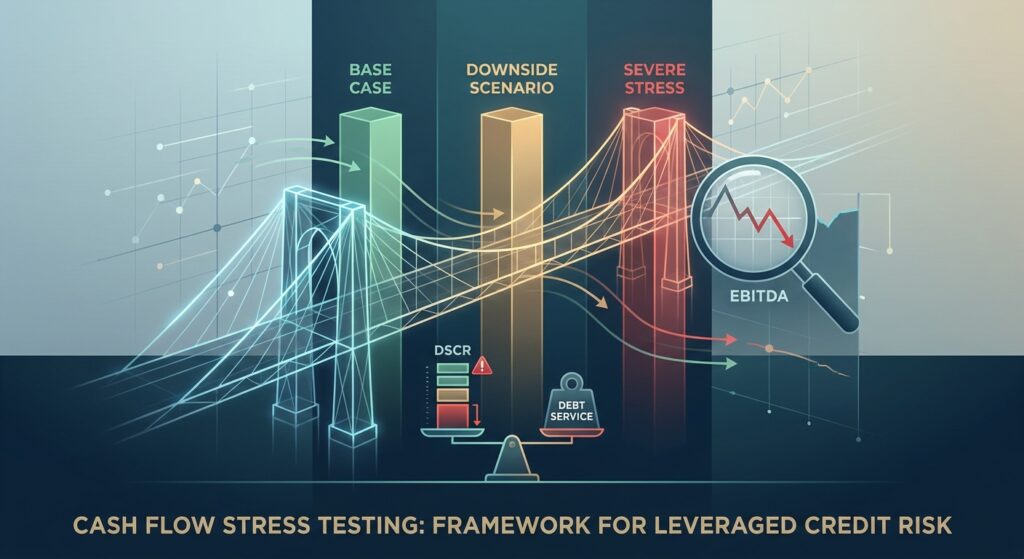
Rigorous cash flow stress testing operates across three defined scenario tracks. Each track isolates a different source of credit risk and applies distinct revenue, margin, and working capital assumptions to the same base debt structure.
Scenario 1: Base Case
This is the sponsor’s operating plan, adjusted for underwriter skepticism. Remove add-backs that lack third-party support. Normalize one-time items conservatively. Apply a modest revenue haircut of 5–10% to reflect execution risk. This is not your stress scenario; it is your entry point.
Scenario 2: Downside Case
Apply a 15–20% revenue decline (consistent with a moderate recession or sector-specific demand contraction) and compress EBITDA margins by 200–300 basis points to reflect operating leverage. Extend the cash conversion cycle by 10–15 days to stress working capital. This scenario should mirror conditions the business has actually experienced or that are plausible given its industry cyclicality.
Scenario 3: Severe Stress / Liquidation Threshold
Apply a 30%+ revenue shock, full margin compression to breakeven or below, and model the point at which the borrower can no longer service interest obligations. This is your covenant breach and potential default scenario. It answers the critical portfolio question: at what level of performance deterioration does the lender’s recovery analysis become the operative framework?
As the Moody’s Analytics credit portfolio modeling framework emphasizes, default risk can increase quickly and in correlation with the macro environment, making it essential that stress scenarios are calibrated to real cyclical patterns, not invented adversity.
Walking Through the Calculations: The $10M EBITDA Manufacturer
Return to our example. The borrower reports $10M in adjusted EBITDA. The proposed debt structure is $45M in total debt (4.5x leverage). Annual cash interest at SOFR + 500 with SOFR at approximately 4.3% equals roughly 9.3% all-in, or approximately $4.2M in annual interest expense. Mandatory amortization on the term loan adds another $1.1M. Total annual debt service: approximately $5.3M.
Base Case Debt Service Coverage Ratio (DSCR):
- Adjusted EBITDA: $10.0M
- Less: Capex (maintenance estimate): ($1.5M)
- Less: Cash taxes (estimated): ($0.8M)
- Free Cash Flow available for debt service: $7.7M
- DSCR: $7.7M ÷ $5.3M = 1.45x
Downside Case (–18% revenue, –250bps margin compression):
- Stressed EBITDA: $7.2M
- Free Cash Flow available for debt service: $4.9M
- DSCR: $4.9M ÷ $5.3M = 0.92x: below 1.0x, covenant breach territory
This calculation reveals that an 18% revenue decline, not a catastrophic event for a cyclical manufacturer, is sufficient to push the borrower into negative debt service coverage. The lender now faces a structurally critical question: is there enough covenant headroom to detect this deterioration early, and is there sufficient collateral recovery to protect principal in a default scenario?
PGIM’s large-cap private credit research highlights that tighter security documentation and larger borrower scale, with stronger revenue resilience, have historically supported lower defaults and higher recovery rates, reinforcing why collateral quality and covenant tightness are inseparable from cash flow analysis.
What Institutional Lenders Require, and Where Deals Break Down
Experienced credit institutions embed stress testing directly into their underwriting approval standards. Key benchmarks that appear consistently across institutional credit frameworks include:
- Minimum DSCR of 1.20x in the base case, with the downside case not breaching 1.0x for more than one projected quarter without a clear recovery path.
- Total leverage below 5.0x for non-technology, non-recurring revenue businesses, with a path to de-leverage below 4.0x within 24 months.
- Interest coverage ratio above 2.0x in the downside case, with EBITDA / cash interest as the primary metric.
- Liquidity buffer of at least 10% of annual revenue in available revolver capacity or unrestricted cash, ensuring the borrower can weather a working capital trough without triggering default.
As Fitch’s Global Corporate Rating Criteria (December 2024) states, where one rating factor is significantly weaker than others, that weakest element attracts greater analytical weight, a principle directly applicable to cash flow stress testing. A borrower with strong collateral but marginal DSCR coverage does not receive credit for asset value; the cash flow weakness becomes the dominant risk driver.
📊 Credit Performance Reference Points
- Leveraged loan default rates have historically spiked to 8–10% during recessionary periods, underscoring why downside scenarios must reflect cyclical reality rather than mild softness.
- Senior secured recovery rates in leveraged loans have averaged in the 60–80% range historically, varying significantly by industry, collateral quality, and covenant package, per Moody’s Analytics portfolio modeling research.
- Covenant breaches most commonly occur between months 18–30 post-close, the precise window when stress test projections should be most granular.
Common Red Flags in Submitted Cash Flow Models
- Linear revenue growth assumptions with no cyclical trough modeled, a signal that the sponsor has not stress-tested their own projections.
- Capex treated as fully discretionary in downside scenarios, masking the true maintenance spend required to sustain EBITDA.
- Working capital improvements baked into FCF without operational justification, inflating apparent debt service capacity.
- EBITDA add-backs exceeding 15–20% of reported EBITDA, which materially increases the probability that normalized cash generation falls short of underwritten performance.
Cash Flow Stress Testing Underwriting Checklist
- Obtain three full years of audited financials plus interim management accounts. Rebuild EBITDA from the income statement, do not begin with the sponsor’s adjusted figure.
- Identify revenue concentration risk. If the top three customers represent more than 40% of revenue, apply a specific customer attrition scenario in the downside case.
- Separate maintenance capex from growth capex. Use maintenance capex only in your FCF-to-debt-service bridge. Confirm with management and third-party diligence.
- Model quarterly, not annually. Annual DSCR masks intra-year liquidity troughs. A borrower can have a 1.3x annual DSCR and still face a Q3 cash shortfall that triggers a revolver draw and covenant test.
- Test the covenant step-down schedule. Identify the exact quarter when the financial maintenance covenant tightens and overlay your downside EBITDA trajectory. Calculate the headroom at each test date.
- Run a fixed-charge coverage ratio (FCCR) calculation inclusive of lease obligations, as many middle-market borrowers carry material off-balance-sheet commitments that appear only in footnotes.
- Document your scenario assumptions explicitly in the credit memo, including the source basis for each revenue decline and margin compression input. Vague stress tests provide no analytical protection.
Key Takeaways for Credit Practitioners
- The base case is not an underwriting case. Capital protection is determined by the downside scenario. If the deal only works at plan, it does not work.
- DSCR below 1.0x in a moderate downside scenario is a structural disqualifier absent compensating collateral coverage or equity cushion, not a negotiating point.
- Quarterly cash flow modeling exposes liquidity risk that annual projections obscure, particularly for businesses with seasonal working capital cycles.
- EBITDA add-back discipline is cash flow discipline. Every unsupported add-back inflates apparent coverage ratios and understates true default probability.
- Stress test covenant interaction explicitly. A covenant that trips at 4.0x leverage in month 24 must be overlaid against your downside leverage trajectory, if the cushion is below 15–20%, the early warning system is structurally inadequate.


