
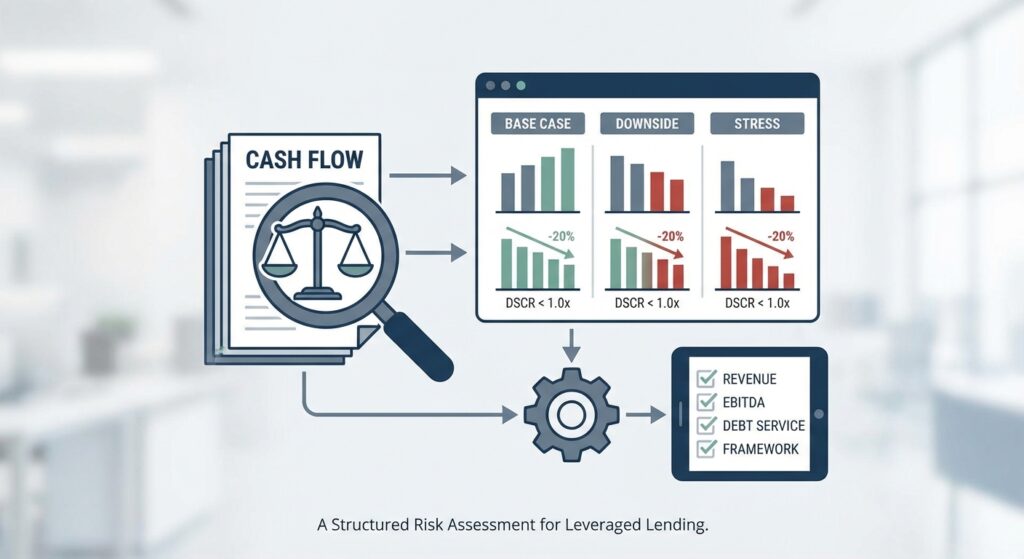
The Underwriting Question Every Lender Must Answer
Before a term loan closes, before the credit memo is approved, and before the commitment letter is signed, one question should anchor every underwriting decision: If this borrower’s revenue contracts by 20% next year, can it still service its debt?
In leveraged lending, the answer is rarely obvious. Sponsors and management teams present base-case projections with confident EBITDA trajectories. Confidential Information Memorandums (CIMs) are engineered to tell an optimistic story. The underwriter’s job is to pressure-test that story: systematically, numerically, and without sentiment. Cash flow stress testing is the discipline that separates rigorous credit analysis from capital destruction.
As the Basel Committee on Banking Supervision reaffirmed in its updated Principles for the Management of Credit Risk (April 2025), sound credit-granting processes must include structured assessment of cash flow durability across adverse scenarios, not merely a review of trailing performance under favorable conditions.
The Analytical Framework: Three-Scenario Cash Flow Architecture
Institutional credit teams build stress tests around a three-scenario architecture: a base case, a downside case, and a severe stress case. Each scenario is not a guess; it is a structured shock applied to the borrower’s income statement, working capital, and debt obligations simultaneously.
Consider a $10M EBITDA manufacturing company being underwritten for a $45M senior secured term loan (4.5x leverage). The CIM projects 8% revenue growth and 200bps of EBITDA margin expansion over three years. Before accepting those projections, an underwriter decomposes the model into its core drivers:
- Revenue: Volume assumptions, pricing power, customer concentration, and contract duration
- EBITDA Margin: Fixed vs. variable cost structure, labor exposure, input cost sensitivity
- Working Capital: Days Sales Outstanding (DSO), inventory turns, payables cycle
- Capex: Maintenance vs. growth capex, deferred investment risk
- Debt Service: Scheduled amortization, PIK toggles, revolver draws, interest rate sensitivity
As outlined in the LBO debt capacity literature, total leverage in most current deals ranges from 4.0x to 5.0x EBITDA: down from levels exceeding 6.0x that were common in prior cycles, reflecting tighter lender discipline in a higher-rate environment. At 4.5x, our manufacturing borrower is at the upper bound of institutional comfort, which makes stress testing non-negotiable. See: ibinterviewquestions.com.
Walking Through the Calculations: From Base Case to Breach
Below is a simplified three-scenario stress test for the $10M EBITDA manufacturing borrower, with a $45M term loan at an assumed 8.5% all-in interest rate and 5% annual amortization ($2.25M/year):
| Metric | Base Case | Downside (−15% Rev) | Stress (−25% Rev) |
|---|---|---|---|
| Revenue | $65M | $55.25M | $48.75M |
| EBITDA | $10.0M | $7.2M | $5.1M |
| Cash Interest | $3.83M | $3.83M | $3.83M |
| Amortization | $2.25M | $2.25M | $2.25M |
| DSCR | 1.64x | 1.18x | 0.84x ⚠ |
| Interest Coverage (EBITDA/Interest) | 2.61x | 1.88x | 1.33x ⚠ |
| Leverage (Debt/EBITDA) | 4.5x | 6.25x ⚠ | 8.8x 🔴 |
The stress scenario reveals the borrower’s critical vulnerability: a 25% revenue contraction, well within manufacturing cycle norms, drives the Debt Service Coverage Ratio (DSCR) below 1.0x, the minimum threshold for debt service from operating cash flow alone. Leverage balloons to 8.8x EBITDA, far exceeding institutional thresholds. If the credit agreement includes a maintenance leverage covenant set at 6.5x, the borrower breaches in the downside scenario before reaching the stress case.
This is precisely the covenant headroom analysis that disciplined underwriters perform: measuring the distance between projected performance and covenant trigger levels under each scenario. As the fixed income risk literature notes, compressed credit spreads can create a false sense of safety, but deteriorating DSCR statistics do not lie. See: ainvest.com.
What Institutional Lenders Require: Standards and Red Flags
Experienced direct lenders and institutional credit committees evaluate stress test outputs against a defined set of performance thresholds. The most widely applied benchmarks in senior secured lending include:
- Minimum DSCR: 1.20x in base case; the loan should not breach 1.0x until the severe stress scenario
- Maximum Leverage: Senior secured debt should not exceed 5.0x EBITDA at close; total leverage rarely surpasses 6.0x in disciplined structures
- Minimum Interest Coverage: 2.0x EBITDA-to-cash-interest in base case; 1.5x in downside
- Fixed Charge Coverage Ratio (FCCR): At least 1.10x inclusive of capex and scheduled amortization
- According to S&P Global, the trailing 12-month U.S. speculative-grade default rate approached 4.5–5.0% in late 2024, with leveraged loans outpacing high-yield bonds in default frequency among lower-rated issuers.
- Moody’s data indicates that senior secured recovery rates in leveraged loan defaults have averaged approximately 60–65 cents on the dollar historically, but have declined toward 40–50 cents in covenant-lite structures where lenders had limited early intervention rights.
- The Basel Committee’s 2025 updated Credit Risk Principles note that banks with formal stress testing protocols embedded in origination experienced materially lower loss rates during the 2020 and 2022–2023 credit stress episodes. See: bis.org.
- In SaaS and software-related credit portfolios, AI-driven competitive disruption is now a recognized underwriting risk factor. SaaS Capital’s 2026 AI Assessment Framework flags that competitive dynamics in B2B software markets will shift materially by 2027, requiring lenders to stress ARR retention assumptions in software credit underwriting. See: saas-capital.com.
Common Red Flags in Cash Flow Stress Testing
- Margin stickiness assumption: Models that hold EBITDA margins flat as revenue declines ignore fixed cost absorption effects, a foundational underwriting error in manufacturing and distribution credits
- Working capital blind spots: Revenue shocks compress receivables faster than payables adjust, creating short-term liquidity gaps that are invisible in annual EBITDA-focused models
- Capex deferral fiction: Management teams routinely assume capex reductions offset stress, without distinguishing between growth capex (deferrable) and maintenance capex (not deferrable without asset degradation)
- Single-variable stress tests: Testing only revenue in isolation understates correlated risk; a demand shock simultaneously compresses margins, strains working capital, and may trigger rate increases on floating-rate debt
Underwriting Checklist: Cash Flow Stress Testing Diligence Points
- ✅ Decompose the base case EBITDA into its revenue, margin, and volume components, never accept a single EBITDA figure without tracing its construction
- ✅ Map fixed vs. variable costs explicitly; calculate the EBITDA impact of a 10%, 20%, and 30% revenue decline using the actual cost structure
- ✅ Model three scenarios (base, downside, stress) with distinct revenue, margin, and working capital assumptions for each
- ✅ Calculate DSCR, FCCR, and Interest Coverage under each scenario, document where each covenant is breached and at what revenue level
- ✅ Assess covenant headroom: How many months of performance deterioration before a maintenance covenant is tripped? Is there a cure mechanism?
- ✅ Stress interest rates: For floating-rate debt, model a +150bps and +300bps rate shock on top of the revenue stress scenario
- ✅ Validate liquidity sources: Confirm revolver availability, cash on hand, and seasonal working capital needs are modeled across each stress scenario
- ✅ Challenge management capex assumptions: Obtain a breakdown of maintenance vs. growth capex; apply a floor to maintenance capex in the stress case
- ✅ Document key risks in the credit memo: The stress test output should appear explicitly in the credit approval document with scenario assumptions stated
Key Takeaways for Credit Underwriters
- 🔑 DSCR below 1.0x in a downside scenario is a structural warning sign: not a recoverable footnote. If the credit cannot service debt in a moderate stress, the structure is wrong before the loan is made.
- 🔑 Covenant design must be calibrated to the stress test output: maintenance covenants should trigger intervention before the borrower reaches a liquidity crisis, not after.
- 🔑 Single-scenario underwriting is not underwriting: it is base-case financing. Institutional lenders require at minimum a downside and a stress case with distinct assumptions for each cash flow driver.
- 🔑 Fixed cost structure is the most underweighted risk variable in leveraged credit, a borrower with 70% fixed costs and 4.5x leverage has a dramatically different stress profile than one with 50% fixed costs at the same leverage multiple.
- 🔑 Recovery rates are not a substitute for underwriting discipline: covenant-lite structures that reduce early intervention rights have historically produced recovery rates 15–20 percentage points below fully-covenanted equivalents, according to Moody’s historical recovery data.


