
The Underwriting Question Every Lender Must Answer First
Before a single basis point of spread is priced, before a term sheet is issued, the fundamental question in any direct lending transaction is deceptively simple: Can this borrower service its debt through a full economic cycle, including a downturn it has not yet experienced?
Base-case financial projections provided in a Confidential Information Memorandum (CIM) almost universally show revenue growth, margin expansion, and comfortable coverage. Management teams are optimists by nature and incentive. The underwriter’s job is not to accept that narrative; it is to systematically dismantle it and determine where the structure breaks.
Cash flow stress testing is the discipline that separates disciplined credit underwriting from transactional rubber-stamping. It is not a single calculation. It is a repeatable analytical process that translates macroeconomic and business-specific risks into quantified impacts on debt serviceability, covenant headroom, and, ultimately, recovery outcomes if the deal deteriorates. The Basel Committee on Banking Supervision, in its updated 2025 Principles for the Management of Credit Risk, reinforces that sound credit-granting processes must incorporate forward-looking scenario analysis, not solely historical performance metrics.
This article walks through the exact framework Bond Capital’s underwriting desk uses to stress test cash flows on a middle-market direct lending opportunity, from building the base model to sizing the debt package and designing covenant triggers.
The Framework: Five Layers of Cash Flow Stress
Effective stress testing is not a single downside case. It operates across five analytical layers, each designed to answer a different risk question:
- Base Case Validation: Is management’s projection internally consistent with historical performance, industry dynamics, and margin benchmarks?
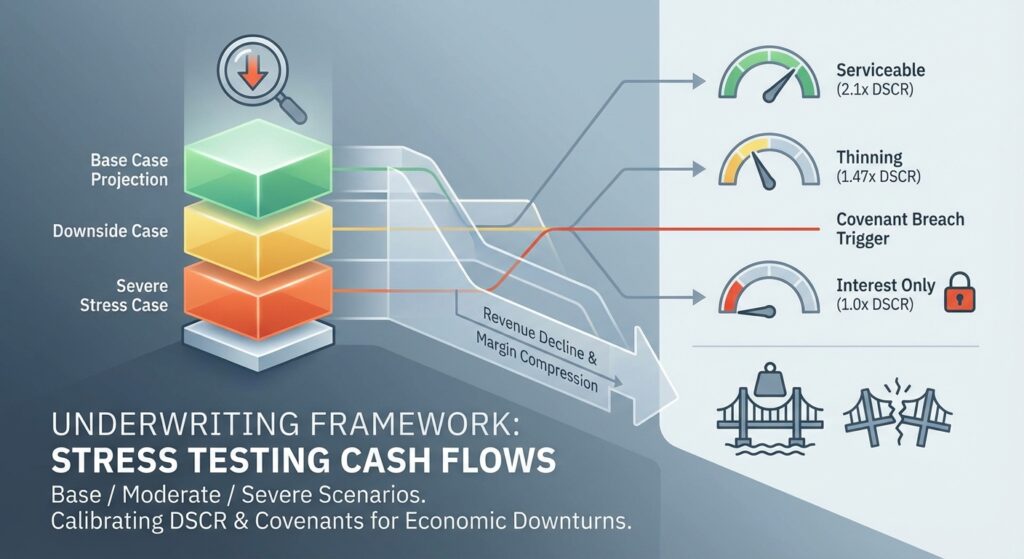
- Downside Case (Moderate Stress): What happens under a plausible recession scenario, typically a 10–15% revenue decline with margin compression of 200–300 bps?
- Severe Stress Case: What happens in a deep cyclical downturn, modeled at 20–30% revenue decline with fixed-cost deleverage and working capital deterioration?
- Covenant Breach Analysis: At what EBITDA level does the borrower breach the maintenance covenant, and how many quarters of performance deterioration does it take to get there?
- Break-Even and Recovery Analysis: What is the minimum EBITDA at which the borrower can service interest only, and what is the implied collateral coverage at that level?
This layered approach aligns with the credit analysis framework described by the CFA Institute’s Credit Analysis Models curriculum, which identifies expected exposure, probability of default, and loss given default as the three core inputs to any credit risk assessment. Stress testing operationalizes all three simultaneously.
The Analysis: Walking Through a $10M EBITDA Manufacturing Borrower
Consider a middle-market industrial manufacturer with the following base-case financials at close:
- LTM Revenue: $65M
- LTM Adjusted EBITDA: $10M (15.4% margin)
- Proposed Total Debt: $45M (4.5x EBITDA)
- Annual Cash Interest: $3.6M (8.0% all-in rate)
- Annual Capex: $1.5M (maintenance)
- Cash Taxes and Working Capital: $0.9M
Base Case Free Cash Flow to Debt Service:
EBITDA ($10.0M) − Capex ($1.5M) − Taxes/WC ($0.9M) = $7.6M Levered FCF
Debt Service Coverage Ratio (DSCR): $7.6M ÷ $3.6M = 2.1x: serviceable.
Moderate Stress (15% Revenue Decline, 150 bps Margin Compression):
Revenue falls to $55.3M. EBITDA margin compresses to 13.9%, yielding EBITDA of $7.7M.
Levered FCF: $7.7M − $1.5M − $0.9M = $5.3M
DSCR: $5.3M ÷ $3.6M = 1.47x: still serviceable but thinning.
Severe Stress (25% Revenue Decline, 300 bps Margin Compression):
Revenue falls to $48.8M. EBITDA margin at 12.4% = EBITDA of $6.0M.
Levered FCF: $6.0M − $1.5M − $0.9M = $3.6M
DSCR: $3.6M ÷ $3.6M = 1.0x: the borrower covers interest only. Principal repayment stops. The capital structure is at maximum stress.
This analysis immediately surfaces the covenant design requirement: a Total Net Leverage maintenance covenant set at 5.5x (with a 22% EBITDA buffer to the covenant trigger from close) would breach at approximately $8.2M EBITDA, reached under moderate stress in Year 2. The lender’s early warning system must be calibrated to catch deterioration before the severe case materializes.
As debt capacity analysis in the current rate environment indicates, total leverage in most direct lending transactions now ranges from 4.0x to 5.0x EBITDA, down from 6.0x+ pre-2022, a structural acknowledgment that rising base rates have compressed the FCF available to service fixed obligations, making conservative initial sizing essential.
Industry Standards: What Institutional Lenders Require
Institutional direct lenders and BDCs have converged on several underwriting standards that stress testing must validate:
- Minimum DSCR at close: Most senior secured lenders require a base-case DSCR of 1.5x–2.0x; unitranche structures targeting 1.25x in severe stress are considered aggressive.
- Covenant headroom: Maintenance covenants are typically set with 25–35% EBITDA cushion to the closing run-rate, sized to trigger before a covenant default becomes a payment default.
- Leverage ceiling: Per updated credit risk management principles from the Basel Committee (April 2025), sound credit-granting processes require documented analysis of borrower cash flow sufficiency under stressed conditions, not solely at origination leverage.
- Fixed Charge Coverage Ratio (FCCR): The FCCR (EBITDA − Capex − Taxes) ÷ (Interest + Required Amortization) should remain above 1.1x in the moderate stress case to be considered bankable at market terms.
🔴 Red Flags That Stress Testing Exposes
- EBITDA margin that has never been sustained through a prior downturn in the borrower’s own history
- Revenue concentration exceeding 20% in a single customer, amplifying the revenue stress multiplier
- Capex classified as “maintenance” that is actually growth-dependent, understating true cash drag
- Working capital assumptions that ignore seasonal swings or supply chain exposure
- Management addbacks to EBITDA that inflate the denominator used to size all leverage ratios
The CFA Institute’s Fundamentals of Credit Analysis specifically highlights the risk of sole reliance on issuer-provided financial metrics, a lesson reinforced by high-profile credit failures where adjusted EBITDA materially overstated true cash generation capacity.
Underwriting Checklist: Stress Testing Documentation Requirements
Before any credit committee submission, Bond Capital’s underwriting desk requires the following stress testing documentation to be complete:
- Three-scenario model (Base / Downside / Severe): with clearly documented revenue and margin assumptions tied to industry comparables and historical performance data, not management projections alone.
- Historical EBITDA volatility analysis: minimum 5-year trailing period; document the worst 12-month EBITDA trough and compare to proposed leverage.
- Covenant breach waterfall: map exactly which covenant trips first, at what EBITDA, and how many quarters of decline are required to reach that threshold.
- DSCR and FCCR at each stress layer: document minimum coverage ratios and note the precise conditions under which debt service is impaired.
- Break-even EBITDA calculation: the EBITDA floor below which cash interest cannot be covered from operations without asset sales or additional equity.
- Recovery analysis at severe stress: collateral coverage and enterprise value at stressed EBITDA multiples; what is the lender’s recovery if the borrower defaults in Year 3?
- Qualitative risk factors: customer concentration, industry cyclicality, management depth, competitive positioning: each factor must be explicitly linked to the stress assumptions applied.
The credit evaluation framework used across institutional lending platforms incorporates both quantitative ratio analysis and structured qualitative assessments (sector analysis, debtor analysis, and macroeconomic conditions) into a unified credit scoring process. Stress testing should integrate both dimensions.
Key Takeaways
- 📌 Base-case projections are not underwriting inputs; they are starting points for stress. Every management forecast requires a corresponding downside case grounded in historical performance and industry cycle data.
- 📌 The DSCR at severe stress is the most important number in the credit model. A 1.0x severe-stress DSCR signals the borrower can cover interest only, the lender is relying entirely on collateral value for principal recovery.
- 📌 Covenant triggers must be sized to provide early warning, not confirmation of failure. A leverage covenant that trips only after payment default has already begun offers no practical protection.
- 📌 EBITDA addbacks require independent validation. Every management adjustment to reported EBITDA should be documented, tested for recurrence, and stress-tested at zero, because in a downturn, non-recurring costs often recur.
- 📌 Stress testing is a living process, not a closing exercise. Portfolio monitoring should re-run downside scenarios quarterly against actual performance, flagging any borrowers where the distance to covenant breach has compressed by more than 30% from origination.


