
The Underwriting Question Every Lender Must Answer Before Closing
Before any credit committee approves a direct lending transaction, one question should dominate the room: If this borrower’s revenue falls 15% over the next 18 months, does the business still service its debt? Not in the base case, in the downside case. That distinction is where underwriting discipline either holds or breaks down.
In the current credit environment, total leverage in middle-market deals typically ranges from 4.0x to 5.0x EBITDA, down materially from the 6.0x-plus levels that characterized the low-rate era, reflecting lender caution as debt capacity has been recalibrated against higher all-in borrowing costs. At these leverage levels, even moderate operating deterioration can compress debt service coverage ratios to breach territory, and lenders who modeled only management’s hockey-stick projections are the first to be restructuring the loan rather than collecting interest.
Stress testing cash flows is not a back-of-envelope sensitivity check. It is a structured analytical process that separates institutional underwriting from optimistic capital deployment. This framework walks through how experienced credit desks build that process from the ground up.
The Analytical Framework: Three-Scenario Cash Flow Architecture
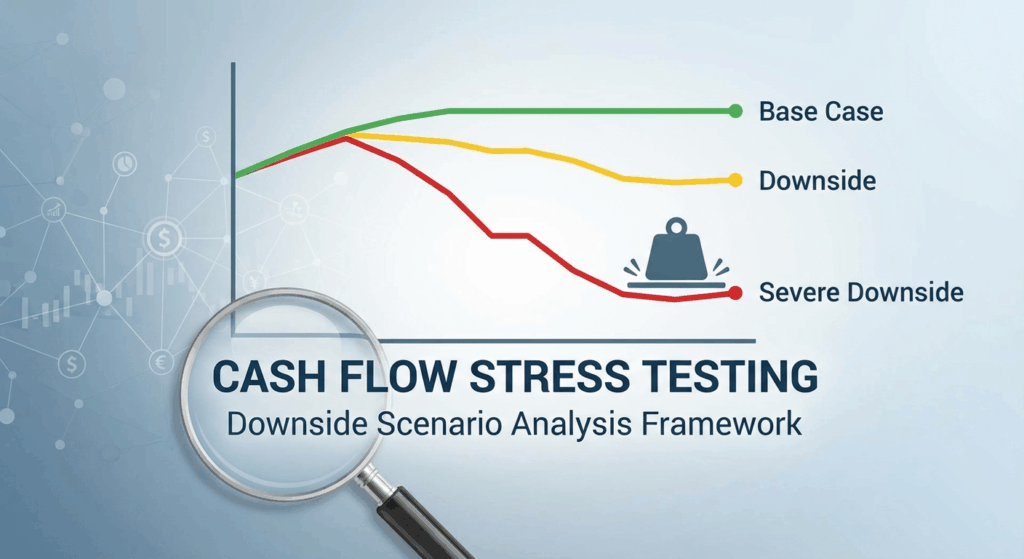
Rigorous stress testing begins with a three-scenario model (Base, Downside, and Severe Downside) each driven by operationally grounded assumptions rather than arbitrary percentage haircuts. The Basel Committee’s 2025 updated Principles for the Management of Credit Risk explicitly reinforces that sound credit-granting processes must incorporate forward-looking scenario analysis, stress testing, and clearly defined risk appetite thresholds, disciplines that apply with equal force to bank lenders and private credit funds.
The framework rests on four core cash flow drivers that must be independently stressed:
- Revenue: Volume, pricing, and customer concentration shocks
- Gross Margin: Input cost inflation, labor pressure, and mix shift
- Fixed Cost Structure: Operating leverage exposure when volumes fall
- Capital Expenditure Requirements: Maintenance CapEx floors that cannot be deferred without impairing operations
Example, Analyzing a $10M EBITDA Manufacturing Company: Consider a sponsor-backed manufacturer with $10M LTM EBITDA, 4.5x leverage ($45M total debt), a floating-rate term loan at SOFR + 550 bps, and $2M in annual maintenance CapEx. Base case assumes flat revenue with 3% annual margin improvement. The underwriter must ask: what happens if the company’s two largest customers, representing 40% of revenue, reduce orders by 20% due to their own demand softness?
In that scenario, revenue falls approximately 8%, gross margin compresses 150 bps due to fixed cost deleverage, and EBITDA drops to roughly $7.8M. After $2M maintenance CapEx, unlevered free cash flow is $5.8M. Against $4.5M in annual debt service at current rates, the Debt Service Coverage Ratio (DSCR) compresses from a comfortable 1.8x to a stressed 1.29x: approaching, but not yet breaching, a typical 1.20x maintenance covenant floor.
Walking the Calculations: Where the Stress Really Bites
The DSCR compression above exposes the danger of single-variable stress testing. Experienced underwriters layer scenarios, revenue decline plus margin compression plus interest rate movement, because real credit stress is rarely monocausal.
Extending the manufacturing example to a Severe Downside: revenue falls 15%, gross margin contracts 250 bps, and SOFR moves up 50 bps. EBITDA lands near $6.5M. After $2M maintenance CapEx and approximately $4.7M in debt service, DSCR falls to 1.02x: inside the covenant and with no cushion for working capital swings, litigation, or seasonal cash needs. This is the scenario that forces a restructuring conversation.
Key metrics to compute and track across all scenarios include:
- Total Leverage (Debt/EBITDA): Flag if stressed EBITDA pushes leverage above 6.0x
- Interest Coverage Ratio (EBITDA / Cash Interest): Minimum acceptable threshold typically 2.0x in base case; watch for sub-1.5x in downside
- Fixed Charge Coverage Ratio (FCCR): Includes CapEx, rent, and scheduled amortization, the most conservative and therefore most informative coverage test
- Free Cash Flow Conversion: What percentage of EBITDA becomes actual cash available for debt service after working capital, CapEx, and taxes?
- Loan-to-Value (LTV): In asset-heavy businesses, what is the collateral coverage if the enterprise must be liquidated in the Severe Downside?
As detailed in debt capacity frameworks used by leveraged finance practitioners, the relationship between leverage and free cash flow conversion is the ultimate arbiter of credit durability, not EBITDA alone. A business generating $10M EBITDA but consuming $6M in CapEx and working capital has materially less debt capacity than its headline multiple suggests. See ibinterviewquestions.com for a structured overview of how debt capacity analysis is applied in leveraged transactions.
What Institutional Lenders Look For, and Where Underwriters Get It Wrong
The Basel Committee’s 2025 credit risk principles identify four pillars of sound credit management: establishing a robust risk environment, operating a sound credit-granting process, maintaining disciplined administration and monitoring, and ensuring adequate controls. Stress testing sits at the intersection of the second and third pillars; it must be done at origination and repeated throughout the loan’s life as operating conditions evolve.
Fitch’s rating methodology for corporate issuers, as outlined in its Procedures and Methodologies documentation, applies both qualitative factors (competitive intensity, sector volatility, management quality) and quantitative metrics in tandem. Private credit underwriters should adopt the same dual-lens approach rather than over-indexing on sponsor relationships or EBITDA multiples.
Common underwriting failures institutional lenders have documented:
- Accepting adjusted EBITDA without stress-testing the adjustments: Management add-backs that are non-recurring in presentation but recurring in reality are a primary source of leverage being higher than modeled at close.
- Using a single-year LTM as the stress base: If LTM already reflects peak margins or a one-time contract win, the base case is artificially high before any downside adjustment is applied.
- Ignoring customer concentration in revenue scenarios: A 40%+ customer concentration in a B2B business is a binary revenue risk, not a smooth sensitivity curve. Stress tests must model the full customer loss, not a 10% haircut.
- Setting covenant levels too close to the base case: Covenants set at 10-15% headroom above the maintenance test offer no meaningful early-warning function. Institutional lenders typically require 25-30% covenant headroom in the base case to provide actionable remediation time.
📊 Credit Performance Data Points
- Middle-market leveraged loan default rates have historically trended between 2% and 4% annually during non-recessionary periods, with spikes exceeding 8% during economic contractions, per Cliffwater’s direct lending research.
- Total leverage in most direct lending transactions in 2025–2026 ranges from 4.0x to 5.0x EBITDA, reflecting lender discipline following the rate cycle, down from 6.0x+ at the 2021 peak.
- The Basel Committee’s updated 2025 principles reinforce that credit risk concentration (across borrowers, sectors, and geographies) remains a leading cause of systemic credit loss in both bank and non-bank lending portfolios.
- Fitch’s sector-level methodology requires qualitative assessment of management quality and governance alongside quantitative metrics, reflecting that financial stress is frequently preceded by operational or management deterioration that numbers alone do not immediately capture.
Stress Testing Underwriting Checklist
Before any credit approval, a disciplined underwriter should be able to affirm each of the following:
- Three scenarios modeled: Base, Downside (revenue -10% to -15%), and Severe Downside (revenue -20%+, margin compression, and rate stress applied simultaneously)
- EBITDA adjustments validated: Every add-back above $250K should be documented, time-bounded, and haircut in the downside model
- Customer concentration mapped: Top 5 customers identified, revenue modeled as a full loss for any customer above 15% of revenue
- Maintenance CapEx floored: CapEx cannot be zeroed out in downside, identify the minimum required to maintain operations and keep it in every scenario
- DSCR calculated in all scenarios: Minimum acceptable: 1.20x in Downside; flag anything below 1.10x in Severe Downside for committee review
- Covenant headroom validated: Confirm 25-30% cushion between base case EBITDA and the maintenance covenant trigger
- Liquidity runway assessed: Revolver availability, seasonality impact on cash, and months of operating cash in a revenue stop scenario
- Collateral coverage in liquidation: Document LTV against appraised or orderly liquidation value of pledged collateral in the Severe Downside
- Industry cycle position identified: Is this underwriting at peak margins or mid-cycle? Stress assumptions must reflect sector cyclicality, not just company history
- Documentation collected: Three years of audited financials, QoE report, management projections with assumptions, CapEx schedules, customer contracts, and debt service waterfall
Key Takeaways for Credit Practitioners
- 🔑 Stress testing is not a sensitivity tab; it is the underwriting thesis. If the investment rationale only survives the base case, the credit is not appropriately sized for the risk being taken.
- 🔑 Layer your stresses simultaneously. Revenue decline, margin compression, rate movement, and CapEx floors must be applied together, not in isolation, to approximate real-world credit deterioration.
- 🔑 Covenant headroom is an early-warning system, not a formality. Covenants set too tight give lenders no remediation runway; covenants set with 25-30% headroom create actionable intervention points before default.
- 🔑 Customer concentration is a binary risk in stress scenarios. Model the complete loss of any customer above 15% of revenue, not a percentage haircut, to understand the true downside exposure.
- 🔑 The Basel Committee’s 2025 credit risk principles confirm that ongoing monitoring is as critical as origination discipline. Stress tests performed only at close and never refreshed leave lenders blind to deteriorating credits until it is too late to act.


