
The Underwriting Challenge: Defending Value in Volatile Markets
In the credit underwriting discipline, the primary objective is not merely to deploy capital, but to ensure its return. As we navigate the financial landscape of early 2026, the principles of risk management have shifted from pure asset appreciation to rigorous cash flow preservation. The 2025 update to the Principles for the management of credit risk by the Basel Committee emphasizes that sound credit-granting processes must include an assessment of the borrower’s ability to withstand adverse economic conditions [bis.org]. For underwriters, this means that accepting a “Base Case” model provided by a borrower is insufficient. The real underwriting work begins when we ask: “What happens when the revenue stops growing?”
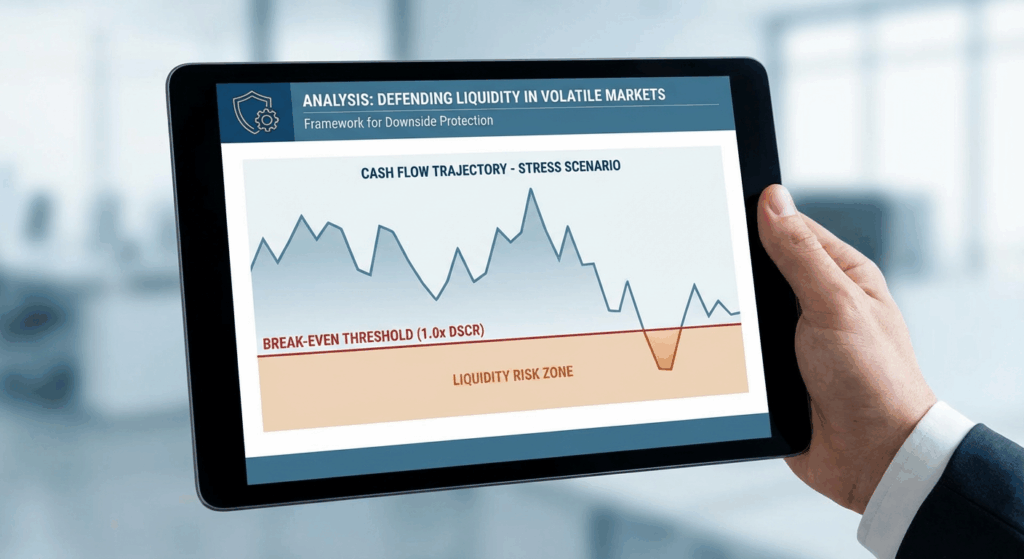
The challenge lies in accurately predicting how a business behaves under pressure. A borrower’s ability to service debt is often non-linear; a 10% decline in revenue can precipitate a 50% decline in Free Cash Flow (FCF) due to operating leverage. Effective underwriting requires stressing the cash flow statement to identify the break-even point where debt service coverage ratios (DSCR) breach 1.0x or covenant levels are triggered.
The Framework: Methodology and Key Metrics
A robust stress-testing framework moves beyond simple sensitivity analysis (e.g., margins -1%). It requires a structural decomposition of the P&L to understand the rigidity of the cost structure. According to Fitch Ratings’ 2025 methodologies, quantitative metrics must assess inherent exposure to volatility and business risk [assets.ctfassets.net]. We utilize a three-tiered approach:
- Base Case: Adjusted management guidance. We typically haircut revenue growth assumptions by 25-50% and maintain margins flat rather than expanding.
- Downside Case (Recession): Modeled on historical cyclical lows for the specific industry. This often involves negative revenue growth and margin contraction due to inability to pass on fixed cost inflation.
- Break-Even Analysis: The “burn down” metric. We calculate exactly how much revenue or margin can be lost before the DSCR hits 1.0x or the Fixed Charge Coverage Ratio (FCCR) breaches the covenant level (usually 1.15x-1.25x).
Key metrics scrutinized include Fixed-Charge Coverage Ratio (FCCR), Senior Leverage vs. Total Leverage, and Liquidity Run-Way (months of cash burn available).
The Analysis: The Operating Leverage Trap
To demonstrate the mechanics of stress testing, consider a hypothetical manufacturing borrower, “Alpha Corp,” with the following Base Case profile:
- Revenue: $50 million
- EBITDA: $10 million (20% margin)
- Total Debt: $40 million (4.0x Leverage)
- Interest Expense: $4 million (10% cost of debt)
- CapEx: $2 million (Maintenance)
Step 1: Determine Cost Structure.
Alpha Corp has high operating leverage. Of its $40 million in costs, $30 million is fixed (rent, salaried labor, SG&A) and only $10 million is variable (materials).
Step 2: Apply the Stress Scenario.
Assume a 15% decline in Revenue (down to $42.5 million).
Variable costs drop proportionally (20% of revenue) to $8.5 million.
Fixed costs remain at $30 million.
Step 3: Calculate the Impact.
New EBITDA = $42.5M (Rev) – $30M (Fixed) – $8.5M (Variable) = $4.0 million.
Cash Flow Available for Debt Service (CFADS) = $4.0M EBITDA – $2.0M CapEx = $2.0 million.
The Result:
Interest Expense is $4.0 million. The company now has a $2 million cash flow deficit. Despite only a 15% drop in sales, EBITDA collapsed by 60%, and the company cannot service its interest. This reveals a critical red flag: the borrower lacks the flexibility to cut costs in a downturn.
Industry Standards and Red Flags
Institutional lenders and rating agencies set high bars for asset quality. The FDIC’s scrutiny on asset quality highlights that the ability to identify and manage credit risk is reflected in the adequacy of allowances and exposure to default [fdic.gov]. In the current market, “covenant-lite” structures are increasingly scrutinized. Best practices dictate that a borrower should be able to withstand a 20-25% revenue decline without breaching a 1.0x Fixed Charge Coverage Ratio.
Common Red Flags in Underwriting:
- “Hockey Stick” Projections: Forecasts that show flat performance for 6 months followed by exponential growth.
- Ignoring Working Capital Unwind: Failing to model that in a downturn, inventory may become obsolete (cash trap) rather than turning into cash.
- Maintenance CapEx Misclassification: Borrowers often classify operational costs as “Growth CapEx” to inflate Adjusted EBITDA / FCF.
Credit monitoring frameworks suggest reviewing these stress tests quarterly, adjusting for actual performance to see if the “cushion” to default is expanding or compressing.
Underwriting Checklist: The Diligence Process
When preparing a Credit Investment Memorandum (CIM) or conducting diligence, execute this 5-point stress test:
- Isolate Fixed vs. Variable Costs: Review the General Ledger. Do not accept management’s allocation without verification. Verification includes checking lease terms and labor contracts.
- Customer Concentration Stress: If the top customer (20% of rev) walks away, does the company survive? Model the immediate loss of the largest contract.
- Input Cost Sensitivity: If COGS increases by 10% (inflation), can the borrower pass it on? If not, recalculate margins.
- Working Capital Cycle: Stress the Days Sales Outstanding (DSO). If customers pay in 60 days instead of 45, how does that impact liquidity?
- Covenant Breaches: Identify the exact dollar amount of EBITDA decline that triggers a breach. Is this decline probable over the loan term?
Key Takeaways
- Operating Leverage is a Double-Edged Sword: High fixed costs magnify losses in a downturn; underwriters must penalize high-leverage structures in such businesses.
- Cash Flow > EBITDA: Focus on Cash Flow Available for Debt Service (CFADS) after Maintenance CapEx and Taxes, not just headline EBITDA.
- Define the Break-Even: Know the exact revenue number where the loan defaults. If it is within 10% of current levels, the risk is likely too high.
- Management Adjustments are Risks: Treat “Pro Forma” add-backs with extreme skepticism; use unadjusted historical notions for the downside case.
- Monitor Continuously: Stress testing is not a one-time closing event; it is a quarterly discipline to reassess risk ratings.


