
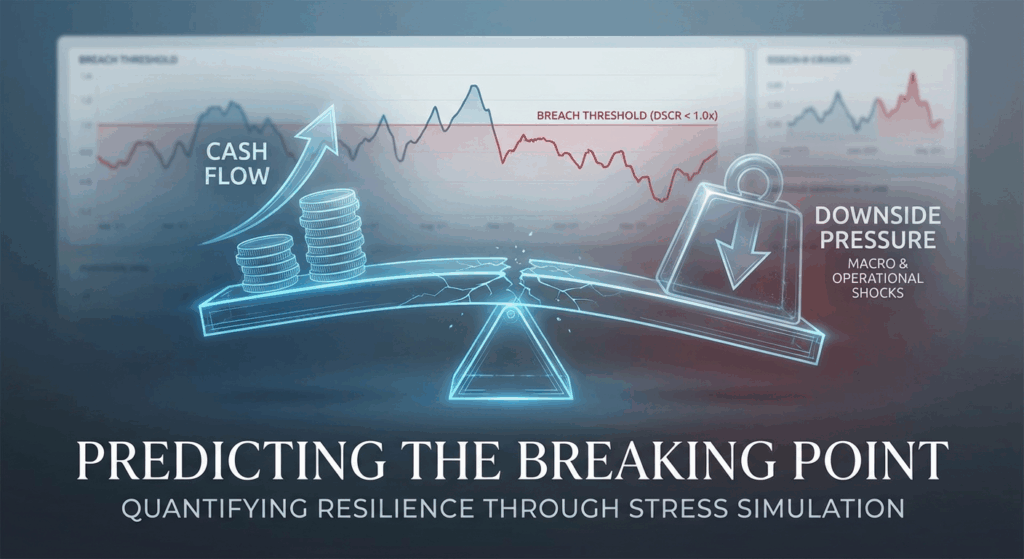
The Underwriting Challenge
The underwriting challenge in corporate credit is not merely assessing a borrower’s ability to service debt under optimal conditions, but quantifying their resilience when macroeconomic or operational variables deteriorate. As credit cycles mature and base rates fluctuate, relying solely on management’s base-case projections is a fundamental underwriting failure. The rapid shifts in the cost of capital and persistent cost inflations have highlighted the fragility of highly levered balance sheets. For credit analysts and portfolio managers, the core underwriting questions remain: At what point does the capital structure break? How much revenue contraction or margin compression can the business absorb before tripping a financial covenant or missing a principal payment? Stress testing cash flows provides the empirical answer. By subjecting a borrower’s Free Cash Flow (FCF) profile to severe but plausible downside scenarios, lenders can establish the true margin of safety. This rigorous risk assessment bridges the gap between theoretical credit capacity and actual default risk, ensuring that debt structures survive the inevitable volatility of the business cycle.
The Framework
The foundation of effective stress testing rests on isolating the primary drivers of cash flow generation and applying targeted shocks to those variables. A robust methodology looks beyond static EBITDA reductions to examine working capital dynamics, capital expenditure constraints, and variable interest rate exposures. Key metrics monitored during this process include the Fixed Charge Coverage Ratio (FCCR), Debt Service Coverage Ratio (DSCR), and the maximum Total Leverage Ratio.
Consider analyzing a $10M EBITDA manufacturing company seeking a $35M senior secured term loan (3.5x leverage) at an assumed 8.0% interest rate, with $2M in annual maintenance CapEx and $1M in mandatory debt amortization. In the base case, the company generates $10M EBITDA minus $2.8M interest, $2M CapEx, and $1M amortization, leaving $4.2M in excess cash flow. The coverage ratios appear reasonably healthy at a 2.6x DSCR.
However, a standard downside framework applies a cascading series of shocks:
- Revenue Contraction: A 15% top-line decline modeling a cyclical demand shock.
- Margin Compression: A 300-basis-point reduction in gross margins to simulate raw material inflation without pricing power.
- Interest Rate Shock: A 200-basis-point increase in SOFR or equivalent floating base rates.
- Working Capital Drag: An expansion of Days Sales Outstanding (DSO) by 15 days, reflecting slower customer payments.
These interconnected variables must be modeled dynamically. As revenue falls, variable costs decrease, but fixed overhead creates negative operating leverage, compressing EBITDA disproportionately. The framework systematically recalculates the resulting operating cash flow against rigid fixed charges.
The Analysis
Applying this downside framework to the $10M EBITDA manufacturer reveals significant vulnerabilities. A 15% revenue decline coupled with a 300 bps margin compression reduces core EBITDA from $10M to $5.5M. Simultaneously, the 200 bps interest rate shock increases annual interest expense from $2.8M to $3.5M on the $35M floating-rate debt.
Walking through the stressed cash flow waterfall, we subtract the new $3.5M interest expense, $2M maintenance CapEx, and $1M debt amortization from the stressed $5.5M EBITDA. The resulting un-levered free cash flow drops to negative $1.0M. The DSCR (defined as [EBITDA – CapEx] / [Interest + Principal]) collapses from a base case of 2.6x to a stressed 0.77x. A ratio significantly below 1.0x indicates the borrower cannot service fixed charges from period-generated operating cash flow.
To identify the structural severity of this shortfall, the underwriter must examine alternative liquidity reserves. If the company holds $5M in an undrawn revolving credit facility, it can conceptually fund this $1.0M deficit, assuming no covenant breaches. However, if the credit agreement includes a maximum total leverage covenant of 4.5x, the company is in immediate default: $35M debt / $5.5M EBITDA = 6.36x leverage. This scenario analysis shifts the underwriting focus from potential yield optimization directly toward structural downside protection and initial covenant design.
Industry Standards
Institutional lenders and rating agencies mandate rigorous stress testing to maintain portfolio quality. According to the Basel Committee on Banking Supervision’s Principles for the Management of Credit Risk (2025), banks and institutional lenders must maintain "an appropriate credit administration, measurement and monitoring process," which intrinsically relies on dynamic downside modeling rather than static ratio assessment. Furthermore, as noted in the Fitch Ratings Procedures and Methodologies for Determining Credit Ratings, quantitative metrics such as expected volatility, geographic diversification, and margin resilience must be forcefully tested against varying business environments and operating realities.
Institutional lenders systematically search for specific red flags during diligence. A common critical mistake is the failure to properly classify maintenance versus growth CapEx. If a borrower historically capitalized recurring software expenses or routine equipment repairs, underwriters must reclassify these items to accurately reflect the true, inescapable cash drain during a protracted downturn. Another prominent red flag is an over-reliance on aggressive EBITDA add-backs (like anticipated cross-selling synergies or unverified organizational cost savings) which inherently evaporate in a severe macro-stress environment.
Standard Institutional Stress Testing Parameters
- Revenue Shock: 10% to 25% base-case reduction dependent on cyclicality.
- Margin Contraction: 200 to 500 bps reduction at the gross profit line.
- Cost of Capital: Minimum +200 bps adjustment on unhedged floating rate facilities.
- Liquidity Runway: Analyzing survival without covenant breach over a rolling 12-to-18-month timeline.
Underwriting Checklist
To standardize downside protection and eliminate confirmation bias, deploy the following modular stress testing checklist during the diligence phase:
1. Revenue & Margin Diligence
- Identify the maximum customer concentration limit and shock the loss of the single largest client account.
- Calculate the specific operating leverage ratio (the proportion of fixed structural costs to variable costs).
- Review historical gross margin troughs during the last measurable economic downturn or industry specific recession.
2. Cash Flow Mechanics
- Strip out all management-proposed EBITDA add-backs, maintaining focus strictly on unadjusted cash generation.
- Isolate true maintenance CapEx from growth expenditures using an itemized historical fixed asset register.
- Stress the working capital cash conversion cycle (e.g., extend DSO by 15-30 days, reduce DPO by 10 days).
3. Capital Structure Resilience
- Calculate the exact "break-even" EBITDA threshold required to sustain a minimum 1.0x DSCR.
- Map out the precise quarter-by-quarter timeline to covenant breach under the downside case.
- Assess immediately available liquidity (resizing the functional revolver availability under restrictive borrowing bases) to bridge a cash burn scenario.
Key Takeaways
- Focus on Cash, Not Accounting Metrics: An EBITDA proxy is dangerously inadequate; true credit capability must be calculated post-interest, taxes, CapEx, and definitive working capital shifts.
- Operating Leverage Amplifies Risk: High fixed-cost business models generally experience severe free cash flow compression during even minor top-line revenue contractions.
- Locate the Exact Breaking Point: Base cases are largely directional; calculating the exact EBITDA level where DSCR falls below the critical 1.0x threshold is mandatory for sound underwriting.
- Liquidity Determines Survival: A breached financial covenant sparks immediate renegotiation, but an absolute liquidity deficit causes default. Accurately model the timeline to zero functional cash.
- Standardize Shock Assumptions: The consistent application of severe base rate hikes and margin compression across an entire credit portfolio is legally and operationally necessary for accurate aggregate risk measurement.


