
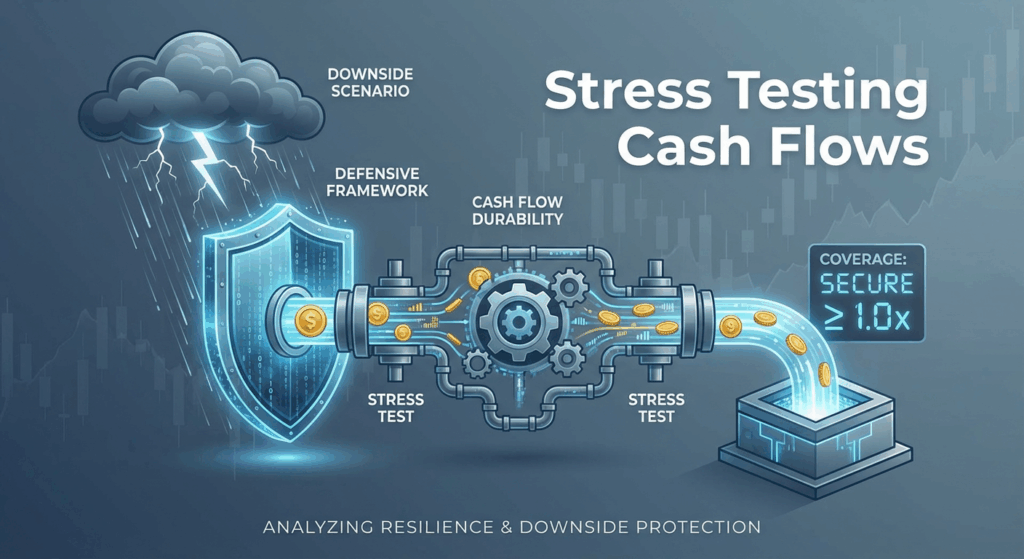
The fundamental asymmetry of credit underwriting is often summarized by a single maxim: lenders do not participate in the upside, but they bear the full weight of the downside. Unlike equity investors, whose returns can scale exponentially with a company’s success, a lender’s return is capped at the interest rate and principal repayment. Therefore, the primary objective of credit analysis is not to identify growth potential, but to ensure the durability of cash flows under adverse conditions.
Robust underwriting moves beyond pro forma optimism to rigorous stress testing. It requires dissecting a borrower’s ability to generate cash flow independent of accounting profits and measuring how much margin for error exists before debt service is compromised. This article outlines a defensive underwriting framework focused on stress testing cash flows and assessing credit durability.
The Analytical Framework: Cash Flow Durability
Effective credit analysis begins with a clear distinction between accounting earnings (EBITDA) and distributable cash flow. While EBITDA is a standard proxy for operating performance, it does not pay interest or principal, cash does. A sound underwriting process must bridge the gap between these two figures through a hierarchy of cash flow analysis.
Institutional lenders typically structure their analysis around the Fixed Charge Coverage Ratio (FCCR) or the Debt Service Coverage Ratio (DSCR). According to the Basel Committee on Banking Supervision’s principles for managing credit risk, a sound credit-granting process involves a comprehensive assessment of the borrower’s risk profile, of which cash flow capacity is central.
The Hierarchy of Cash Flow Analysis:
- Adjusted EBITDA: Operating earnings normalized for non-recurring items.
- Unlevered Free Cash Flow (UFCF): Adjusted EBITDA minus Capital Expenditures (Capex) and changes in Working Capital.
- Cash Flow Limit: The actual cash available to service debt after essential reinvestment in the business.
Risk professionals must determine whether the “Cash Flow Limit” is sufficient to cover principal and interest payments not just today, but in a downside scenario. The real estate underwriting guidelines discussed by industry analysts emphasize sequencing metrics correctly, interpreting coverage ratios (like DSCR) in isolation can obscure risk if the underlying cash flow assumptions are flawed.
The Analysis: Stress Testing a $10M EBITDA Company
To illustrate the mechanics of stress testing, consider a hypothetical manufacturing company requesting a senior term loan. We will analyze the borrower under a “Base Case” and a “Stress Case” to see how leverage and coverage metrics evolve.
Scenario Assumptions:
- LTM EBITDA: $10.0 million
- Proposed Debt: $35.0 million (3.5x Leverage)
- Interest Rate: 8.0% (Annual Interest Expense: $2.8 million)
- Required Amortization: $1.75 million (5% of principal)
- Maintenance Capex: $1.5 million
Metric 1: Base Case DSCR Calculation
- Cash Flow Available for Debt Service (CFADS): $10.0M (EBITDA) – $1.5M (Capex) – $1.0M (Taxes/Working Capital estimate) = $7.5 million.
- Total Debt Service: $2.8M (Interest) + $1.75M (Principal) = $4.55 million.
- Base Case DSCR: $7.5M / $4.55M = 1.65x.
At 1.65x coverage, the deal appears healthy. However, a defensive underwriter must determine the break-even point.
Metric 2: The Downside Stress Test
Assume an economic contraction causes a 15% decline in revenue. For a manufacturing business with high fixed costs, this might translate to a 25-30% drop in EBITDA due to operating leverage.
- Stressed EBITDA: $7.0 million (30% decline).
- Stressed CFADS: $7.0M – $1.5M (Capex) – $0.5M (Taxes) = $5.0 million.
- Stressed DSCR: $5.0M / $4.55M = 1.10x.
In this scenario, the coverage ratio tightens significantly, leaving essentially zero margin for error. If interest rates were to simultaneously rise by 200 basis points, the floating rate debt service would increase, potentially pushing the DSCR below 1.0x, a technical default.
Industry Standards and Risk Metrics
Institutional lenders rely on standardized metrics to grade the quality of a credit. The Central Bank of Bahrain’s rulebook on credit quality assessment highlights the necessity of internal risk rating systems that differentiate degrees of risk. Similarly, the fundamentals of credit analysis dictate that risk is composed of two main components: Default Probability and Loss Given Default (LGD).
Key Credit Monitoring Standards:
- Leverage Ceilings: Most senior cash flow lenders cap Total Debt / EBITDA between 3.0x and 4.5x for middle-market companies, depending on industry stability.
- Minimum DSCR: A covenant minimum of 1.25x is standard, providing a 25% cushion against cash flow degradation.
- Recovery Expectations: Credit analysis literature notes that Expected Loss = Default Probability × (1 – Recovery Rate). Underwriting must focus on collateral value (Working Capital, Equipment, Real Estate) to estimate recovery rates if the primary source of repayment (cash flow) fails.
Quantitative analysis from sources like IFT World emphasizes that credit spread risk, the yield premium over risk-free bonds, must compensate the lender for both the probability of default and the expected severity of loss.
Underwriting Checklist: Due Diligence Essentials
To execute a disciplined underwriting process, the following checklist should be applied during the diligence phase:
1. Quality of Earnings (QoE) Verification
Are the “add-backs” to EBITDA legitimate? Scrutinize one-time expenses, owner compensation adjustments, and pro forma synergies. If 20% of EBITDA comes from adjustments, the base case leverage is artificially low.
2. Customer Concentration Analysis
Does any single customer account for more than 15-20% of gross profit? If so, stress test the loss of that specific relationship.
3. Working Capital Trends
Is the company generating cash from operations, or is it funding growth by stretching payables? meaningful divergence between EBITDA and Operating Cash Flow is a red flag.
4. Covenant Design
Set financial covenants (Leverage Ratio, FCCR) with appropriate “headroom”, typically 15-20% below the base case projection, to act as an early warning system rather than a trigger for immediate liquidation.
Key Takeaways
- Cash > Accounting: Always underwrite to Unlevered Free Cash Flow, not just EBITDA.
- Stress the Margins: Apply operating leverage to revenue declines; a 10% revenue drop often means a >10% EBITDA drop.
- Covenants Protect Value: Well-structured covenants force a borrower back to the table before liquidity is exhausted.
- Assess Recovery: Understanding the “Loss Given Default” is as important as assessing the probability of default.
- Focus on Durability: The best credit metric is the consistency of margins through a full economic cycle.


