
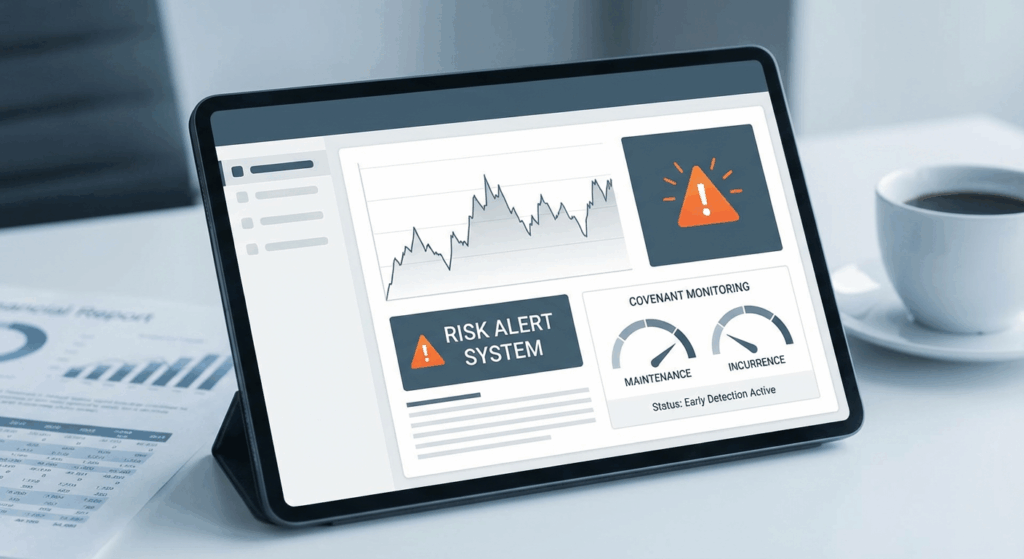
The Underwriting Challenge: Covenants as Early Warning Systems
In the landscape of corporate credit, covenants are often misunderstood as merely punitive measures or legal boilerplate. However, effective covenant design is the structural backbone of risk management, functioning not as a trap for the borrower, but as an early warning system for the lender. For credit underwriters, the challenge lies in calibrating these control mechanisms to provide operational flexibility for the borrower while ensuring capital preservation for the lender.
As credit conditions evolve, the rigorous application of covenant structures, specifically maintenance covenants, remains a distinguishing factor between resilient portfolios and those susceptible to default. The 2025 Principles for the Management of Credit Risk by the Basel Committee emphasizes that a sound credit-granting process must be paired with robust ongoing monitoring. Covenants provide the contractual trigger for that monitoring, forcing a dialogue when a borrower’s financial health begins to deviate from the underwritten plan.
The Framework: Structuring for Protection and Performance
A robust covenant framework relies on two primary pillars: Maintenance Covenants and Incurrence Covenants. While checking the box on standard leverage ratios is common, sophisticated underwriting involves tailoring these definitions to the specific cash flow dynamics of the business.
- Maintenance Covenants: These require the borrower to meet specific financial tests at regular intervals (usually quarterly), regardless of their actions. They are critical for monitoring portfolio health.
- Incurrence Covenants: These only restrict actions (e.g., incurring additional debt or making acquisitions) if doing so would breach a specific ratio.
According to Fitch Ratings’ Corporate Rating Criteria, financial structure and flexibility are key rating drivers. An effective underwriting framework weighs the “cushion”, the spread between projected performance and the covenant breach level. Standard industry practice targets a cushion of 15% to 25% off the base case financial model, allowing for normal business cyclicality while tripping if a structural deterioration occurs.
The Analysis: Stress Testing the Ratio
To illustrate the mechanics of covenant setting, consider a manufacturing company with $10 million in EBITDA seeking a $30 million term loan. The underwriter must determine the appropriate Fixed Charge Coverage Ratio (FCCR).
Step 1: Define Free Cash Flow (FCF)
We start with EBITDA but must adjust for real cash outflows.
Formula: EBITDA – Unfinanced CapEx – Cash Taxes – Dividends
$10M (EBITDA) – $1.5M (CapEx) – $1.5M (Taxes) = $7.0M Effective Cash Flow
Step 2: Calculate Fixed Charges
Formula: Cash Interest + Scheduled Principal Amortization
Assuming 8% interest on $30M debt ($2.4M) and 5% amortization ($1.5M):
$2.4M + $1.5M = $3.9M Total Fixed Charges
Step 3: Determine the Ratio and Set the Covenant
Actual FCCR: $7.0M / $3.9M = 1.79x
To set the covenant, we apply a ~20% cushion to the EBITDA to see where the break point lies. If EBITDA falls to $8M, the numerator drops to $5M (assuming fixed CapEx/Taxes stay similar for stress), and the ratio tightens. A standard covenant level would be set at 1.25x, providing ample room for minor misses but preventing a slide into liquidity distress.
Industry Standards and Portfolio Monitoring
Institutional lenders and regulators increasingly view the “credit administration program” as a vital component of asset quality. The FDIC’s Risk Management Manual (October 2025) notes that the ability of management to identify and manage credit risk is reflected heavily in asset quality ratings. Covenants are the tool that allows management to demonstrate this control.
Red Flags in Covenant Definitions:
- “EBITDA” Drift: Be wary of definition creep where “EBITDA” includes excessive add-backs for “synergies” or “one-time costs” that repeat annually. Restricting add-backs to 10-15% of EBITDA is a best practice.
- Covenant Holidays: Agreements that waive testing for initial periods (e.g., first 4 quarters) significantly increase risk by blinding the lender to early underperformance.
- Equity Cure Rights: While standard, unlimited equity cures (allowing owners to inject cash to “fix” a ratio miss) can mask fundamental operational issues. Best practice limits cures to 2 times over the life of the loan.
Underwriting Checklist: Covenant Diligence
When structuring a new credit facility, the following diligence points ensure the covenants serve their intended risk management purpose:
- [ ] Definition Validation: Does the credit agreement’s definition of EBITDA match the underwritten Adjusted EBITDA?
- [ ] Base Case Cushion: Is the covenant set at least 15-20% below the management’s base case projection?
- [ ] Downside Stress Test: Will the covenant trip before the borrower runs out of liquidity? (The “Tripwire” test).
- [ ] Reporting Frequency: Are compliance certificates required within 30-45 days of quarter-end to ensure timely data?
- [ ] Cross-Default Provisions: Does a default on other material debt trigger a default in this facility?
Key Takeaways
- Purpose is Dialogue, Not Default: Covenants should be designed to force a conversation while the borrower still has options, not when they are insolvent.
- Cash is King: Fixed Charge Coverage Ratios are often more predictive of default risk than leverage ratios because they account for CapEx and taxes.
- Beware of Add-Backs: Rigorous underwriting requires capping “adjusted” EBITDA to prevent artificial inflation of compliance ratios.
- Monitor Trends, Not Just Levels: A borrower that meets covenants but shows a deteriorating trend in cushion (e.g., 25% -> 10% -> 2%) requires immediate watchlist attention.
- Structural Integrity: As highlighted by the Basel Committee (2025), a sound credit culture requires that monitoring processes are as disciplined as initial origination.


