
The Underwriting Challenge: Structuring Protection in a Volatile Market
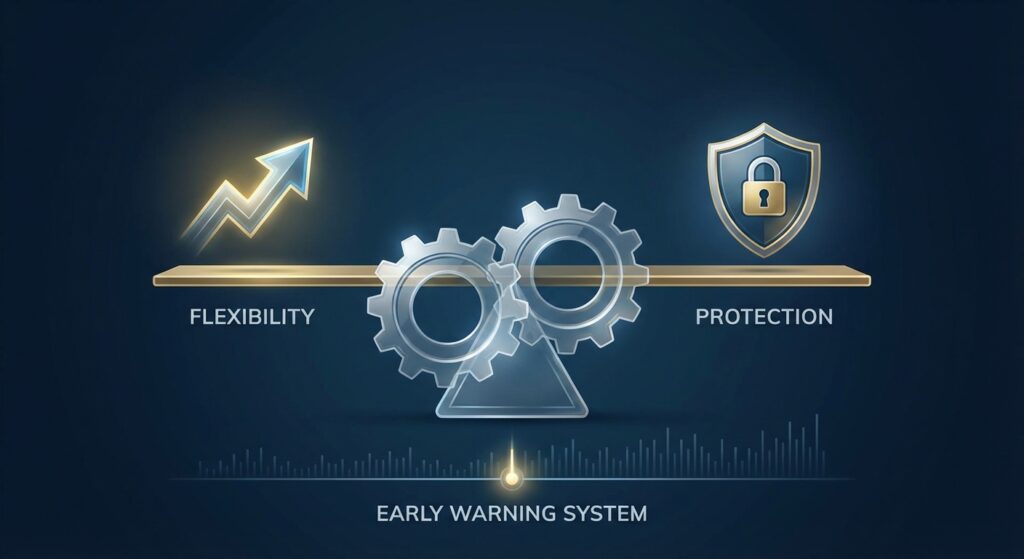
In the current lending landscape of 2026, the primary challenge for credit underwriters is not merely identifying solvent borrowers, but structuring agreements that remain resilient throughout an economic cycle. Covenants serve as the lender's “early warning system,” designed to trigger engagement before a borrower faces a liquidity crisis. However, the prevalence of “covenant-lite” structures in the upper middle market has migrated downstream, putting pressure on lenders to balance competitive terms with rigorous risk management.
Effective covenant design is not about imposing arbitrary restrictions; it is about aligning the credit agreement with the borrower's operating reality while preserving the lender's capital. As highlighted in the Basel Committee's 2025 Principles for the Management of Credit Risk, a sound credit-granting process requires clearly defined criteria that look beyond initial approval to ongoing administration and monitoring.
The Framework: Maintenance vs. Incurrence
Institutional underwriting generally categorizes covenants into two baskets: maintenance covenants, which require regular testing (typically quarterly), and incurrence covenants, which only trigger when the borrower takes a specific action (e.g., issuing new debt or making an acquisition).
For middle-market direct lending, maintenance covenants remain the gold standard for risk mitigation. The two most critical metrics are:
- Total Net Leverage Ratio: Measures part of the capital structure relative to earnings power (Total Net Debt / EBITDA).
- Fixed Charge Coverage Ratio (FCCR): Measures the ability of cash flow to cover non-discretionary obligations.
According to Fitch Ratings' Corporate Rating Criteria, quantitative metrics must be weighed alongside qualitative factors like sector risk and management governance. However, in a downside scenario, the mathematical clarity of a covenant provides the legal footing necessary for intervention.
The Analysis: Stress Testing a $10M EBITDA Borrower
To illustrate proper covenant design, consider a manufacturing borrower with $10 million in EBITDA seeking a $40 million senior term loan. The proposed interest rate is 8%, and the amortization is 5% per annum.
1. Base Case Calculation
- EBITDA: $10,000,000
- Capex (Unfinanced): $2,000,000
- Cash Taxes: $1,000,000
- Interest Expense: $3,200,000 ($40M * 8%)
- Scheduled Principal: $2,000,000 ($40M * 5%)
Fixed Charge Coverage Ratio (FCCR) Formula:
(EBITDA – Unfinanced Capex – Taxes) / (Interest + Principal)
Calculation:
($10M – $2M – $1M) / ($3.2M + $2M) = $7M / $5.2M = 1.35x
2. Determining the Cushion
A standard covenant level is often set with a 15-20% cushion to the base case projection. If we set the minimum FCCR covenant at 1.15x, we must solve for the EBITDA break-even point.
3. The Stress Test
If the borrower's EBITDA contracts by 20% to $8M due to a margin compression scenario:
- New Numerator: $8M (EBITDA) – $2M (Capex) – $0.8M (Taxes, adjusted) = $5.2M
- Denominator: $5.2M (Interest + Principal remain fixed)
- New FCCR: 1.00x
In this scenario, a 20% drop in EBITDA triggers a covenant breach (below 1.15x), allowing the lender to return to the table to restructure fees, restrict dividends, or mandate operational changes before cash actually runs out.
Industry Standards and Best Practices
Institutional investors, such as insurance companies and pension funds, differentiate between public bonds and private credit largely through these protective mechanisms. As noted by MetLife Investment Management, private placement debt often offers incremental income potential specifically due to financial covenants that allow for renegotiation and fee generation during periods of stress.
Red Flags in Diligence
When reviewing credit agreements or CIMs, underwriters should watch for:
- Excessive “Add-Backs”: EBITDA definitions that allow uncapped adjustments for “future synergies” or “one-time costs” can artificially inflate the starting EBITDA, rendering the leverage covenant ineffective.
- “Equity Cure” Rights: Clauses that allow owners to inject cash to simulate EBITDA for covenant testing purposes. Best practice limits these to 2-3 times over the life of the loan and requires the cash to be used for debt repayment.
- Loosely Defined “Permitted Indebtedness”: Baskets that allow the borrower to incur significant additional debt without lender consent, diluting the senior lender's position.
Underwriting Checklist: The Covenant Screen
Before closing a transaction, the underwriting team must validate the covenant package against the following 2026 risk standards:
- Definition Check: Does “EBITDA” exclude non-cash items and limit extraordinary add-backs to 10-15% of the total?
- cushion Calibration: Is the covenant set tight enough to trigger action before insolvency (e.g., 20-25% downturn), but loose enough to avoid technical defaults during normal seasonality?
- Cross-Default Provisions: Does a default on a different debt facility (e.g., an ABL revolver) automatically trigger a default on the Term Loan?
- Reporting Requirements: Are compliance certificates required within 30-45 days of quarter-end? Slow reporting renders covenants useless.
- Distributions Block: Is there a clear block on dividends or equity distributions if a default exists or if leverage exceeds a specific turn?
Key Takeaways
- Covenants are Triggers, Not Safety Nets: They force a conversation, they do not guarantee repayment.
- Cash Flow is King: The FCCR is often a more reliable indicator of distress than Net Leverage because it accounts for Capex and Taxes.
- Watch the Denominator: In a rising rate environment, floating-rate interest can rapidly erode coverage ratios even if EBITDA remains flat.
- Definition Discipline: An aggressive EBITDA definition can make a 4.0x leverage covenant behave like a 6.0x covenant.
- Active Monitoring: As per the FDIC Asset Quality Manual, the ability of management to identify and manage credit risk is as critical as the asset quality itself.


