
Understanding the Hierarchy of repayment Risk
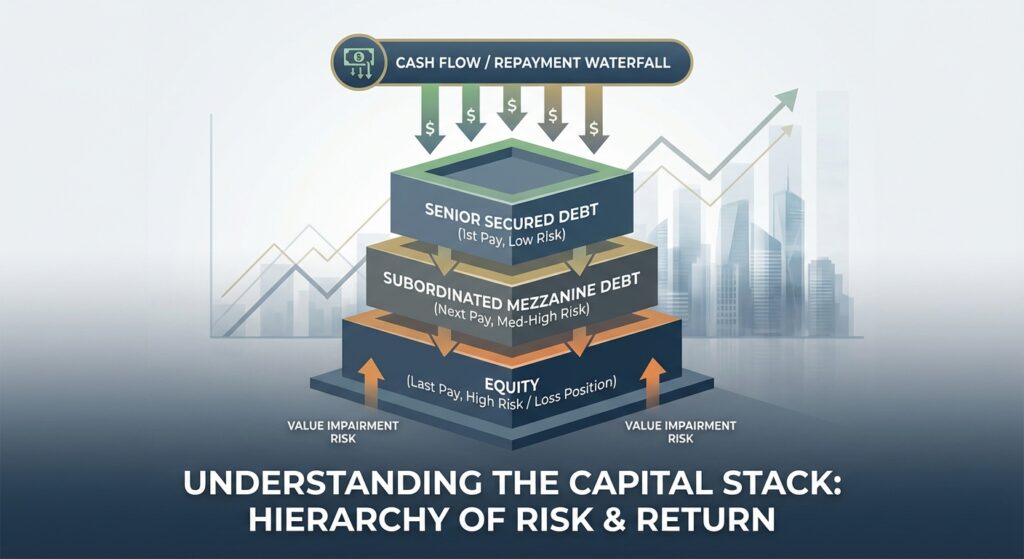
In the world of private credit, the most critical concept isn’t the interest rate; it is the Capital Stack. This structure defines the legal order of repayment in a transaction, serving as the DNA of any deal. Whether you are an investor seeking yield preservation or a business owner calculating the cost of growth, understanding where you sit in this stack determines your risk and your potential return.
While public markets focus heavily on earnings per share, private credit focuses on downside protection through seniority. The capital stack dictates who gets paid first when things go right, and more importantly, who gets paid at all if things go wrong. It is the architectural blueprint of financial risk.
The Concept: Seniority and Subordination
The capital stack is arranged hierarchically, similar to layers of a cake. The top layers represent the safest positions, while the bottom layers absorb the highest risk.
- Senior Secured Debt: This sits at the very top. “Senior” means it has the first claim on cash flows and assets. “Secured” means it is backed by collateral (accounts receivable, inventory, intellectual property, or real estate). In a bankruptcy or liquidation, these lenders are paid first.
- Subordinated (Mezzanine) Debt: This sits in the middle. It is junior to senior debt, meaning it only gets paid after senior lenders are satisfied. To compensate for this higher risk, it typically commands a higher interest rate and often includes “equity kickers” (warrants).
- Equity: This sits at the bottom. Equity holders own the upside potential but are in the “first loss” position. They only receive residual value after all debt obligations are met.
How It Works: The $100 Million Waterfall
To see the mechanics of seniority in action, consider a hypothetical manufacturing company, Alpha Corp, with an Enterprise Value (EV) of $100 million. To finance a buyout or expansion, the capital stack is structured as follows:
- Senior Secured Loan: $50 million (50% of capital structure)
- Equity Contribution: $50 million (50% of capital structure)
Scenario 1: Successful Exit
Five years later, Alpha Corp is sold for $150 million.
The Senior Lender receives their principal back ($50M) plus the interest collected over the term. They do not share in the extra $50M of value creation. The Equity holders receive the remaining $100 million, effectively doubling their money.
Scenario 2: Distress Scenario
The market turns, and Alpha Corp is forced to liquidate assets for only $60 million.
The Senior Lender still receives their full $50 million principal repayment because available funds cover their claim. The Equity holders receive the remaining $10 million, suffering an 80% loss on their initial investment.
Scenario 3: Severe Impairment
In a worst-case bankruptcy, assets are sold for just $40 million.
The Senior Lender receives the entire $40 million, taking a $10 million loss. The Equity holders receive $0.
This “waterfall” mechanism illustrates why private credit investors prioritize Senior Secured positions: significant value destruction must occur before their principal is at risk.
Current Market Relevance
The distinction between capital stack layers has become increasingly vital in the 2025-2026 economic environment. According to recent data, the structural shift in lending participants is reshaping opportunities.
- Yield Environment: With base rates (SOFR) remaining elevated around 4.3%, senior direct lending strategies are currently generating gross yields of 10-12%. This allows credit investors to achieve equity-like returns while retaining the protective seniority of debt.
- Institutional Allocation: This risk-adjusted profile is driving demand. The UBS Global Family Office Report 2025 noted that family offices doubled their private credit allocations from 2% to 4% in a single year, marking it as the fastest-growing allocation in their survey.
- The Bank Retreat: Regulatory changes, specifically Basel III standards, have forced traditional banks to retreat from middle-market lending. As banks pull back, private credit managers are increasingly filling the senior operational role rather than just subordinated or distressed roles.
However, investors must remain vigilant. While the asset class grows, liquidity stress in semi-liquid structures suggests that the underlying loan quality (senior vs. junior) matters more than the fund structure itself.
Decision Framework
For Investors: The Equity Cushion
When evaluating a private credit opportunity, the primary metric to scrutinize is the Equity Cushion. This represents the percentage of the company’s value that creates a buffer below your debt position. In our example above, the 50% equity contribution meant the company’s value could drop by nearly half before the senior loan was impaired. In today’s market, investors should look for:
- Senior Secured positions (First Lien).
- Loan-to-Value (LTV) ratios that offer at least a 40-50% equity cushion.
- Covenants that allow the lender to intervene early if performance degrades.
For Operators: Cost vs. Control
For business owners and CFOs, choosing a tranche in the capital stack is a trade-off between Cost of Capital and Dilution.
- Use Senior Debt When: You have stable cash flows and assets. It is the cheapest form of capital (10-12% vs. 25%+ cost of equity) and non-dilutive, allowing you to keep full ownership upside.
- Use Mezzanine/Equity When: You are asset-light or in hyper-growth mode where cash flows cannot support regular interest payments. You accept dilution or higher rates in exchange for flexibility.
Key Takeaways
- Seniority is Safety: In the capital stack, senior lenders get paid first. This position offers the strongest protection against business failure.
- The Waterfall Principle: Cash flows cascade down. Losses cascade up. Equity holders take the first loss; senior lenders take the last loss.
- Yield Arbitrage: Current market conditions allow senior debt investors to earn double-digit yields (10-12%) often associated with riskier asset classes.
- Banks are Leaving, Funds are Entering: Regulatory shifts have permanently moved senior middle-market lending from bank balance sheets to private credit funds.
- Equity Cushion is Key: For both lenders and borrowers, the thickness of the equity slice determines the resilience of the debt.


