
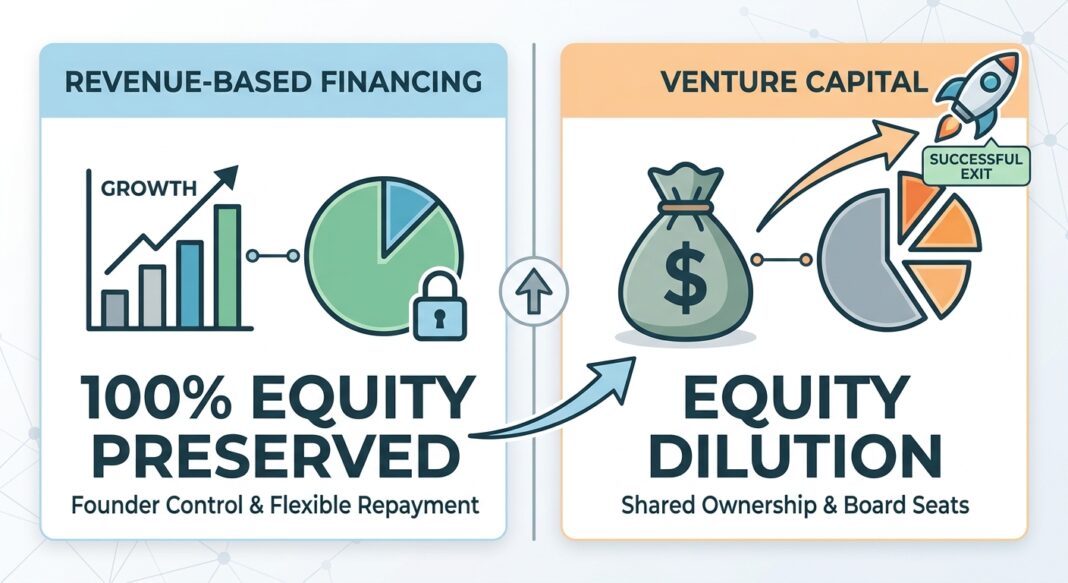
The Story: Six Employees, $1.7M ARR, Zero Dilution
Ken Hoppe didn’t want a board. He didn’t want a cap table full of investors with their own agendas. He wanted to build a profitable software company, own it outright, and grow it on his terms. So when Modigi, his six-person SaaS business operating inside the Salesforce ecosystem, needed working capital to hire its first salesperson and customer success manager, he didn’t call a VC.
He called Founderpath.
Modigi secured $400,000 in revenue-based financing in under 72 hours. No equity changed hands. No board seat was granted. No warrants were attached. The cost? An 8–12% discount rate over a 12-month payback period, structured to move in lockstep with the company’s monthly recurring revenue. Ken and his co-founder retained 100% ownership throughout.
The result: Modigi reached $1.7 million in ARR profitably, serving billion-dollar enterprises, and is now tracking toward $3–4 million in EBITDA within 24 months. The company achieved what most VC-backed startups burn millions trying to approximate, escape velocity, without ever giving away a single point of the cap table.
Ken’s story isn’t an outlier. It’s a signal. Across SaaS, CPG, and direct-to-consumer healthcare, a cohort of capital-efficient founders is quietly rewriting the script on how growth gets funded, and who keeps the upside when it does.
The Decision: What the Equity Path Actually Costs
To understand why founders like Ken are choosing debt structures over venture capital, you have to run the math that most term sheets are designed to obscure.
Consider the counterfactual: Modigi raises a seed round instead. At $1.7M ARR in the Salesforce ecosystem, a reasonable seed valuation might land between $8M and $12M. A $500K raise at a $9M pre-money cap gives away approximately 5.3% of the company: before dilution from future rounds, option pools, or pro-rata rights. That 5.3% carries board dynamics, reporting requirements, growth-rate expectations, and an implicit mandate to raise again within 18–24 months, whether the business needs it or not.
Founderpath’s $400K cost Ken somewhere between $32,000 and $48,000 in total financing fees, and nothing else. No dilution. No governance overhead. No forced timeline to exit.
This trade-off is exactly what the founders of Whims Delights navigated when they needed working capital to fund production runs for their better-for-you chocolate brand. Leanne Viola and Jesse Barruch had bootstrapped the company from their life savings ($200,000 from selling a Vancouver rental property) to $1.6 million in 2025 revenue across 800+ retail doors. They were simultaneously running a $2M equity raise on a $7M pre-money valuation. When Founderpath offered a $300,000 asset-backed revolving credit line at 12% on drawn balance only, collateralized 1.5x by inventory, the founders did a simple calculation: every dollar of debt was a dollar of dilution they didn’t have to sell. At the current cap, that $300K line fully drawn replaced roughly 4 points of ownership.
“Debt before equity preserves valuation,” is how the Founderpath team framed it. The Whims deal structure (interest accruing only on drawn balance, no fixed repayment cadence, a line that scales to $500K–$600K as inventory grows) was architected specifically around a CPG production cycle. Capital in, inventory built, product sold, line repaid, cycle reset. The cost of capital tracks the actual business operation, not a banker’s amortization schedule.
The Outcome: Non-Dilutive Capital as Exit Accelerant
The most instructive proof point in this cohort isn’t a bootstrapped SaaS company or a chocolate brand. It’s Musely.
The direct-to-consumer telemedicine platform (which has served over 1.2 million patients with compounded treatments for skin, hair, and menopause care) has been cash flow positive for years and has not raised a single dollar of equity capital since its $20 million seed round in 2014. When General Catalyst’s Customer Value Fund approached CEO Jack Jia about a potential deal, his default answer, as it had been to every VC who called, was no.
But CVF wasn’t offering equity terms. It was offering a revenue-share arrangement: $360 million in non-dilutive capital, repaid as a fixed, capped percentage of revenue generated from the use of the funds, no equity stake, no interest charges in the traditional sense, no governance rights. Jia modeled it against a standard bank loan and against a dilutive equity round and found it decisively superior to both. The capital will fund customer acquisition for a business that grows 50% year-over-year and whose biggest constraint isn’t product or market, it’s the working capital required to acquire customers at scale in a high-CAC DTC environment.
At Musely’s revenue trajectory, the cost of the CVF arrangement is a fraction of what a conventional equity round would have extracted, in both dollars and control. Jia keeps his ownership position intact. He keeps his board composition intact. And he deploys $360 million in growth capital without a single new shareholder.
The pattern holds at the exit end of the lifecycle, too. SafePointe, an AI-based weapons detection company founded by Greg and Timothy Holifield, used a $1 million venture debt facility from TIMIA Capital to triple its monthly recurring revenue in under 12 months, and was subsequently acquired by SoundThinking (Nasdaq: SSTI) less than a year after closing the debt facility. The equity investors who came in alongside TIMIA made 10x on their investment in nine months. TIMIA’s capital cost a fraction of that in comparison. Greg Holifield’s assessment was unambiguous: “When there are no warrants associated with debt, it is truly fantastic money, and much cheaper than equity.”
Similarly, Myagi, a retail sales enablement SaaS platform, used a $2.5 million non-dilutive facility from TIMIA Capital in 2021 to grow ARR from $2.4 million to $4.4 million, then exited to Rallyware in 2023. Co-founder Simon Turner, who had run the full spectrum of capital options across multiple ventures, put it plainly: “Debt is a powerful tool for capital-efficient businesses when used under the right circumstances.”
The Lessons: A Framework for Capital-Efficient Founders
These four stories (spanning SaaS, CPG, DTC healthcare, and AI hardware) share a common architecture. The capital decisions weren’t made by accident. They were made by founders who understood something that the venture capital industry has a structural incentive to obscure: equity is the most expensive capital a growing business can raise.
The VC model is built on a portfolio logic that has nothing to do with your company’s optimal capital structure. A fund that returns 3x needs its winners to return 30x, which means your investor’s incentive is to push you toward growth at a pace and scale that maximizes the fund’s return, not your net worth. Simon Turner captured this precisely: “Venture capitalists will challenge you to grow at all costs. One thing venture capital doesn’t take into account is that many businesses have a natural cadence at which they grow. Growing too fast can be detrimental.”
Non-dilutive structures (revenue-based financing, venture debt, asset-backed revolving lines) align cost of capital to business performance rather than to a fund’s return timeline. They are not appropriate for every company or every stage. Pre-revenue businesses, capital-intensive deep tech, and markets requiring decade-long infrastructure investment may have genuine structural needs for equity. But for capital-efficient businesses with recurring revenue, strong margins, and predictable cash flows, the calculus almost always favors debt first.
The framework is straightforward: use debt for what debt can fund, working capital, hiring, production runs, customer acquisition, and reserve equity for what debt genuinely cannot, market creation, multi-year R&D, or situations where the equity partner brings strategic value that exceeds the dilution cost. Whims Delights is still raising its equity round, but it’s doing so from a position of strength, not necessity, because the inventory line solved the immediate operational constraint. Musely never needed to raise equity at all. SafePointe and Myagi used debt to accelerate the equity value they’d already built, and captured the upside at exit without sharing it with a late-stage dilutive round.
Key Insights
- Equity is the most expensive capital on the table. Revenue-based financing at 8–12% and venture debt facilities often cost a fraction of what a dilutive round extracts in ownership, governance, and strategic autonomy, particularly when the equity investors make 10x at exit.
- Non-dilutive capital can be an exit accelerant, not just a growth tool. SafePointe tripled MRR and exited within 12 months of closing its TIMIA debt facility. Myagi grew ARR by 83% and exited within two years. Debt funded the inflection point that drove acquisition value.
- Structure matters as much as rate. Whims Delights specifically rejected standard ABL structures with weekly repayment because the amortization schedule would have eroded margin before the first inventory cycle sold through. A 12% rate on a non-amortizing revolver is dramatically cheaper in practice than a 12% rate on a term loan.
- Profitable, capital-efficient businesses have more financing options than they realize. Musely’s $360M CVF arrangement (available because the company had a decade of cash flow positivity and a predictable revenue stream) illustrates that non-dilutive capital scales with business quality. The better the business, the better the terms available without selling equity.
- VC incentives and founder incentives are structurally misaligned in many growth scenarios. A fund’s portfolio logic demands outlier returns on a defined timeline. A founder’s optimal outcome is often steady, controlled growth that maximizes personal equity value over a longer horizon. Recognizing that misalignment before signing a term sheet is the most important capital decision a founder can make.


