
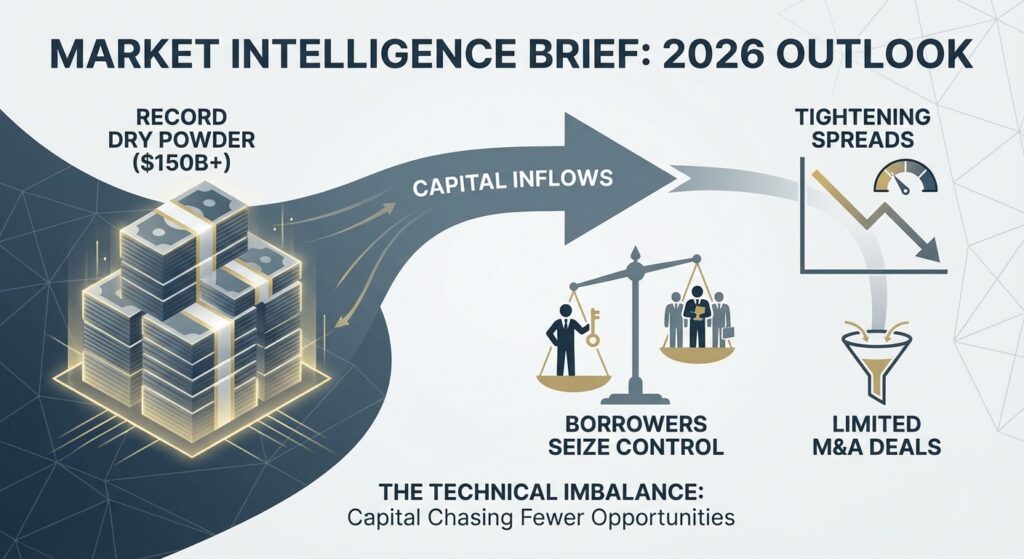
The Technical Imbalance: Borrowers Seize Control as Dry Powder Chases Limited Deals
As markets settle into early 2026, the private credit landscape is defined by a pronounced supply-demand mismatch that has firmly placed borrowers in the driver’s seat. Following a volatile 2025 characterized by tariff-driven disruptions in Q2 and a subsequent rebound, the current environment sees record levels of capital chasing a still-recovering M&A pipeline.
Institutional inflows have continued unabated, pushing U.S. direct lending dry powder to record highs. However, this liquidity wall is meeting a deal environment where new-money LBO activity remains muted compared to historical averages. The result is a highly competitive “borrower’s market” where private lenders are not only compressing spreads but offering increasingly flexible terms to win mandates against a resurgent syndicated loan market.
Quantitative Snapshot: Market Metrics
| Metric | Current Level / Trend | Context | Source |
|---|---|---|---|
| Syndicated Loan Volume | $404 Billion (Quarterly Record) | Rebounded sharply post-Q2 disruptions; highest quarterly total on record acting as fierce competition for private credit. | Portage Point |
| Direct Lending Dry Powder | >$150 Billion | Capital raised has exceeded deployment, creating intense pressure to lend. | Capstone / Pitchbook LCD |
| New Money Share | 18% of Issuance | Activity is dominated by refinancing and repricing; genuine M&A financing remains scarce. | Portage Point |
| Asset-Based Spreads | Tightened 10–30 bps | Specifically in bilateral and club transactions; indicative of broader yield compression. | MetLife MIM |
Sector Analysis: Infrastructure & Specialization Lead
While broad corporate lending faces margin compression, capital is rotating toward specialized verticals offering structural protection or growth tailwinds.
Infrastructure & Digital Heavyweights
Infrastructure debt has emerged as a standout performer. Recent data from MetLife Investment Management highlights $3.3 billion in quarterly activity across this segment, driven by digital infrastructure and utility projects. The sector benefits from the dual tailwinds of lower interest rates, following the Fed’s 25 bps cut in September 2025, and insatiable demand for data center financing. Long-dated issuance here remains attractive to liability-matching investors.
Asset-Based Finance (ABF)
As corporate credit spreads tighten, lenders are engaging more deeply in asset-based finance to secure yield. Consumer and commercial asset classes are seeing stable appetite, with spreads tightening 10–30 basis points in recent club transactions. This sector is proving resilient, offering diversification away from pure corporate credit risk.
Middle Market LBOs
The core middle market is colder. Loan transaction volumes for private credit have declined or remained flat for five consecutive quarters leading into late 2025. Capstone Partners reports that despite hope for a rebound, activity is largely confined to refinancing. However, with tariff policy visibility improving, M&A activity is slowly “inching upward,” potentially unlocking the backlog of private equity exits in 2026.
Implications for Market Participants
For Borrowers: The Optimization Window
Conditions are currently optimal for capital structure reviews. With syndicated markets hitting record volumes ($404B in Q3 2025) and private lenders flush with cash, borrowers can aggressively dual-track financing processes. B-minus rated issuers, in particular, drove 44% of recent refinancing activity, signaling that even lower-rated credits can access favorable repricing terms. Now is the time to extend maturities and reduce interest expense.
For Lenders: The Discipline Test
The “technical imbalance” (too much capital, too few deals) poses a significant underwriting risk. As Capstone Partners note, average fund sizes have surged over 50% since 2020. Managers are under immense pressure to deploy capital, which historically leads to covenant loosening. The resurgence of the syndicated market adds pressure, forcing direct lenders to concede on terms to retain high-quality assets. Lenders must resist the urge to drift into lower-quality credits merely to maintain deployment pace.
Key Market Insights
- Syndicated Resurgence: The bank market is back with record force, ending the period where private credit was the only game in town for large deals.
- Spread Compression: Expect continued tightening, particularly in high-quality upper-middle-market loans, as competition intensifies.
- Refi Dominance: New money opportunities are scarce (only ~18% of volume); the bulk of activity is opportunistically fixing balance sheets.
- Sector Rotation: pure-play corporate lending is crowded; look for alpha in infrastructure, data centers, and complex asset-based facilities.
- Dry Powder Overhang: With $150B+ in uninvested capital in the U.S. alone, the floor for deal terms will remain low through Q1/Q2 2026.


