
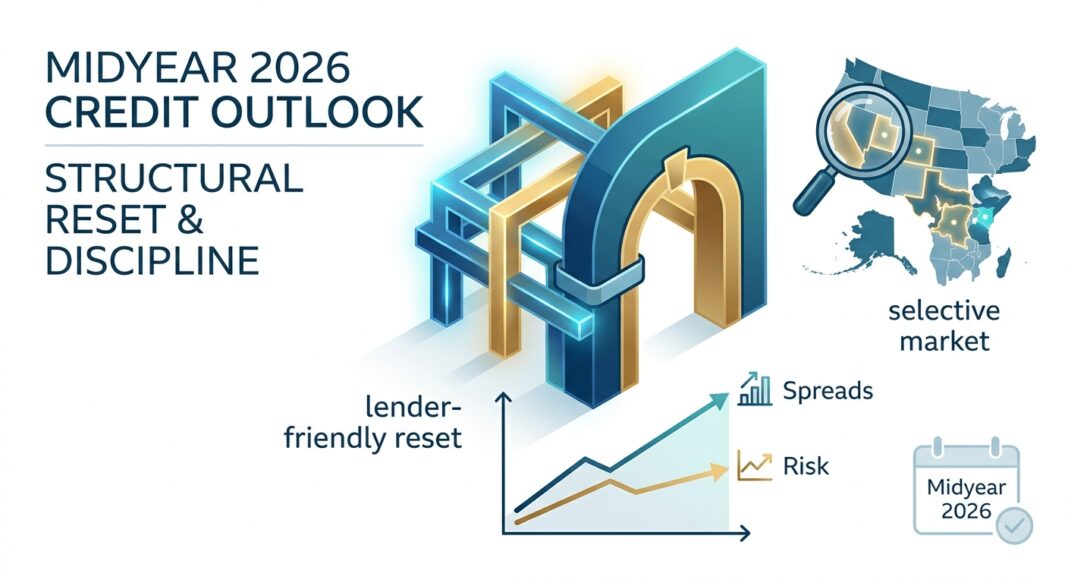
The Macro Story: A Credit Market in Structural Reset
At midyear 2026, private credit is not in crisis, but it is in transition. The headline metrics are well-known: the Federal Reserve has held rates steady, SOFR remains anchored near 4.33%, and meaningful rate relief has been repriced out of most lender models. What is less appreciated, and more consequential for institutional capital allocators and borrowers alike, is that a quiet but durable structural reset is underway in how credit is being underwritten, priced, and structured across both the public syndicated and private direct lending markets.
According to Lord Abbett’s 2026 Midyear Private Credit Outlook, spreads in private credit have widened by roughly 50 to 100 basis points since late 2025. But the more important development is structural: new loan originations are increasingly characterized by lower leverage multiples, tighter covenants, fewer payment-in-kind (PIK) provisions, and more rigorous documentation. This is the kind of lender discipline that was conspicuously absent during the compressed-spread environment of 2023–2024, and its return signals a potential inflection point in the credit cycle.
The macro forces driving this reset are clear. As detailed by ABF Journal’s Middle Market Debt Weekly, sticky inflation and a resilient labor market have effectively locked the Fed into a higher-for-longer posture. Borrowers who modeled SOFR drifting toward 3.0% in the back half of 2026 are now confronting debt service materially heavier than their original projections. For lenders, this compresses fixed-charge coverage ratios (FCCR) across floating-rate credits, particularly in the lower-middle market, and forces a sharper focus on covenant headroom and collateral quality.
Quantitative Market Snapshot
The following data box captures key market metrics as of Q2 2026, drawing from institutional sources to provide an objective benchmark for credit market conditions:
| Metric | Current Value (Q2 2026) | Prior Period | Source |
|---|---|---|---|
| Private Credit Spread Widening (vs. Late 2025) | +50 to +100 bps | Tighter / compressed | Lord Abbett / PitchBook |
| S&P Leveraged Loan Index Spread | ~487 bps | Tighter pre-Liberation Day (Apr 2025) | ABF Journal / S&P |
| Private Credit Non-Accrual Rate (Q1 2026) | 1.4% | Below 1.0% (2023–2024 avg.) | Heron Finance / SEC Filings |
| PIK Interest Rate (Q1 2026) | 3.9% | Elevated; marginal Q1 decrease | Heron Finance / SEC Filings |
| Private Credit Avg. LTV (First Lien, Q1 2026) | ~40% | Stable; no material loosening | Heron Finance / SEC Filings |
| Fund-Level Leverage (Debt/Equity) | ~1.0x | Rising; warrants monitoring toward 1.2x | Heron Finance / SEC Filings |
| European Mid-Market: 5-Yr SONIA (UK) | ~4.3% (+80 bps vs. prior) | ~3.5% (pre-March 2026 repricing) | AlixPartners Spring 2026 |
Critically, Debt/EBITDA ratios across private credit portfolios have remained stable, with no material upward drift observed over the past three years, a sign that underwriting discipline on borrower leverage has held, even as fund-level leverage has edged higher. With roughly 90% of private credit loans structured as first lien at conservative LTVs, realized loss rates are expected to remain near the asset class’s long-run average of approximately 1% annually, per Heron Finance’s Q2 2026 State of Private Credit Benchmark Report.
Sector Analysis: Where Lender Appetite Is Moving
The midyear 2026 credit landscape is defined not by uniform tightening, but by elevated dispersion: the widest sector-level spread divergence in several years, according to Wellington Management’s Midyear Fixed Income Outlook. That dispersion is creating differentiated lender appetite across industries.
Technology & Software: Selective Caution
Technology, particularly software-related credits originated during the 2021–2022 vintage, is under the most scrutiny. Per Lord Abbett, portfolio concentration in older software vintages and more aggressively financed credits is among the leading indicators of non-accrual risk. However, Wellington notes that AI-related disruption fears have created a spread dislocation in certain software and technology issuers that may not reflect underlying fundamental deterioration, presenting a selective opportunity for disciplined lenders willing to differentiate signal from noise.
High Yield & Leveraged Loans: Widening Creates Entry Points
The S&P Leveraged Loan Index at ~487 bps represents one of the wider spread levels observed since the post-Liberation Day dislocation of April 2025. Wellington identifies high yield, bank loans, and convertibles as the most compelling fixed income sub-sectors entering H2 2026, particularly for investors able to exploit issuer-level dispersion rather than relying on index-level exposure. Bank loans, specifically, have moved from relatively unattractive to more compelling as spreads have compensated for weaker underlying underwriting standards in the broadly syndicated market.
Energy & Consumer: Structural Pressure Mounting
Per ABF Journal, rising energy costs and a strained consumer are pressuring the weakest balance sheets in these sectors, keeping the restructuring pipeline active. Lenders are increasingly focusing on asset-backed lending (ABL) structures with verified collateral in these sectors, where enterprise value multiples are less reliable as credit support.
European Mid-Market: Refinancing Dominates, M&A Stalled
In the UK and Eurozone, AlixPartners reports that refinancing is dominating deal flow as valuation gaps suppress M&A. Five-year SONIA at ~4.3% and EURIBOR at ~2.8% are driving opportunistic refinancings while liquidity remains available, but borrowers with flat EBITDA trajectories and rolling PIK structures face increasingly tough lender scrutiny. The potential re-engagement of UK bank balance sheets, following the Bank of England’s reduction in Tier 1 capital benchmarks from 14% to 13%, may gradually introduce more competitive bank lending in the mid-market through 2027.
Implications for Institutional Investors and Operators
For Borrowers
The higher-for-longer rate environment is not abstract; it is transmitting directly into fixed-charge coverage ratios across floating-rate credits. Middle market borrowers who structured their capital stacks around SOFR drifting toward 3.0% are now managing a meaningfully higher debt service burden. Operators with upcoming refinancing needs should act proactively while liquidity windows remain open, particularly in the European market where AlixPartners flags a narrowing opportunity for refinancing before conditions tighten further. Borrowers should also expect lender due diligence to intensify around FCCR covenant headroom, PIK usage, and documentation quality, the era of borrower-friendly terms has closed.
For Lenders and Institutional Investors
For capital deploying into private credit today, the structural setup is meaningfully better than it was six months ago. Wider spreads combined with improved covenant protections, lower leverage multiples at origination, and conservative LTVs (~40% on first lien paper) represent a more defensible risk-adjusted entry point. Lord Abbett notes that M&A activity is quietly recovering, which is expanding the pipeline of new lending opportunities for managers with dry powder. However, fund-level leverage trending toward 1.0x, with the 1.2x threshold flagged as a monitoring trigger, warrants discipline in portfolio construction.
Key Risk to Monitor
Non-accruals at 1.4% in Q1 2026 are concentrated among smaller borrowers and older vintages, but the direction of travel matters. Should the Fed remain on hold through year-end and energy or consumer headwinds intensify, the restructuring pipeline could widen beyond its current, manageable level. Manager selection and vintage discipline are the primary levers institutional LPs can pull to manage this risk.
Forward-Looking View: The Next 3–6 Months
The second half of 2026 is likely to be defined by portfolio differentiation, not market-level distress. As Lord Abbett observes, the gap between stronger and weaker portfolios is becoming more visible: non-accruals, PIK usage, sector concentration, and 2021–2022 vintage exposure will increasingly separate high-quality managers from peers who deployed capital aggressively during the compressed-spread era.
Wellington’s framing of supply-shock dynamics (where growth and inflation move in opposite directions, compressing the traditional offset between duration and credit risk) supports a moderately lower duration posture and a preference for credit selection over index exposure. The best opportunities in H2 2026, across both public and private markets, are likely to sit in credits where fear has moved further than fundamentals justify.
For the middle market specifically, M&A activity is regaining its footing, slowly but with growing conviction. Direct lenders with locked-up capital, clean documentation standards, and verified collateral are positioned to capture deal flow from a more risk-averse broadly syndicated market. That structural advantage (patient, committed capital versus syndication-dependent liquidity) is the decisive differentiator entering the second half of the year.
Key Market Insights
- Spread widening is real but secondary: Private credit spreads are up 50–100 bps since late 2025, but the more durable shift is structural: tighter covenants, lower leverage at origination, and stronger documentation represent a more meaningful improvement in lender protection than spread alone.
- FCCR headroom is thinning across floating-rate credits: With SOFR anchored near 4.33% and rate cuts repriced out of consensus, borrowers who underwrote to a 3.0% SOFR path face materially heavier debt service, lenders should stress-test covenant headroom accordingly.
- Non-accruals at 1.4% signal concentration risk, not systemic stress: Smaller borrowers and 2021–2022 vintage software credits are the primary drivers; first-lien structures at ~40% LTV provide meaningful loss protection, but manager selection is critical.
- Sector dispersion is the widest in years: Broad index spreads mask significant divergence across sectors and issuers: disciplined credit selection at the issuer level, particularly in technology and high yield, is yielding better risk-adjusted opportunities than passive index exposure.
- European mid-market faces a narrowing refinancing window: UK and Eurozone rate repricing (+80 bps on 5-yr SONIA) is compressing M&A activity; borrowers with upcoming maturities should prioritize proactive refinancing while lender liquidity remains available and before potential bank re-engagement reshapes competitive dynamics in 2027.


