
Market Headline: The Lender-Friendly Reset Is Now Structural
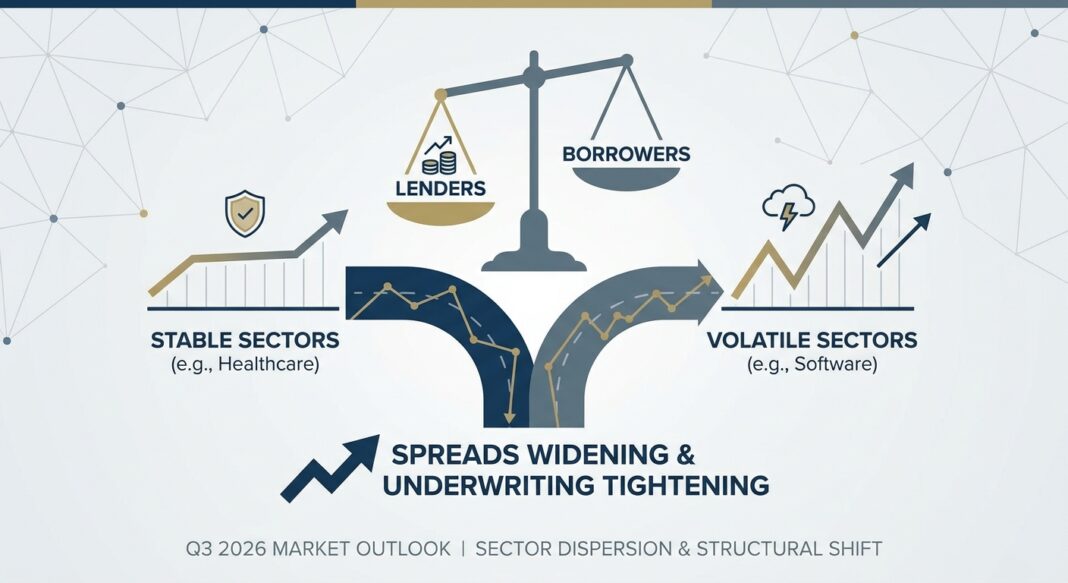
The defining macro story of Q3 2026 is not a crisis; it is a recalibration. After an extended period in which abundant private credit dry powder and constrained deal flow gave borrowers outsized pricing power, a convergence of forces has decisively shifted the balance back toward lenders. Spreads have reset wider, documentation is tighter, and for the first time in several years, lenders are being paid appropriately for the risk they are absorbing.
According to Lord Abbett’s 2026 Midyear Investment Outlook, spreads have widened by roughly 50 to 100 basis points since late 2025, while new credits are increasingly structured with less leverage, more covenants, fewer PIK requests, and tighter documentation. This is not a marginal adjustment. It represents a regime change from the compressed-spread, covenant-lite environment that characterized 2023–2024.
Three catalysts converged to produce this reset: (1) geopolitical volatility, specifically the U.S.-Iran military conflict in February 2026, which elevated inflation expectations and reset base rate assumptions; (2) an AI-driven repricing of software and technology credits that exposed the fragility of revenue assumptions embedded in peak-cycle underwriting; and (3) a wave of BDC redemption requests that forced semi-liquid vehicles to confront structural liquidity mismatches.
Valuation Research Corporation’s Q1 2026 update captures the macro backdrop directly: “heightened volatility in early 2026, driven by AI-related disruption concerns and geopolitical developments, pushed credit markets back into price discovery mode.” Primary market activity slowed in late Q1, secondary spreads widened (particularly for tech and software-exposed credits) and lender appetite became increasingly bifurcated by sector and credit quality.
The opportunity set that emerges from this reset is real, but so is the differentiation requirement. Lord Abbett notes that “a more active market gives lenders more to choose from, but stronger deal flow is usually only helpful if a manager has the ability and discipline to say no.” That discipline, not just access to capital, is now the primary source of alpha.
Quantitative Market Snapshot: As of September 23, 2026
| Metric | Current Value | Prior Period | Change | Source |
|---|---|---|---|---|
| SOFR (Overnight) | 3.85% | 4.34% (Sep 2025) | −49 bps YoY | NY Fed via SOFRrate.com |
| 3-Month Term SOFR | ~3.68% | ~3.67% (Q1 2026) | +1 bps QoQ | VRC Q2 2026 Report |
| Middle Market Private Credit Spreads (Core) | S+500 bps | S+450–475 bps (late 2025) | +50–100 bps | Hamilton Lane 2026 Private Credit Focus |
| Lower Middle Market Spread Premium vs. Large-Cap | +232 bps | Historically ~150–180 bps | Widening divergence | Avante Capital Partners LMM Playbook |
| Software Sector Secondary Spreads vs. B-Rated Loan Index | +229 bps above B-index | ~In-line at YE 2025 | +245 bps vs. YE 2025 | VRC / PitchBook LCD (June 19, 2026) |
| Healthcare Direct Lending Spreads | ~S+500 bps | Broadly stable vs. Q4 2025 | No material compression | Octus Direct Lending Analytics |
| 5-Year U.S. Treasury Yield | ~4.23% | 3.92% (Q1 2026) | +31 bps QoQ | VRC Q2 2026 Report |
| BDC Median Non-Accrual Rate | 0.33% (Q1 2026) | 0.00% (2022) | Rising, but contained | Wellington Management / BDC filings |
| Global High Yield Default Rate (Estimated 2026) | ~2.0% | 1.5% (YE 2025) | +50 bps YoY est. | AllianzGI High Yield Outlook 2026 |
| Private Credit Market Size (Global AUM) | ~$1.96 trillion (2026 est.) | $1.75 trillion (2025) | +12% YoY | Mordor Intelligence / PwC 2026 |
Key KPI Context for Underwriters
- Debt/EBITDA (Leverage): S&P Global estimates debt-to-EBITDA ratios have reached 7.5x–8.0x in some sectors excluding EBITDA addbacks, a level that is now under active lender scrutiny as a risk trigger, particularly in software-exposed credits where EBITDA assumptions proved optimistic.
- FCCR (Fixed Charge Coverage Ratio): Heron Finance’s Q2 2026 Benchmark Report confirms that borrower interest coverage ratios improved year-over-year due to lower interest rates and some EBITDA growth, but lender tolerance is declining. Market consensus now requires FCCR above 1.20x–1.50x at close for new credits, with maintenance covenant step-downs at 1.10x triggering lender protection rights.
- PIK Loan Share: PIK (payment-in-kind) loans now account for more than 11% of the private credit market, up from roughly 5% in early 2022, per Columbia Threadneedle’s analysis citing S&P data. An estimated 3–4% of private credit deals have amended terms midstream to add PIK features, a form of shadow restructuring that underwriters must now price into origination assumptions.
- Loan-to-Value (LTV): Heron Finance notes that loan-to-value ratios remain conservative across segments, with stable LTVs indicating lenders have not materially loosened underwriting standards in the last two years, a structural cushion if credit markets deteriorate.
Sector Analysis: Lender Appetite and Structural Market Shifts
Healthcare: The Perennial Anchor
Healthcare remains the most consistently favored sector in direct lending. Octus data confirms that healthcare led all sectors in private credit activity in 2025, representing 19% of all direct lending deals, and critically, it was the only major sector not to experience significant year-over-year pricing compression, with spreads averaging approximately SOFR+500 bps in Q4 2025. That pricing discipline has held into 2026. Creative Planning notes that demographic shifts and non-cyclical service models continue to attract lenders seeking stable, predictable cash flows, a structural advantage that compounds over credit cycles. For operators and sponsors, healthcare assets continue to command tighter leverage covenants but benefit from deeper lender pools and more competitive execution timelines.
Software & Technology: Risk-Off and Repricing
The most dramatic sector-level move of 2026 has unfolded in software. PitchBook LCD data as of June 19, 2026 shows secondary software spreads approximately 245 basis points wider than year-end 2025 levels and roughly 229 basis points above the broader B-rated loan index, directly reflecting AI-driven disruption anxiety. The repricing is not uniform, companies with demonstrated AI-resilient or AI-enabling revenue models are being underwritten differently from legacy software businesses reliant on user-base moats that AI tools are actively eroding. Capstone Partners’ Q1 2026 Middle Market Leveraged Finance Update identifies AI risk assessment as now a “critical analytical component both in underwriting a new transaction as well as evaluating existing credits.” Lenders are demanding explicit AI resilience frameworks from software borrowers before committing capital.
Infrastructure, Asset-Based Finance & AI Build-Out: The Growth Vectors
While direct lending faces margin compression and sector-specific turbulence, capital is rotating aggressively into specialty strategies. PitchBook data cited by Investing.com shows direct lending’s share of total private debt capital raised dropped from 58.4% in 2024 to roughly 31% by Q1 2026, as allocators shifted into infrastructure debt, real estate credit, special situations, and asset-backed strategies. Specialty finance raised $37 billion in 2025, more than the prior two years combined. Morgan Stanley estimates, via Reuters analysis, that private credit could supply more than half of the $1.5 trillion needed for global data center buildouts through 2028, a multi-year structured finance opportunity that is attracting both infrastructure specialists and generalist direct lenders expanding their mandates.
Consumer Discretionary & Legacy Media: Elevated Stress
Moody’s and S&P Global have flagged legacy media, consumer retail, and healthcare services as carrying elevated downgrade and default risk in 2026. The most vulnerable profiles share a recognizable pattern: acquisition-fueled debt loads accumulated during the 2020–2022 LBO boom, significant floating-rate exposure, and business models facing structural disruption from AI automation and e-commerce displacement. Lenders active in consumer discretionary are applying incremental stress scenarios and demanding tighter FCCR floors, typically 1.25x–1.40x, to offset operating leverage risk in a still-elevated rate environment.
Bank Re-Entry and Competitive Dynamics
A critical structural nuance in H2 2026: banks are partially returning to the upper middle market. VRC’s Q2 2026 report notes that after a risk-off March, “banks have gradually returned to the market in June, contributing to increased competition in the upper middle market and alleviating some of the upward pressure on credit spreads.” However, the Federal Reserve’s April 2026 SLOOS confirms that banks reported tighter lending standards and tighter terms on all categories of non-depository financial institution (NDFI) loans over the prior year: including higher premiums on riskier loans, stricter covenants, and shorter maximum maturities. The Q3 2026 SLOOS data (updated August 3, 2026 via FRED) shows C&I lending standards for large and middle-market firms registering at 0.0 net tightening, suggesting a brief pause in further tightening, though not a loosening. Small business C&I standards continue to show modest net tightening at +1.8, underscoring the bifurcation between large-cap access and lower-market credit availability.
Implications: What This Means for Borrowers, Lenders & Operators
For Borrowers and Operators
The window of extraordinary borrower-friendly terms that characterized 2023–2024 has materially closed. Operators seeking debt capital in H2 2026 should anticipate: (1) all-in costs 50–100 basis points higher than equivalent transactions priced in late 2025; (2) tighter covenant packages, including financial maintenance covenants tied to leverage and FCCR thresholds; and (3) more conservative EBITDA addback treatment as lenders apply greater scrutiny to pro forma adjustments. For software-exposed businesses, the repricing is steeper still, and borrowers without a credible AI-resilience narrative face increasingly thin lender pools. In the lower middle market, where Avante Capital identifies a 232-basis-point spread premium over large-cap, operators with $5M–$25M EBITDA face both wider pricing and greater documentation scrutiny, but also a more differentiated and potentially relationship-driven lender conversation.
Critically, businesses with strong FCCR profiles (above 1.50x), predictable recurring revenue, and defensible competitive moats (particularly in healthcare services, business services, and infrastructure-adjacent sectors) remain in the preferred credit tier and will continue to attract competitive execution from multiple lenders.
For Institutional Investors and Lenders
Morgan Stanley’s 2026 Midyear Private Credit Outlook confirms that many long-term allocators (including pension plans and insurers) continue to increase exposure to private credit, attracted by income generation and historically attractive risk-adjusted returns in a higher-rate environment. However, the illiquidity premium argument requires recalibration: a direct comparison of private credit vs. high yield shows that the heroic returns of 2019–2023 reflected a wider spread environment than today’s, and allocators should reset return expectations accordingly. The direct lending premium over leveraged loans, which peaked at 3%–4% in 2023, has compressed to the 1.5%–2.0% range by late 2025, per JPMorgan’s analysis via Bloomberg data.
The more compelling institutional opportunity lies in the divergence: managers with genuine origination discipline, sector specialization, and underwriting infrastructure to say no to marginal credits are being rewarded with better loan economics than the market headline suggests. PwC’s 2026 Global Private Credit Survey of over 120 credit portfolio managers identifies capital shifting toward specialist strategies (asset-backed finance, non-sponsor lending, and selective hybrid capital) as the primary mechanism through which managers are defending yield without accepting proportionally higher risk.
Forward-Looking View: H2 2026 Liquidity and Lending Dynamics
Lord Abbett’s midyear framing is apt: “The second half of 2026 is likely to be defined by dispersion.” The macro forward curve remains broadly flat as of June 2026, with VRC noting that market expectations continue to reflect a higher-for-longer rate environment. With SOFR at 3.85% and 5-year Treasuries at approximately 4.23%, the all-in cost of private credit financing for middle market borrowers at S+500 bps equates to approximately 8.85%–9.0% on a floating basis, meaningfully higher than the 7.5%–8.0% range that prevailed in late 2024.
The M&A recovery that was widely anticipated for 2026 has delivered mixed results. VRC data shows North American sponsor-backed M&A volumes fell 52.3% from January to June 2026, while corporate M&A, not PE-driven, surged 71% year-to-date to $1.53 trillion in the Americas, per LSEG. This divergence matters: corporate acquirers typically access investment-grade or broadly syndicated markets, while PE-driven buyouts are the primary demand driver for private credit. A recovery in sponsor activity, tied to private equity’s need to exit companies now averaging 6–7 year hold periods, remains the primary lever for deal volume acceleration. PitchBook’s 2026 US Private Credit Outlook projects that only 44% of current volume supports leveraged buyouts, versus 61% in 2021, a gap that is expected to close as PE exit pressure intensifies through Q4 2026 and into 2027.
Cleary Gottlieb’s analysis projects that the direct lending market, now matching the broadly syndicated loan market at $1.5–$2 trillion, is forecast to reach $3 trillion by 2028, underpinned by continued bank retrenchment under Basel III Endgame capital requirements and borrower preference for bespoke, flexible financing solutions. Structural tailwinds remain firmly in place. The near-term question is not whether private credit grows, but which managers will capture that growth with adequate risk-adjusted discipline.
Key Market Insights: Actionable Intelligence
- Spreads have reset: S+500 bps is the new middle market anchor. Per Hamilton Lane, private credit spreads have rebounded from the mid-400 bps level to S+500 bps context, a 50–100 bps widening since late 2025. Borrowers and sponsors should underwrite financing costs at this level, not at the compressed levels of 2023–2024.
- The lower middle market offers a genuine illiquidity premium, with real risks. Avante Capital documents a 232-bps spread premium in the $5M–$25M EBITDA segment over large-cap private credit, a differentiated opportunity that the capital wave has not yet reached. However, non-accrual rates are highest in this segment, demanding superior origination and monitoring discipline.
- Software underwriting requires an AI resilience framework. Capstone Partners confirms that AI disruption analysis is now a standard underwriting component. Software credits pricing at 245+ bps above the B-rated loan index are signaling a market-wide repricing of AI-exposed business models that lenders can no longer ignore.
- FCCR above 1.20x–1.50x is the new lender floor. As Heron Finance’s Q2 2026 Benchmark Report confirms, borrower interest coverage is improving, but lender tolerance for thin coverage is declining. FCCR and debt/EBITDA (with scrutiny on addbacks) are the primary KPIs determining credit tiering and pricing in new underwriting.
- Capital is rotating from direct lending to specialty credit. With direct lending’s share of private debt fundraising falling from 58% (2024) to 31% (Q1 2026), per PitchBook/Investing.com, the growth story is now asset-backed finance, infrastructure debt, and hybrid capital. Institutional investors and operators with complex or collateral-rich capital structures should actively engage specialty lenders who are allocating new mandates in these strategies.


