
Bond Capital | Market & Sector Intelligence | July 31, 2026
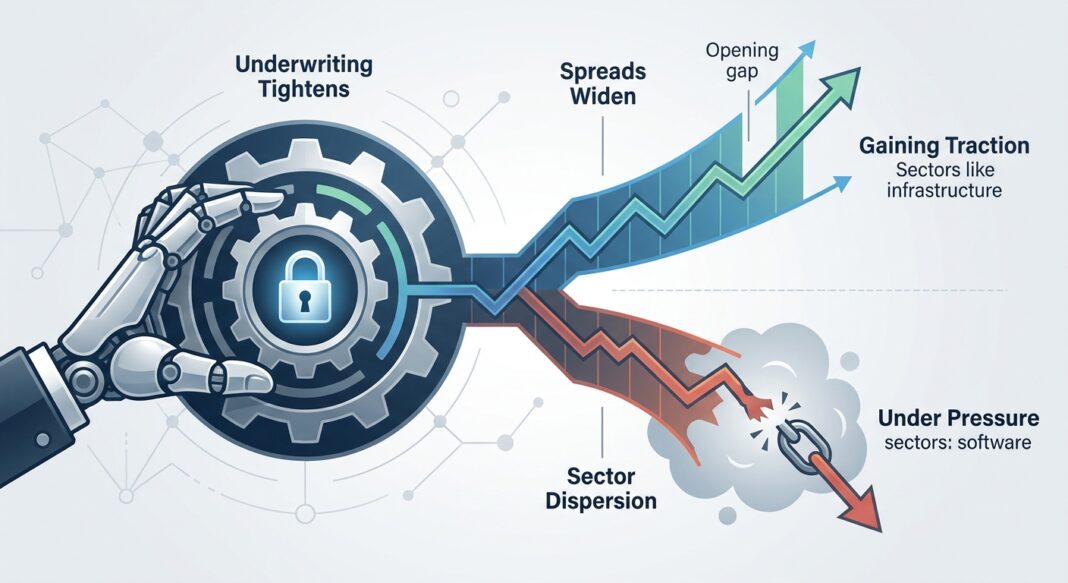
Private Credit’s Lender-Friendly Reset: Spreads Widen, Underwriting Tightens, and Sector Dispersion Accelerates
A structural inflection point has arrived for private credit markets. Spreads have widened materially from 2025 lows, bank lending standards are tightening in parallel, and AI-driven disruption is forcing a hard repricing of software-sector risk, creating a bifurcated market where manager discipline and sector selectivity matter more than at any point in the current cycle.
The Macro Picture: A Market Reset That Favors the Disciplined
Private credit entered 2026 carrying momentum from a record-setting 2025 M&A cycle, but three converging shocks rapidly rewrote the playbook. A U.S.-Iran military conflict in late February drove energy-cost volatility and inflation uncertainty; an accelerating AI-driven reassessment of SaaS business models triggered sharp software-sector loan repricing; and a wave of BDC redemption requests exposed structural vulnerabilities in semi-liquid, retail-oriented private credit vehicles. The result: a lender-friendly reset that, while disruptive in pockets, is materially improving new-money terms for disciplined capital allocators entering deals today.
According to Lord Abbett’s mid-year analysis (June 2026), spreads have widened by roughly 50 to 100 basis points since late 2025, while covenant and documentation terms have improved alongside them. The backdrop is simultaneously one of more deals and more selectivity: M&A activity is generating an expanded opportunity set, but capital providers with AI and software concerns have become markedly more discriminating about which credits they will finance.
Critically, this is not just a pricing story. The Federal Reserve’s April 2026 Senior Loan Officer Opinion Survey (SLOOS) confirmed that banks tightened C&I lending standards for the first quarter of 2026, with 8.1% of banks reporting net tightening for large and middle-market firms: a reading that historically correlates with expanded private credit origination opportunity as borrowers unable to access bank facilities migrate to direct lenders. This structural dynamic, running now for three consecutive years, continues to underpin private credit’s secular growth thesis.
The macro credit quality signal remains mixed but not alarming. Moody’s (April 2026) reports the average 12-month expected probability of default for all U.S. listed companies at 7.9% as of March 2026, down from 9.1% a year earlier but still elevated by historical standards. For high-yield specifically, PDs have declined to 3.2%, and T. Rowe Price (June 2026) notes that default rates remain below historical averages across global high-yield markets. The stress is concentrated, not systemic, a distinction that defines both the risk and the opportunity in this environment.
Quantitative Market Snapshot: Key Credit Metrics, Mid-Year 2026
The following data box synthesizes the most current available pricing, standards, and flow data across private and public credit markets. All figures are sourced from primary institutional research.
📊 Data Box: Key Market Metrics (as of June–July 2026)
| Metric | Current Level | Prior Period | Change | Source |
|---|---|---|---|---|
| MM Private Credit Spreads (Senior First-Lien) | SOFR + 450–550 bps (Q1 2026) | SOFR + 430–510 bps (Q4 2025) | ↑ ~25 bps on new issues | Northleaf Capital, Q1 2026 |
| Unitranche Coupon Spreads | SOFR + 475–550 bps | SOFR + 450–525 bps (YE 2025) | ↑ ~25 bps vs. year-end | VRC Q2 2026 Private Markets Update |
| Unitranche All-In Yields | 9.00%–9.75% | ~8.75%–9.25% (Q4 2025) | ↑ ~50 bps QoQ (swap-adjusted) | VRC Q2 2026 Private Markets Update |
| Software Sector Secondary Spreads | ~245 bps wider than year-end B-rated loan index | Broadly in-line with index (YE 2025) | ↑ +245 bps (sector dislocation) | VRC / PitchBook LCD, June 19, 2026 |
| Bank C&I Lending Standards (Large/MM Firms, Net % Tightening) | 8.1% (Q1 2026) | Broadly unchanged (Q4 2025) | ↑ Tightening resumed | Fed SLOOS / FRED, May 4, 2026 |
| Bank C&I Lending Standards (Small Firms, Net % Tightening) | 6.6% (Q1 2026) | Low-single-digit % (Q4 2025) | ↑ Gradual tightening | Fed SLOOS / FRED, May 4, 2026 |
| MM Private Credit Leverage (Typical Range) | 3.5x–5.5x EBITDA | 4.0x–5.5x EBITDA (2025) | ↓ More conservative floor emerging | CTA Acquisitions / Market Composite, 2026 |
| Private Credit Estimated Default Rate (2025) | 1.6%–4.7% (excl. distressed exchanges) | <2% (2023–2024 benign period) | ↑ Rising; stress concentrated in software | Moody’s, April 2026 |
| 3-Month Term SOFR | 3.68%–3.69% (June 2026) | ~3.67% (Q1 2026) | ⇨ Broadly flat; higher-for-longer | VRC Q2 2026 / Chatham Financial |
| Direct Lending Fund Redemptions (Q1 2026) | ~$1.8 billion from 10 largest funds | Minimal (2025) | ↑ Significant increase; AI/credit quality concerns | VRC Q2 2026 Private Markets Update |
The combination of a higher SOFR forward curve and wider spreads has driven direct lending gross asset yields firmly into the high single-digit range on an unlevered basis, offering a compelling premium versus public credit alternatives. Northleaf Capital (Q1 2026) notes that combining current base rates and spreads, direct lending continues to generate high single-digit unlevered returns, an attractive premium relative to public credit markets. Meanwhile, LTV ratios across established private credit funds remain conservative, with Heron Finance’s Q2 2026 benchmark analysis of 69 global private credit funds finding that stable LTVs indicate lenders have not materially loosened underwriting standards over the last three years, providing a meaningful first-loss cushion should conditions deteriorate further.
Sector Analysis: Hot, Cold, and Structurally Shifting
🔴 Under Pressure: Software & Legacy SaaS
The defining sector story of 2026 is the structural repricing of software credit risk. The Bank for International Settlements (March 2026) reported that outstanding loans to SaaS firms grew from approximately $8 billion in 2015 to over $500 billion, or 19% of total direct loans, by end-2025, with a third of all private credit funds now carrying SaaS exposure. That concentration is now being stress-tested. According to VRC / PitchBook LCD data (June 19, 2026), software secondary spreads are approximately 245 basis points wider than year-end levels and roughly 229 basis points above the broader B-rated loan index, a dramatic sector-specific dislocation. A.L. Capital Advisory flags that a record $25 billion in software-sector loans now trade below 80 cents on the dollar in the leveraged loan market, a public signal that many BDC portfolios have yet to reprice. Lenders underwriting new software exposure are demanding materially higher risk premiums, shorter tenors, and stronger covenant packages, a marked reversal from the lightly-documented SaaS deals that characterized 2021–2023 vintages.
Importantly, KBRA’s research also highlights a distinct sub-sector concern: healthcare practice roll-ups carry the lowest interest coverage ratio in their assessed universe at 1.1x EBITDA/interest, with approximately 36% of 111 assessed roll-ups facing maturities before year-end 2026. This subsector warrants lender caution independent of the AI/software narrative.
🟢 Gaining Traction: Infrastructure, Asset-Backed Finance & Defense
Capital is rotating decisively toward assets with hard collateral, long-duration cash flows, and government-linked revenue visibility. Moody’s (January 2026) identifies asset-backed finance (ABF) as the leading growth engine, with alternative asset managers funding newer, more diverse pools, increasingly consumer loans and data infrastructure credit. European infrastructure and defense spending is creating a distinct origination wave: With Intelligence reports that managers including Apollo Global Management and Ares Management have cited a “substantial origination opportunity” on the continent. On the technology side, Creative Planning (March 2026) notes Morgan Stanley estimates private credit could supply more than half the $1.5 trillion needed for global data center buildouts through 2028.
🟡 Bifurcated Appetite: Healthcare Services & Industrials
Lender appetite is split within healthcare. Non-cyclical, cash-flow-stable healthcare services businesses continue to attract capital at competitive terms, demographic tailwinds and recurring revenue models remain fundamentally sound. However, overleveraged roll-up platforms, particularly those with Medicaid/Medicare reimbursement exposure, face sharply tighter underwriting conditions. In industrials, Capstone Partners (Q1 2026) notes that lenders are tightening standards for energy-intensive businesses whose leverage was predicated on stable energy costs, a direct consequence of geopolitical-driven oil price volatility. Octus data confirms that healthcare spreads in Q4 2025 averaged approximately SOFR + 500 bps: the only major sector to avoid year-over-year price tightening, underscoring its structural risk premium.
Implications: What This Means for Operators and Investors
For Borrowers & Operators
The credit environment for mid-market borrowers has bifurcated sharply by sector and credit quality. For high-quality, sponsor-backed companies in non-cyclical sectors (business services, infrastructure, and select healthcare) the market remains competitive, with lenders offering senior secured first-lien paper at SOFR + 450–550 bps and leverage multiples of 3.5x–5.5x EBITDA. For borrowers in software, energy-intensive manufacturing, or leveraged roll-up platforms, lenders are demanding tighter covenants, lower leverage, and meaningful equity cushions. The key KPIs under lender scrutiny are intensifying: Fixed Charge Coverage Ratios (FCCR) of 1.25x or higher are increasingly a floor, not a target. Debt-to-EBITDA tolerances are compressing, particularly for businesses where EBITDA quality is questioned due to AI disruption. Companies contemplating refinancing in 2026 should expect more detailed diligence on revenue durability, customer retention quality, and AI exposure, and should be prepared to demonstrate covenant compliance under stress scenarios.
For Institutional Investors & Lenders
The mid-year reset is creating a genuine vintage opportunity for disciplined new-money deployment. Lord Abbett (June 2026) argues that more deal flow, wider spreads, and stronger documentation have improved the setup for new loans materially, even as portfolio stress increases dispersion across managers. The divergence between stronger and weaker portfolios is becoming more visible: non-accruals, PIK usage, sector concentration, and 2021–2022 vintage exposure are the indicators most predictive of future impairment. PwC’s 2026 Global Private Credit Survey found that more than 80% of portfolio managers plan to increase private credit allocations over the next year, with emphasis shifting to investment selection, governance, and downside protection. Investors should specifically monitor PIK income as a share of total BDC interest income as a leading indicator: if it rises above 10% in Q2 2026 filings, it historically precedes accelerating hard defaults.
Forward-Looking View: Liquidity and Lending Dynamics (H2 2026 – H1 2027)
Lord Abbett summarizes the consensus view well: the second half of 2026 will be defined by dispersion. The headline asset-class narrative (private credit as a monolithic, resilient strategy) is giving way to a more nuanced reality in which manager discipline, sector selection, and vintage exposure are the dominant performance drivers.
On the macro rate path, the SOFR forward curve remains broadly flat as of June 2026, with 5-year U.S. Treasury yields at approximately 4.23%, up from 3.92% in March, reinforcing a higher-for-longer rate environment that supports gross direct lending yields in the 9%–10% range on unlevered paper. VRC projects that market expectations continue to reflect this higher-for-longer path, with the forward curve broadly flat. For floating-rate direct lending, this environment sustains the yield advantage over fixed-rate public alternatives.
M&A volumes are expected to continue recovering. Intralinks projects approximately 10,000 PE deals totaling $1.4 trillion in 2026, with AI infrastructure, industrials, and professional services featuring prominently. This expanding deal set, combined with a persistent maturity wall of 2021-era loans coming due, should sustain healthy origination volumes for lenders with dry powder and sector conviction. With Intelligence further notes that Basel IV implementation will accelerate the structural shift away from European bank lending, currently ~70% of total European lending, toward private debt funds, opening a multi-year origination opportunity on the continent.
The key risk to monitor: the true stress rate in private credit (when liability management exercises and selective defaults are counted alongside official non-accruals) may approach 5%, roughly double the sub-2% reported in official NAVs. Model Diplomat (July 2026) reports that 28 of 53 publicly traded BDCs posted losses in Q1 2026, up from 12 a year earlier, a data point that warrants watching in Q2 2026 filings due in August. If this cohort expands, it will test whether the market’s contained-stress narrative holds.
📌 Key Market Insights: Five Actionable Takeaways
- New-Money Vintage Advantage: Spreads 50–100 bps wider than late-2025 lows, combined with improved covenant packages, make Q3 2026 a constructive entry point for disciplined direct lenders deploying fresh capital into non-software, non-energy-intensive credits.
- Software Is Not a Monolith, Underwrite Granularly: The 245 bps sector-wide dislocation in software secondary spreads masks significant dispersion. AI-native infrastructure credits (data centers, compute) carry different risk profiles than legacy SaaS. New underwriting must model AI disruption scenarios explicitly, lenders who skip this step are taking unpriced risk.
- FCCR & Leverage Floors Are Tightening: Lenders are resetting practical underwriting floors. Expect FCCR minimums of 1.25x–1.50x and leverage caps of 4.5x EBITDA to become standard ask for new middle-market loans; borrowers presenting 2021-era capital structures will face re-trading pressure or refinancing friction.
- Bank Retreat Is Structural, Not Cyclical: The Fed SLOOS shows net tightening across C&I categories for both large/middle-market and small firms. Basel IV and regulatory capital constraints continue to widen the structural origination gap that private credit fills, particularly in Europe, where the bank-to-private credit shift is accelerating into a multi-year structural tailwind.
- Watch PIK and Non-Accrual Signals in August BDC Filings: Q2 2026 BDC earnings reports (due August 2026) are the single most important near-term market signal. PIK income above 10% of total interest income and expanding BDC loss cohorts would signal that the current stress is moving from software-contained to cycle-broad, a key credit cycle positioning trigger for institutional allocators.


