
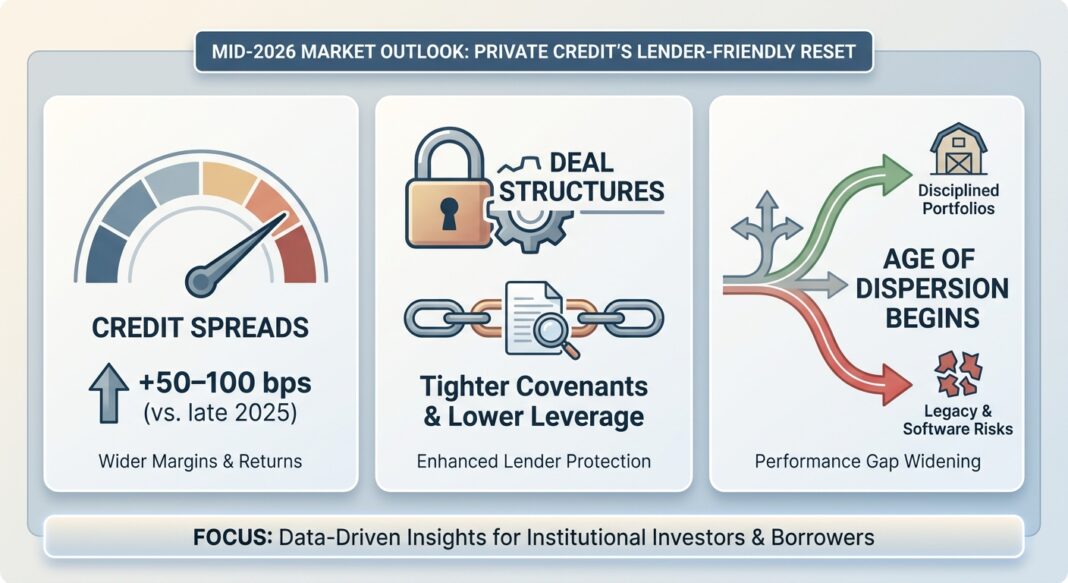
Private Credit’s Lender-Friendly Reset: Spreads Widen, Structures Tighten, and the Age of Dispersion Begins
Market Headline: The Credit Cycle Has Turned, Lenders Are Back in Command
Entering the second half of 2026, private credit markets have executed a meaningful structural pivot. The story is not merely one of spread widening; it is a wholesale reset of underwriting discipline, covenant intensity, and lender selectivity that accelerated sharply through Q1 and Q2. Three compounding forces drove the shift: an AI-driven repricing across software and technology credits that sent secondary spreads in the sector roughly 200 basis points wider since year-end 2025; renewed Middle East geopolitical tension injecting persistent upside inflation risk into Federal Reserve policy; and ongoing tariff and trade uncertainty that suppressed risk appetite across the capital stack.
Per Lord Abbett’s 2026 Midyear Outlook, the market has “reset in a more lender-friendly direction”, with spreads approximately 50–100 bps wider than late 2025 levels, and, critically, new loans increasingly accompanied by fewer payment-in-kind (PIK) requests, tighter documentation, more covenants, and lower leverage multiples. Simultaneously, the Fed’s April 2026 SLOOS confirmed banks tightened C&I lending standards across firms of all sizes in Q1 2026, with large banks reporting a net tightening of 10.0% on C&I loans to large and middle-market firms, validating private credit’s structural demand tailwind. For lenders with dry powder and the discipline to deploy it selectively, midyear 2026 represents one of the more constructive entry environments since the post-rate-hike dislocation of 2022–2023.
Quantitative Market Snapshot
📊 Key Market Metrics: Midyear 2026
| Metric | Current Value | Prior Period | Direction | Source |
|---|---|---|---|---|
| Direct Lending 1st Lien Spreads (vs. late 2025) | +50–100 bps wider | Late 2025 baseline | ▲ Widening | lordabbett.com |
| S&P Leveraged Loan Index Spread | ~487 bps | ~430–450 bps (mid-2025) | ▲ Near widest since Apr. 2025 | abfjournal.com |
| Software Sector Secondary Spread Widening (since YE 2025) | ~+200 bps | Year-end 2025 | ▲ Sharp widening | valuationresearch.com |
| Fed SLOOS, Net % Large Banks Tightening C&I Standards (Q2 2026) | 10.0% | ~8.1% (all domestic banks) | ▲ Tightening | fred.stlouisfed.org |
| Private Credit Non-Accrual Rate (Q1 2026, top 20 BDCs) | 1.4–1.53% | ~1.0% long-run avg. | ▲ Modestly elevated | heronfinance.com / sec.gov |
| 3-Month SOFR (anchored, Fed on hold) | ~3.7% | Market had priced ~3.0% by H2 2026 | ▲ Higher for longer | capstonepartners.com |
| Middle Market LBO Leverage, Lower-Middle Market (H1 2025) | 4.0x Debt/EBITDA | 3.7x (2024), 3.6x (2023) | ▲ Creeping higher | capitalpad.com |
| PIK Interest as % of Private Credit Income (Q1 2026) | 3.9% (fund-level); ~8% (public BDCs) | Marginally declining from prior Q | ▼ Slight improvement, still elevated | heronfinance.com / withintelligence.com |
KPI Stress Point, FCCR: Floating-rate borrowers who underwrote new credits on an assumption that SOFR would drift toward 3.0% in H2 2026 are now facing materially heavier debt service. With SOFR anchored near 3.7% and the Fed in a formal rate-pause posture per its April 2026 announcement, fixed-charge coverage ratios (FCCR) are compressing across lower-middle-market portfolios, particularly among credits originated in 2023–2024 with optimistic easing assumptions baked into base cases. Per ABF Journal, lenders should expect covenant headroom to thin materially in H2 2026 on those exposed vintages.
Leverage Comparison, Public vs. Private: The divergence in leverage profiles across market segments remains stark. J.P. Morgan Asset Management data cited by CapitalPad places average leverage at 3.2x Debt/EBITDA for companies under $250M enterprise value, versus 5.9x for companies above $1B, a structural cushion in the lower middle market that partially offsets the elevated rate environment. Meanwhile, the Heron Finance Q2 2026 Benchmark Report confirms that across private credit funds, loan-to-value ratios remain conservative at approximately ~40% LTV, providing a meaningful first-loss cushion even as non-accruals have risen modestly.
Sector Analysis: The Great Bifurcation
🔴 Software & Legacy SaaS: Maximum Lender Caution
The most significant sector-level disruption is concentrated in software and legacy SaaS, where AI disruption risk has fundamentally altered lender underwriting. Per Valuation Research Corp., secondary B-rated loan spreads are approximately 67 bps wider than year-end 2025 across the broadly syndicated market, but software credits have experienced roughly 200 bps of secondary spread widening since December 2025, with lenders requiring an additional ~75 bps premium on new software issuance under current risk-off conditions. In the leveraged loan market, a record $25 billion of software-sector loans now trade below the distress threshold of 80 cents on the dollar, per Morningstar LSTA data cited by SaaStr. The January 2026 Fed SLOOS captured this explicitly: banks reported being significantly less likely to approve C&I loans to firms adversely affected by AI disruption. The distinction that matters for credit underwriting, per Lord Abbett, is between profitable, cash-generative, mission-critical software platforms versus pre-profitability ARR borrowers with AI substitution exposure, two categories that are increasingly being priced very differently.
🟢 Healthcare: Preferred Lender Destination
Healthcare remains one of the most consistently favored sectors for direct lenders in 2026. Demographic tailwinds, non-cyclical cash flow models, and recurring revenue profiles make healthcare credits structurally attractive in a higher-for-longer rate environment. Per Creative Planning, demographic shifts and non-cyclical service models continue to attract lenders seeking stable cash flows, and sector specialization in healthcare is expected to accelerate. The Capstone Partners Q1 2026 Leveraged Finance Report confirms that lower-middle-market healthcare and services businesses with strong recurring revenue are commanding TEV/EBITDA multiples of 8.0x–8.5x: a notable premium over the market average of approximately 7.2x.
🟡 AI Infrastructure & Data Centers: Opportunity With Structural Caveats
AI-related infrastructure (data centers, chips, and cloud buildout) represents one of the most actively discussed capital deployment opportunities in private credit. Per Creative Planning, Morgan Stanley estimates private credit could supply more than half of the $1.5 trillion needed for global data center buildouts through 2028. However, Fair Observer flags a structural concern: in some AI financing arrangements, the same firms act as borrowers, investors, and counterparties within closely linked networks, creating a risk that capital circulates within the system without being fully anchored in external demand. The lender underwriting bar for AI infrastructure is therefore bifurcated: contracted, hyperscaler-backed data center credits are well-received; speculative, pre-revenue infrastructure plays face elevated scrutiny.
🟢 Add-On M&A & Sponsor-Backed Credits: Active, With Selectivity
Add-on acquisitions continued to dominate sponsor activity in Q1 2026, representing 73%–80% of private equity deal flow as platform roll-ups drove the pipeline, per ABF Journal. This deal mix structurally benefits incumbent lenders with existing portfolio company relationships. Meanwhile, hybrid ABL–cash-flow structures are gaining traction: asset-based lending and cash-flow private credit disciplines are converging into structures that layer a collateral-backed revolver beneath a cash-flow term loan, giving sponsors larger, cheaper secured tranches while preserving cash-flow capacity, though at the cost of nudging entry leverage and complexity higher.
🔴 Legacy 2021–2022 Vintage Portfolios: Elevated Watch Risk
Portfolios with meaningful exposure to pre-2022 vintage credits face compounding headwinds. Per Valuation Research Corp., these portfolios continue to include companies characterized by elevated leverage, constrained interest coverage, and near-term maturities. The BDC sector faces an additional structural pressure: 23 out of 32 rated BDCs have unsecured debt maturing in 2026, totaling $12.7 billion, a 73% increase over 2025, per Moody’s data cited by SaaStr. The interaction of a BDC maturity wall, rising non-accruals, and elevated PIK usage creates a multi-front pressure test for managers who prioritized asset growth over underwriting discipline in prior cycles.
Implications: For Borrowers and Institutional Investors
For Borrowers
The borrower-friendly era that characterized 2023–2025 (when abundant dry powder chased limited deal flow, compressing spreads and loosening documentation) has structurally closed. As Lord Abbett notes, spreads have ground tighter, leverage moved higher, and loan documents became more flexible in that prior period, conditions that no longer prevail. Today’s new originations come with tighter covenants, more documentation, and fewer PIK concessions. Borrowers should expect: (1) materially higher all-in financing costs versus 2024 refinancings, given SOFR anchored near 3.7% plus wider credit spreads; (2) lender scrutiny of AI-related business model disruption risk as a standalone underwriting category per the Fed SLOOS; and (3) reduced availability of dividend recapitalizations, which Capstone Partners projects will be more difficult and expensive to execute in Q3–Q4 2026. Borrowers with strong FCCR coverage, durable recurring revenue, and clear AI positioning will access capital on demonstrably better terms than those without.
For Institutional Investors and Lenders
For new capital being deployed today, the entry conditions are among the most structurally attractive since 2022–2023. Lord Abbett frames the opportunity clearly: more deal flow from improving M&A, wider spreads, and, most importantly, better credit structures. Dry powder holders with the discipline to say no can now be highly selective across a larger opportunity set. The critical risk for allocators, however, is manager selection: the performance gap between disciplined lenders and those carrying concentrated 2021–2022 vintage software exposure is widening rapidly. The Heron Finance Q2 2026 Benchmark Report confirms that fund-level leverage has increased to approximately 1.0x: a level that remains manageable but warrants monitoring, particularly as it approaches the 1.2x threshold where losses can amplify meaningfully. Allocators should stress-test exposure to semi-liquid vehicles (non-traded BDCs, interval funds) that faced redemption pressure in Q1 2026, and assess commitment availability from financing partners operating under capital constraints.
Crucially, the regulatory backdrop has shifted in ways that may have long-term competitive implications. On December 5, 2025, the OCC and FDIC jointly rescinded the 2013 Interagency Guidance on Leveraged Lending, per Chambers & Partners, giving both private credit lenders and banks greater flexibility to define their own leveraged lending risk appetite. This deregulatory move could sharpen competitive dynamics between bank-originated syndicated credit and private direct lending in the large-cap segment, while potentially expanding the universe of credits that disciplined direct lenders can competitively underwrite in the core middle market.
Forward-Looking View: Liquidity and Lending Dynamics, H2 2026
The next 3–6 months will be defined by a three-variable stress test playing out simultaneously across the private credit ecosystem. First, FCCR compression in the lower middle market will become more visible as borrowers underwritten on easing assumptions report covenant compliance in H2 filings. Second, portfolio differentiation by manager will accelerate: non-accruals, PIK usage, software sector concentration, and 2021–2022 vintage exposure will increasingly separate high-discipline managers from the field. Third, the $12.7 billion BDC maturity wall: arriving precisely as portfolio quality is under review, represents a funding test that will pressure vehicle-level economics for the most exposed BDC franchises.
The constructive offset is real and data-supported. Moody’s notes that average credit risk indicators point to easing defaults through mid-2026, with the broadly syndicated loan default rate (excluding liability management exercises) at just 1.44% as of March 2026, far from cycle stress levels. The Heron Finance benchmark confirms that roughly 90% of private credit loans are first-lien at conservative ~40% LTV, meaning realized losses are expected to remain near the asset class’ ~1% annual historical loss rate even as non-accruals tick upward. Private credit AUM is on track to surpass $2 trillion in 2026 and grow toward $4 trillion by decade-end, per Moody’s, structural demand from insurers, pension funds, and sovereign allocators remains intact.
The market’s trajectory in H2 2026 will be most directly shaped by two binary outcomes: whether the Federal Reserve pivots toward any rate relief (which would ease FCCR compression and refinancing pressure) and whether AI-driven disruption fears in software stabilize or deepen. Until either of those variables resolves, patient capital, disciplined underwriting, and first-lien structural positioning are the clearest competitive advantages available to participants in this market.
💡 Key Market Insights for Bond Capital Readers
- Spreads are wider AND structures are better, a rare double benefit for new deployment: Direct lending 1st lien spreads are approximately 50–100 bps wider than late 2025, and new credits are coming with tighter covenants, lower leverage, and fewer PIK concessions. This structural improvement may matter more to long-run risk-adjusted returns than the price move alone. (Lord Abbett)
- Bank tightening is a structural tailwind for direct lenders, confirmed by Q2 2026 SLOOS data: The Fed’s Q2 2026 SLOOS shows a net 10.0% of large banks tightening C&I lending standards, and tighter standards were also reported for non-depository financial institution (NDFI) loans, including to private equity funds. The bank pullback is systematic, not episodic. (FRED / Fed SLOOS)
- FCCR is the critical operating KPI to monitor in H2 2026: With SOFR anchored near 3.7% and the Fed on hold, borrowers underwritten on a declining-rate assumption face materially higher debt service than projected. Lenders should audit covenant headroom across the 2023–2024 vintage cohort proactively. (ABF Journal)
- Software is a sector-specific credit event, not an asset-class indictment, but manager selection is paramount: The performance gap between disciplined lenders and those with concentrated legacy software exposure is widening into a chasm. Non-accruals, PIK ratios, and 2021–2022 vintage exposure should be the primary due diligence filters for any new allocation to private credit. (Lord Abbett / Heron Finance)
- The regulatory unlock of leveraged lending guidelines creates two-sided competition risk: The December 2025 OCC/FDIC rescission of the 2013 Leveraged Lending Guidance gives both banks and private credit lenders more flexibility to compete at deeper leverage levels. In the large-cap segment, this may re-intensify bank competition. In the core middle market ($20M–$100M EBITDA), direct lenders with speed, flexibility, and relationship depth retain decisive structural advantages. (Chambers & Partners)


