
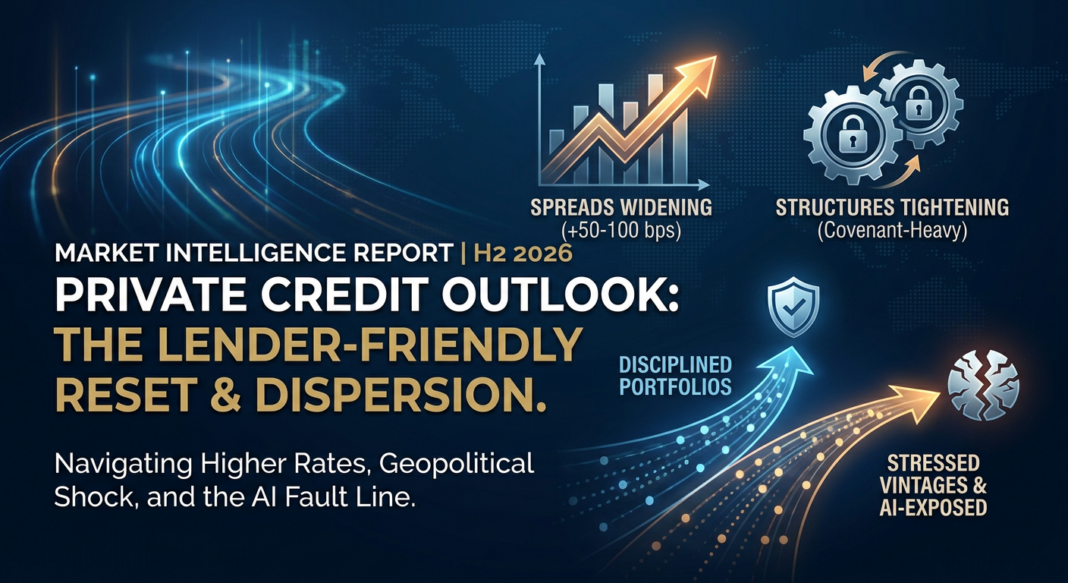
Market Headline: The Reset Is Real, And It Favors Discipline Over Volume
As of 30 June 2026, the U.S. private credit market is navigating one of its most consequential structural inflection points since the asset class emerged from the 2008 financial crisis. Three converging forces (geopolitical shock, AI-driven sector reassessment, and a wave of retail redemptions) have dismantled the borrower-friendly conditions that defined late 2024 and early 2025, and replaced them with a markedly more lender-friendly environment. According to Lord Abbett’s 2026 Midyear Outlook, spreads have widened roughly 50 to 100 basis points since late 2025, while new loans are increasingly structured with less leverage, more covenants, and tighter documentation, a combination that may make today’s entry point more attractive for disciplined lenders than the compressed conditions that prevailed just six months ago.
The macro backdrop complicates the picture. Valuation Research Corp.’s Q2 2026 Private Markets report confirms that headline CPI rose to approximately 4.2% in May, with core PCE at 3.4%, well above the Federal Reserve’s 2% target, while the Fed held its funds rate at 3.50%–3.75% in Q1, signaling a prolonged higher-for-longer posture. Hamilton Lane notes that private credit spreads have re-entered the SOFR+500 context, up from the mid-400 bps range prior to the February 2026 U.S.-Iran military conflict. The second half of 2026 will be defined less by asset-class headlines and more by manager-level dispersion: separating portfolios with credit discipline from those exposed to 2021–2022 vintage stress, covenant-lite structures, and AI-disrupted software credits.
Quantitative Market Snapshot
The table below synthesizes current pricing, credit quality, and structural data across public and private credit markets as of late Q2 2026.
| Metric | Current Value (Q2 2026) | Prior Period | Change / Direction | Source |
|---|---|---|---|---|
| Private Credit (Direct Lending) Unitranche Spread | SOFR + 475–550 bps (coupon) | SOFR + 450–525 bps (YE 2025) | +~25 bps wider | VRC Q2 2026 |
| Middle Market All-In Private Credit Spreads vs. Late 2025 | +50–100 bps wider than late 2025 | Compressed / borrower-friendly (late 2025) | ↑ Widening | Lord Abbett Midyear 2026 |
| B-Rated Secondary Loan Spreads (Broadly Syndicated) | +43 bps wider than YE 2025; ~20 bps inside Q1 peak | YE 2025 baseline | ↑ Widening (moderated from Q1 peak) | VRC / PitchBook LCD (June 19, 2026) |
| Software Sector Secondary Spreads | ~245 bps wider than YE 2025; ~229 bps above broader B-rated index | In-line with B-rated index at YE 2025 | ↑↑ Severe dislocation | VRC / PitchBook LCD (June 19, 2026) |
| Investment-Grade Corporate OAS | ~80 bps; BBB ~100 bps; AA ~50 bps | Historically tight early 2026 | → Historically tight | InvestmentGrade.com, 2026 |
| High Yield Bond Spreads (OAS) | ~285 bps | Modestly wider vs. early 2026 | ↑ Modest widening | InvestmentGrade.com, 2026 |
| Fed SLOOS, Net % Banks Tightening C&I Standards (Large/Mid-Market Firms) | 8.1% (Q2 2026); 10.0% for large domestic banks | Tighter in Q1 2026 (Jan SLOOS: tighter on net) | ↑ Continued tightening bias | FRED / Federal Reserve SLOOS Q2 2026 |
| Leveraged Loan Payment Default Rate (LTM by Issuer Count) | 1.42% (May 31, 2026) | 1.24% (May 2025) | ↑ Rising but below long-term avg. | PitchBook LCD / Morningstar LSTA (May 2026) |
| Leveraged Loan Dual-Track Default Rate (incl. LMEs) | 3.11% (May 31, 2026) | 4.36% (May 2025); 2.84% (April 2026) | ↑ Month-on-month; ↓ year-on-year | PitchBook LCD (June 2026) |
| Distress Ratio (Loans Below 80¢) | 7.23% (end-March 2026), 3-year high | 4.34% (December 2025) | ↑↑ Sharp deterioration, leading indicator | PitchBook LCD / Yahoo Finance (April 2026) |
| Direct Lending BDC Redemption Requests (Non-Traded, Q1 2026) | Avg. 9%–10% of NAV (exceeding 5% caps) | 4.5% of NAV (Q4 2025); 1.6% (Q3 2025) | ↑↑ Sharp acceleration | CNBC / Fitch Ratings (March 2026) |
| Healthcare, Direct Lending Spread (Q4 2025) | ~SOFR + 500 bps (no significant tightening in 2025) | Broadly in line with prior year | → Resilient vs. other sectors | Octus Data (2026 Outlook) |
Key KPI Context, FCCR & Leverage: Lincoln International has documented that lenders are now underwriting to a forward-looking Fixed Charge Coverage Ratio (FCCR) that incorporates rate expectations, directly constraining maximum supportable leverage. Many companies whose interest expense has effectively doubled since early 2022 are seeing their FCCR compress materially. Industry practitioners note that if an FCCR falls below 1.1x under a 100 bps rate shock scenario, covenant structures may fail to provide adequate early warning, a risk concentrated in borrowers with heavy PIK reliance, where PIK exclusions can mask true fixed-charge deterioration. The April 2026 SLOOS further confirms that banks tightened covenants, collateralization requirements, and premiums on riskier C&I loans even while selectively easing spreads over cost of funds for large firms.
Sector Analysis: Winners, Losers, and the AI Fault Line
🔴 Technology & Software: Acute Repricing Underway
Software is the most consequential fault line in today’s credit markets. Secondary spreads on software credits are approximately 245 bps wider than year-end 2025 levels and roughly 229 bps above the broader B-rated loan index (PitchBook LCD, June 19, 2026), reflecting AI-driven disruption concerns catalyzed by Anthropic’s Claude agent announcement in February 2026. Private leveraged finance markets carry a materially higher allocation to software, approximately 20%, versus roughly 13% in the broadly syndicated loan market, according to Lord Abbett / PitchBook data. The stress is vintage-specific: a large cohort of enterprise software transactions financed between 2019 and 2022 (when rates were near zero and AI disruption was not an underwriting concern) is now under pressure. Hamilton Lane warns that while AI disruption has yet to produce systemic bankruptcies, outcomes will be company-specific. Mission-critical, deeply entrenched software with long-term contracts and lower LTVs is defensible; commodity software models with seat-based or broad-access pricing are most at risk. Structural implication: lenders are evaluating AI-exposed borrowers case-by-case, tightening leverage availability and demanding more conservative FCCR headroom.
🟢 Healthcare: Volume Leader, But Emerging Stress Pockets
Healthcare led all sectors for direct lending activity in 2025, accounting for 19% of all 2025 direct lending deals per Octus Data, and was the only major sector that did not see meaningful year-over-year spread compression, landing at an average of approximately SOFR+500 bps in Q4 2025. Large strategic take-privates continue to validate institutional appetite, Blackstone and TPG’s $18.3 billion acquisition of Hologic (PwC, 2026 Mid-Year) signals continued sponsor interest in healthcare platforms. However, caution is warranted: healthcare providers and services accounted for 14% of leveraged loan LMEs in the last 12 months per PitchBook LCD, making it the leading sector by LME share. Highly leveraged healthcare roll-ups, the dominant M&A sub-strategy in the sector, are specifically flagged as vulnerable by credit analysts.
🟡 Infrastructure, Energy & AI Data Centers: Capital Accumulating
PwC’s Global Private Markets Mid-Year 2026 report highlights that private credit AUM now exceeds $2.2 trillion and is forecast to reach $4.5 trillion by 2030 (Preqin), with infrastructure debt as a primary growth vertical. Morgan Stanley estimates private credit could supply more than half of the $1.5 trillion needed for global data center buildouts through 2028. In the Middle East conflict aftermath, lenders are also tightening underwriting for energy-intensive industrials and manufacturing businesses whose leverage was predicated on stable energy costs (Capstone Partners Q1 2026), creating relative value in energy transition infrastructure with stable contracted cash flows.
🟡 Aerospace, Defense & Government Services: Quiet Bright Spot
While the broader capital goods sector saw direct lending volume decline to approximately 13% of deal flow from 15% in 2024, Octus sources identified aerospace, defense, and government services as a bright spot, with elevated M&A activity in late 2025 carrying into 2026. The geopolitical environment is structurally supportive of defense procurement pipelines, driving lender appetite for credits with government contract visibility and predictable revenue.
🔴 Retail, Consumer Cyclicals, and Energy-Cost-Sensitive Industrials: Headwinds
Consumer credit demand is weakening, the April 2026 SLOOS (Federal Reserve) reported modest net shares of banks tightening standards on other consumer loans, with demand for credit card, auto, and consumer loans weakening broadly. Hamilton Lane notes the U.S. unemployment rate rose to 4.4% in February 2026, and a softening labor market threatens EBITDA at consumer-exposed companies. North American PE-sponsored M&A volumes declined meaningfully in 2026, with June deal activity 52.3% below January levels per VRC, reflecting higher financing costs and macro uncertainty.
Implications for Institutional Investors and Business Operators
For Borrowers / Business Operators
The benign borrower environment of 2024–early 2025 has definitively ended. Unitranche coupon spreads have risen to a general range of 4.75%–5.50%, approximately 25 bps above year-end 2025 levels, with OIDs holding between 98.75 and 99.25 (VRC Q2 2026). Operators seeking new credit facilities should expect: (1) more rigorous forward-looking FCCR underwriting that stress-tests at least 100 bps above current rates; (2) maintenance covenants making a comeback in documentation, fewer PIK requests and tighter loan documents; and (3) heightened scrutiny on AI exposure and EBITDA add-backs, particularly for software-adjacent businesses. Companies in energy-intensive sectors face additional leverage compression as lenders price in volatile energy cost assumptions. Operators with robust free cash flow, first-lien security, and non-cyclical demand characteristics remain in a strong negotiating position, particularly in the core middle market where private lenders retain documentation leverage. The OCC/FDIC’s December 2025 rescission of the 2013 Interagency Leveraged Lending Guidance introduces regulatory flexibility, but disciplined lenders are unlikely to loosen credit policy in the current cycle.
For Institutional Investors and Lenders
The structural reset creates a materially more favorable entry point for new capital deployment. More deal flow, wider spreads, and improved documentation represent a constructive combination, but only for managers with genuine underwriting discipline and the willingness to decline marginal credits. McKinsey’s Global Private Markets Report 2026 notes that the top 25 managers now account for approximately 72% of total fundraising, reinforcing capital concentration with scaled platforms that have origination depth and sponsor relationships. Retail-oriented and semi-liquid vehicles face a distinct risk: non-traded BDC redemption requests averaging 9%–10% of NAV in Q1 2026, well above the 5% quarterly cap, create a liquidity mismatch that can force asset sales at depressed marks, amplifying portfolio stress. The FSB’s May 2026 vulnerability report specifically flags valuation opacity, multi-layered leverage structures, and sector concentration (technology, healthcare, services) as systemic risks requiring closer regulatory monitoring. Investors should monitor non-accrual rates, PIK usage, and vintage-year exposure, particularly 2021–2022 cohorts, as the most reliable leading indicators of portfolio quality divergence in H2 2026.
Forward-Looking View: H2 2026 and Into 2027
The six-month forward default rate estimated by the PitchBook LCD Default Predictor stands at 1.86% by issuer count (September 2026), marginally above the current 1.42%, a contained but directionally rising trajectory. The distress ratio reaching a 3-year high of 7.23% by end-March is a more concerning leading indicator that warrants active monitoring. VRC Q2 2026 notes that as banks gradually re-enter the upper middle market in June 2026, upward spread pressure is moderating, with deal activity recovering approximately 10.7% year-over-year in middle market PE and exit activity rising 14%. The forward SOFR curve remains approximately 50 bps above year-end 2025 levels, anchoring all-in yields for direct lending in the high single-digit range, attractive by historical standards, with Morgan Stanley estimating asset yields on directly originated first-lien loans will trough in the 8.0%–8.5% range even after modest spread compression. Asset-backed finance and credit secondaries are the fastest-growing sub-strategies absorbing institutional capital away from compressed core direct lending, a structural diversification trend that will define the market’s evolution toward 2027.
Key Market Insights
- Spread widening is real and structural, not cyclical: Private credit spreads are 50–100 bps wider than late 2025 and approaching SOFR+500: driven by geopolitical risk, AI reassessment, and selective capital deployment. This is a lender-friendly reset, not a credit crisis signal.
- FCCR is the new gating metric: Lenders are stress-testing forward-looking FCCR at 100+ bps rate shocks. Borrowers with FCCR below 1.1x under stress scenarios face leverage constraints and documentation demands; those with robust free cash flow generation hold negotiating leverage.
- Software credit is in active repricing, watch the vintage: Spreads on software names are ~245 bps wider than YE 2025; 2019–2022 vintage loans with covenant-lite structures and PIK features are the highest-risk cohort. Lenders must evaluate AI exposure at the individual company level, not sector-wide.
- Healthcare remains the volume anchor but demands selectivity: Healthcare led 2025 direct lending by deal count but accounted for 14% of LMEs in the last 12 months. Highly leveraged roll-up structures require fresh FCCR analysis and tighter collateralization; non-cyclical, recurring-revenue healthcare sub-sectors remain well-supported.
- Capital is concentrating, scale and discipline now command a premium: The top 25 private credit managers capture ~72% of closed-end fundraising. Institutional investors should prioritize manager selection on underwriting rigor, vintage diversity, and redemption structure; semi-liquid vehicles with concentrated software or retail-oriented capital bases present the clearest liquidity risk heading into H2 2026.


