
Bond Capital | Market & Sector Intelligence | August 10, 2026
Private Credit’s Lender-Friendly Reset: Spreads Widen, Discipline Returns, and Sector Rotation Reshapes the Market
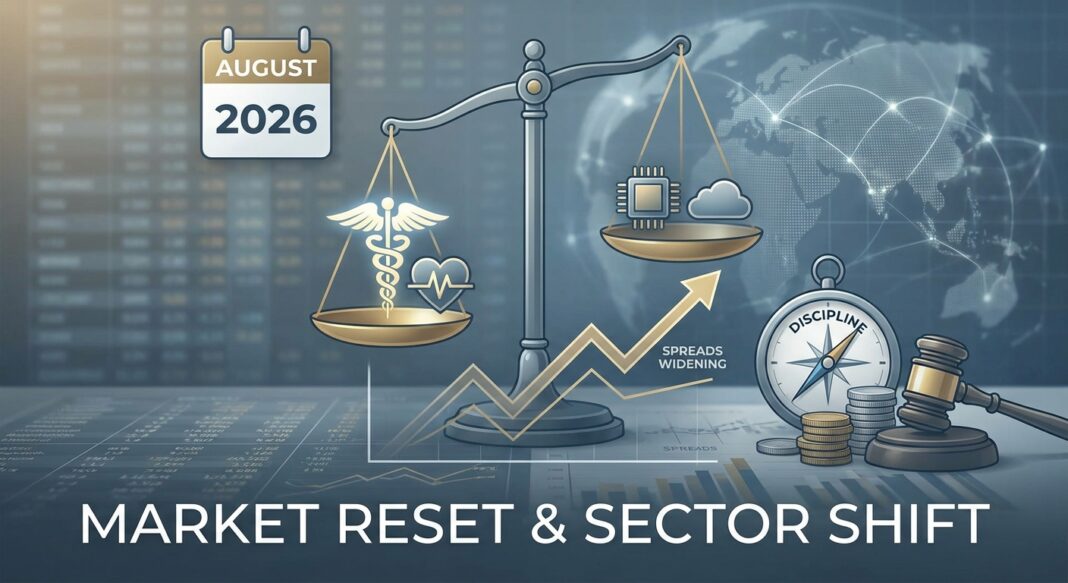
Spreads are 50–100 bps wider than late 2025. Healthcare has displaced software as the dominant lending sector. The Fed SLOOS confirms C&I standards are stable while NDFI loan terms have tightened. For the first time in three years, the structural advantage is migrating back toward disciplined lenders with dry powder.
I. The Main Story: A Lender-Friendly Repricing Takes Hold
Private credit is entering the second half of 2026 in a materially different posture than it held twelve months ago. The asset class, which has grown to roughly $1.3 trillion in the U.S. and is positioned for further expansion, is no longer running on the compressed-spread, covenant-lite, borrower-friendly terms that defined the 2023–2025 cycle. A convergence of macro shocks (geopolitical conflict in the Middle East, AI-driven disruption of software borrowers, elevated redemption pressure in retail credit vehicles, and a sustained higher-for-longer rate environment) has catalyzed a structural repricing.
According to Lord Abbett’s 2026 Midyear Outlook (sourcing PitchBook data), spreads have widened by roughly 50 to 100 basis points since late 2025, while defensive credit terms have also improved. New loans are increasingly coming with better structures: less leverage, more covenants, fewer PIK arrangements, and tighter documentation. This represents a meaningful departure from the lax standards of recent vintages.
The Federal Reserve’s July 2026 Senior Loan Officer Opinion Survey (SLOOS), covering Q2 2026, adds critical regulatory context. On balance, bank lending standards for C&I loans to firms of all sizes were unchanged, while banks reported stronger demand for C&I loans from large and middle-market firms. Separately, banks eased commercial real estate lending standards to the greatest degree since early 2022, suggesting selective risk appetite is returning in CRE. Yet the April 2026 SLOOS revealed a more cautious posture toward nonbank financial institutions (NDFIs): banks reported tighter standards for all categories of NDFI loans over the prior year, including higher risk premiums, stricter covenants, shorter maturities, and lower maximum credit line sizes, directly constraining the leverage available to private credit fund managers themselves.
Together, these forces are creating an environment of structural bifurcation: well-capitalized, disciplined lenders deploying fresh dry powder into wider-spread deals; while managers constrained by legacy portfolios, elevated non-accruals, and redemption-gated vehicles find themselves squeezed from both sides.
II. Quantitative Market Snapshot
The table below consolidates the most current available data across private and public credit markets. All figures reflect Q2 2026 or the most recently published data available as of August 10, 2026.
| Metric | Current Value | Prior Period | Change | Source |
|---|---|---|---|---|
| Direct Lending (Unitranche) Spread | S+475 – S+550 bps | S+425 – S+475 bps (Q4 2025) | +50–100 bps | Lord Abbett / PitchBook, Jun 2026; Nuveen Churchill Q2 2026 Earnings |
| Unitranche All-In Yield | ~9.00% – 9.75% | ~8.50% – 9.25% (Q4 2025) | +~50 bps (swap-adjusted) | Valuation Research Corp. Q2 2026 |
| IG Corporate Bond OAS | +74 bps (Q2 2026 close) | +89 bps (Q1 2026 close) | -15 bps (tightening) | Breckinridge Capital, Q3 2026 Outlook |
| Private Credit vs. Public High Yield Spread Premium | ~150–200 bps | ~350 bps (2019) | Compressed ~150–200 bps vs. historic norms | Owners.PE, Apr 2026 |
| Middle Market Total Leverage (LBO) | 4.0x – 5.0x Debt/EBITDA | 3.6x (FY 2025, LMM) | Modest uptick; below 2021 peak of 6–7x | CT Acquisitions LBO Guide 2026; GF Data / Capital Pad 2026 |
| 3-Month Term SOFR (Base Rate) | 3.68–3.69% | ~3.67% (Q1 2026) | Essentially flat; higher-for-longer | Valuation Research Corp. Q2 2026 |
| Private Credit Default Rate (Fitch) | 6.0% (April 2026) | 9.2% (FY 2025, record) | Declining from peak; stress persists | CryptoBriefing / Preqin, Jun 2026 |
| Private Credit Fundraising (Jan–Apr 2026) | $45B in commitments | $44.5B (Jan–Apr 2025); $52.2B (Jan–Apr 2023) | Flat YoY; down vs. 2023 pace | Preqin via CryptoBriefing, Jun 2026 |
KPI Benchmarks: What Lenders Are Demanding in 2026
Beyond spread pricing, underwriting discipline is being expressed through tighter KPI thresholds. VRC’s Q2 2026 update notes that unitranche coupon spreads now generally range from 4.75% to 5.50%: approximately 25 bps above year-end levels, with OIDs holding steady between 98.75 and 99.25 for standard transactions. Subordinated issuance remains limited, reflecting investor preference for senior exposures. Current LBO market conventions set senior leverage at 3–4x EBITDA and total leverage at 4–6x (down materially from the 6–7x peaks of 2021), with all-in senior debt pricing running approximately SOFR + 450–650 bps, or roughly 9–11% all-in. Lenders are increasingly requiring minimum Fixed Charge Coverage Ratios (FCCR) of 1.10x–1.25x for new credits, with weaker borrowers subject to more aggressive covenant packages.
III. Sector Analysis: The Great Rotation from Software to Healthcare
The most structurally significant shift in 2026’s private credit market is the displacement of software/technology as the dominant sector and the rise of healthcare lending. This rotation is not a temporary blip; it reflects a fundamental reassessment of AI-driven disruption risk embedded in enterprise software borrowers.
Healthcare: New Market Leader
According to PitchBook LCD data, healthcare has claimed the top spot in institutional loan issuance for the first time since 2015, accounting for 14% of volume so far in 2026. PitchBook’s US Private Credit Monitor corroborates this, showing healthcare making up 22% of direct lending issuance YTD through March, up from 18% in 2025, while tech’s share slipped to 14% from 18%. Healthcare’s appeal lies in demographic-driven demand and non-cyclical service models that provide stable, predictable cash flows. Critically, healthcare was the only major sector not to see significant year-over-year price tightening in 2025, with spreads averaging approximately SOFR+500 bps in Q4 2025: an implicit premium that reflects both structural demand and elevated leverage risk.
However, lenders must navigate a nuanced risk within healthcare itself. MSCI data shows that 7.0% of healthcare loans were marked below 80 cents on the dollar at year-end 2025, up from 4.5% eighteen months earlier. Morgan Stanley’s private credit team accordingly maintains a significant underweight to healthcare, noting it has led all sectors in loans placed on non-accrual status over the last year. The divergence in views between healthcare bulls and bears underscores the market’s deepening bifurcation.
Software/Technology: Structural Headwinds Persist
Software’s retreat from dominance is sharp and well-documented. Software’s share of broadly syndicated loan issuance fell to just 8.8% YTD, down from 17.6% in 2025 and its lowest level since 2013. Secondary spreads for software credits are approximately 245 basis points wider than year-end levels and roughly 229 bps above the broader B-rated loan index (PitchBook LCD, June 2026), reflecting ongoing concern over AI-driven revenue disruption. Capstone Partners notes that AI risk assessment has become a critical analytical component in underwriting, lenders are now explicitly modeling AI substitution risk before extending credit to any technology-dependent borrower.
The nuanced view, from Lord Abbett’s midyear analysis, is that not all software exposure should be treated equally. Profitable, cash-generative, mission-critical software businesses differ meaningfully from pre-profitability ARR borrowers or companies vulnerable to AI substitution. Lenders capable of making that distinction will capture spread premium without shouldering undue impairment risk.
Energy-Intensive Industrials: Geopolitically Constrained
The Q1 2026 military operation against Iran introduced a new variable into credit underwriting. Lenders have responded by tightening underwriting standards for energy-intensive industries whose leverage was predicated on stable energy input costs. Elevated oil and transportation costs are compressing EBITDA forecasts for manufacturers, logistics operators, and consumer-facing businesses, directly eroding interest coverage ratios and creating FCCR violations in portfolios with pre-conflict underwriting assumptions.
Infrastructure and AI Data Centers: Emerging Opportunity
Morgan Stanley estimates private credit could supply more than half the $1.5 trillion needed for global data center buildouts through 2028. This represents one of the clearest secular tailwinds in private lending: large-ticket, long-duration, asset-backed infrastructure financing where private capital holds structural competitive advantages over broadly syndicated markets.
IV. Implications for Institutional Investors and Business Operators
For Institutional Investors and Lenders
The current environment structurally favors well-capitalized, institutional-grade managers with available dry powder. Periods of market volatility typically see banks and liquid credit markets retrench, with private equity sponsors turning to private credit for execution certainty. Managers who avoided over-leveraged 2021–2022 vintage credits are now able to deploy into 50–100 bps wider spreads with meaningfully improved documentation and covenant protection.
The most durable advantage in this environment may come from better documentation, more conservative leverage, and the time to conduct stress analysis before capital is deployed. Key portfolio health indicators to monitor include: non-accrual rates, PIK usage levels, 2021–2022 vintage exposure concentration, and sector weights in software and healthcare. Refinancing risk, sector selection, and borrower quality (not expectations of lower rates or an M&A rebound) are likely to define credit market performance in H2 2026.
Investors should also monitor redemption dynamics across BDC and semi-liquid vehicles. Approximately $1.8 billion was withdrawn from the ten largest direct lending funds in Q1 2026, with many funds operating at their 5% contractual redemption caps. Several major managers (including BlackRock, Morgan Stanley, Cliffwater, and Stone Ridge) enforced redemption gates in Q1 2026, with at least one manager proceeding with full fund liquidation. Liquidity risk deserves explicit allocation in any private credit manager evaluation framework.
For Business Operators and Borrowers
The borrower environment is bifurcating rapidly. High-quality borrowers continue to attract aggressive lender bids, tight spreads, and covenant-lite terms. Marginal credits will face wider spreads, tighter structures, and a much smaller pool of willing capital providers.
Operationally, the key pressure point is FCCR compression. With all-in floating-rate costs running 9–11% on senior debt and base rates anchored near 3.7% SOFR, operators need to demonstrate minimum 1.10x–1.25x fixed charge coverage to satisfy lender covenants, a threshold that requires consistent EBITDA performance across volatile input-cost environments. Businesses in energy-intensive sectors should proactively model coverage scenarios at oil price stress levels before approaching the credit market. For software companies, lenders now require explicit AI-disruption analysis as part of the credit memo, operators should prepare detailed competitive positioning documentation addressing AI substitution risk head-on.
Direct lending continues to generate high single-digit unlevered asset returns, maintaining an attractive premium relative to public credit. For borrowers who qualify, execution certainty and structural flexibility remain compelling reasons to favor private credit over broadly syndicated alternatives, particularly for transactions requiring speed or bespoke structuring.
V. Forward-Looking View: H2 2026 and Beyond
The second half of 2026 is likely to be defined by dispersion. The macro setup (elevated rates, geopolitical energy risk, AI disruption, and compressed fundraising) will continue to compress performance among managers with legacy portfolio issues. At the same time, new deal economics have improved materially, and management at leading BDCs are now citing wider spreads and reduced competition in direct lending as a positive signal for deployment.
The July 2026 SLOOS confirms that banks report stronger C&I loan demand from large and middle-market firms, while green shoots are emerging in CRE lending standards, both signals that institutional borrowing appetite is recovering even as consumer credit remains mixed. This should support gradual M&A volume improvement into Q3–Q4 2026, driving fresh origination opportunities for private lenders.
Structurally, Morgan Stanley’s private credit team expects new deal demand together with a large refinancing wave to gradually overtake private credit supply, creating an imbalance that allows disciplined lenders to preserve terms and capture the full illiquidity premium to public markets. For European exposure specifically, Basel IV implementation is expected to accelerate a shift away from bank lending, currently around 70% of total lending in Europe, toward private debt funds, opening a significant structural opportunity for U.S.-based managers with pan-Atlantic mandates.
VI. Key Market Insights: August 2026
- Spread Widening Is Real and Structural: Direct lending spreads are 50–100 bps wider than late 2025 (PitchBook/Lord Abbett), with unitranche all-in yields now running 9.00%–9.75% (VRC Q2 2026). This is not temporary volatility; it reflects a durable repricing of risk, improved documentation standards, and reduced competition from redemption-constrained peers.
- Healthcare Has Dethroned Software, But With Caveats: Healthcare commands 22% of direct lending issuance YTD (PitchBook LCD), but 7.0% of healthcare loans are already marked below 80 cents on the dollar (MSCI). Sector-level optimism must be paired with sub-sector and vintage-specific credit analysis.
- The Fed SLOOS Signals a Stable-But-Selective Bank Posture: C&I standards are unchanged (July 2026 SLOOS), but banks have materially tightened terms for all NDFI loan categories, directly limiting the leverage available to private credit fund managers and constraining fund-level returns.
- AI Disruption Risk Is Now a Core Underwriting Variable: Software’s share of BSL issuance has collapsed to 8.8% (down from 17.6% in 2025), and secondary software spreads are 245 bps above the broad B-rated loan index. Any credit with significant software or tech-services revenue exposure now requires explicit AI-disruption scenario analysis in the credit memo.
- Bifurcation Will Intensify Before It Narrows: High-quality borrowers with strong FCCRs, conservative leverage (<4.5x), and sector tailwinds will continue to access competitive capital. Marginal credits (particularly 2021–2022 vintages in software, consumer products, and energy-intensive industrials) face widening spreads, tighter covenant packages, and an increasingly narrow lender universe.


