
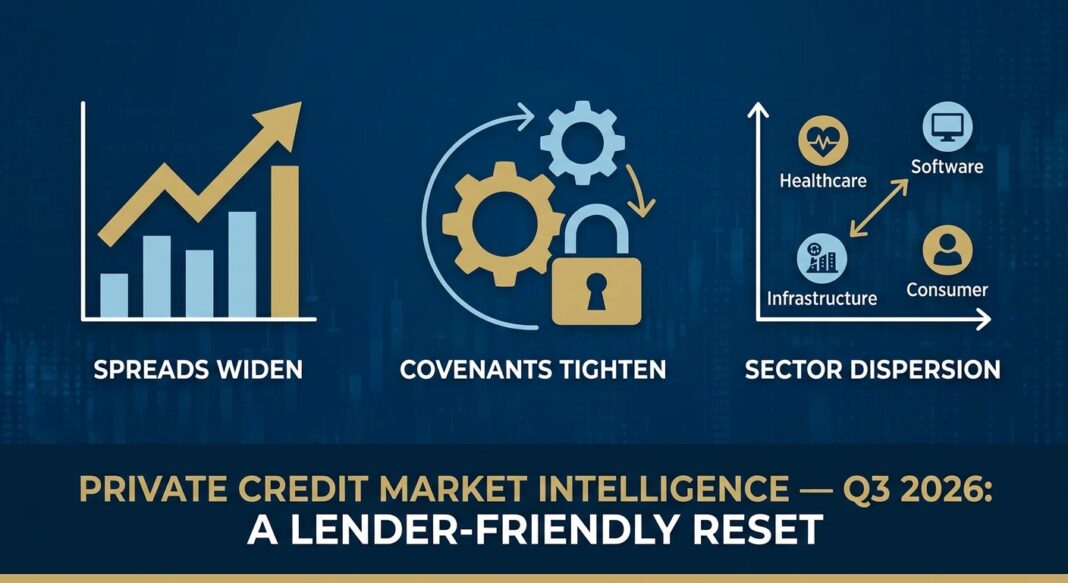
Market Headline: A Lender-Friendly Reset Takes Hold, But Credit Stress Is Rising in the Seams
As of late September 2026, the private credit market is navigating one of its most consequential inflection points since the post-GFC expansion of direct lending. The macro-to-micro story is clear: a regime shift from borrower-friendly spread compression to a lender-friendly reset is underway: driven by geopolitical shocks, AI-related sector disruption, redemption pressure in semi-liquid vehicles, and a Federal Reserve that has kept rates structurally elevated longer than markets anticipated.
Spreads have widened by roughly 50 to 100 basis points higher since late 2025, according to PitchBook data cited by Lord Abbett. Yet the spread move is not the whole story. New loans are increasingly coming with better credit structures: less leverage, more covenants, fewer PIK requests, and tighter documentation. This structural improvement is the more durable signal for institutional capital.
At the same time, stress is surfacing in seasoned portfolios. Non-accruals across the BDC universe averaged 2.1% of total debt through year-end 2025, but in Q1 2026 the rate jumped to 3.3%, up 116 basis points from the prior quarter and 130 points from the year-ago period, per Morningstar data. While the headline default rate in private credit has remained below 2% for several years, once selective defaults and liability management exercises are taken into account, the “true” default rate approaches 5%, according to With Intelligence.
The broad view (a constructive backdrop for private credit, supported by improving M&A activity, normalizing rates, and a market moving back toward lender discipline) still holds at midyear. But the market is bifurcating sharply by sector, vintage, and manager quality, making origination discipline the definitive competitive variable for the remainder of the year.
Quantitative Market Snapshot: As of 27 September 2026
| Metric | Current Value | Prior Period | Change | Source |
|---|---|---|---|---|
| Middle Market Private Credit Spread (Unitranche) | SOFR + 475–550 bps | SOFR + 450–525 bps (Q4 2025) | +~25 bps | VRC Q2 2026 |
| Core Middle Market Spread (Senior Secured) | SOFR + 500 bps | SOFR + 425–450 bps (mid-2025) | +50–75 bps | Hamilton Lane 2026 |
| 3-Month Term SOFR | ~3.68–3.69% | ~3.67% (Q1 2026) | +1 bp QoQ | VRC Q2 2026 |
| 5-Year U.S. Treasury Yield | ~4.23% | 3.92% (March 2026) | +31 bps | VRC Q2 2026 |
| High Yield (HY) Bond Spread (OAS) | ~280 bps | ~308 bps (March 2026) | Tightened ~28 bps | StreetStats / ICE BofA, Sept 24, 2026 |
| Investment-Grade (IG) Bond Spread (OAS) | ~79 bps | ~82 bps (March 2026) | Slight tightening | StreetStats / ICE BofA, Sept 24, 2026 |
| Private Credit Illiquidity Premium vs. Public Credit | 200–400 bps excess return | Consistent across cycles | Stable | SG Analytics / Ares 2026 |
| BDC Non-Accrual Rate (at Cost) | 3.3% (Q1 2026) | 2.1% avg (3-yr prior period) | +116 bps QoQ | Morningstar, Aug 2026 |
| Private Credit Leveraged Loan Distressed Ratio | 6.1% (July 2026) | 4–5% (most of 2025) | +100–210 bps | Fitch / Angel Investors Network, Aug 2026 |
| Software Sector Secondary Spread Premium vs. B-Rated Loan Index | ~229 bps wide | Near parity (year-end 2025) | +229 bps | PitchBook LCD via VRC, June 2026 |
| Direct Lending Market Size (U.S.) | ~$1.5–$2 trillion | ~$1.5 trillion (2025) | Approaching parity with BSL market | Cleary M&A Watch, Feb 2026 |
| Direct Lending Share of Private Debt Fundraising | 31% (Q1 2026) | 58.4% (2024) | −27.4 pp: rotation to ABF, infra, special sits | Wellington / PitchBook via Manhattan Private Credit |
Key KPI Context for Underwriters
- FCCR Floors: As SOFR has declined from its 2023 peak and EBITDA recovery accelerates among PE-backed borrowers, lenders are increasingly requiring Fixed Charge Coverage Ratios (FCCR) above 1.2x–1.5x at close for new credits, with EBITDA-to-interest coverage ratios moving modestly higher per Morgan Stanley’s Private Credit Outlook.
- Leverage Caps: Years of low rates and abundant capital created an environment where lenders accepted higher leverage multiples; now, with rates elevated and economic growth uncertain, those leverage levels are being tested. Lenders are applying more conservative leverage underwriting in 2026, with covenants increasingly maintenance-based rather than incurrence-only.
- PIK Warning Signal: Payment-in-kind (PIK) usage has risen notably in private credit in recent years, with public BDCs now receiving an average of 8% of investment income via PIK, a leading indicator of forward credit stress.
- Bank C&I Lending Standards: The July 2026 SLOOS (covering Q2 2026) showed banks reported basically unchanged standards for C&I loans to firms of all sizes, while banks generally reported easier standards and stronger demand for C&I loans from large and middle-market firms. For C&I loans, banks reported that the current level of standards is easier than the midpoint of their historic ranges since 2005.
Sector Analysis: Lender Appetite, Structural Shifts, and the Dispersion Trade
Healthcare: The Perennial Anchor
Healthcare, a longtime favorite of private credit, was the only industry not to see significant year-over-year price tightening in 2025, with spreads landing at an average of approximately SOFR+500 bps in Q4 2025, according to Octus data. In healthcare, demographic shifts and non-cyclical service models continue to attract lenders seeking stable cash flows into 2026. That said, portfolio-level differentiation within healthcare is critical: healthcare technology as a sub-sector experienced a decline of approximately 33.8% in equity performance year-to-date through June 2026, per VRC data, reflecting divergent disruption risk within the broader category.
Software & Technology: Risk-Off and Repricing
Software sector secondary spreads are approximately 245 basis points wider than year-end levels and roughly 229 basis points above the broader B-rated loan index as of June 2026, based on PitchBook LCD data, reflecting continued uncertainty related to AI-driven disruption. JPMorgan has begun restricting lending to loans associated with software companies in its private credit funds, while a record $25 billion in software-sector loans now trade below 80 cents on the dollar in the leveraged loan market, a public market signal that BDC portfolios have not yet repriced equivalent credits. Underwriters must differentiate: profitable, mission-critical software platforms with demonstrable AI resilience warrant distinct treatment from pre-profitability ARR-only borrowers carrying 2021-vintage leverage.
Infrastructure, Asset-Based Finance & AI Build-Out: The Growth Vectors
Direct lending’s share of private debt fundraising fell from 58.4% in 2024 to 31% by Q1 2026, with capital flowing into infrastructure debt, real estate credit, special situations, and other asset-backed opportunities, per Wellington citing PitchBook data. The second act of private credit is unfolding now: lending against assets: the equipment, receivables, loans, royalties, and infrastructure that generate cash regardless of any single borrower’s fortunes. Asset-based finance is the fastest-rising corner of private credit, backed by insurance capital and a banking retreat from asset-heavy balance sheets.
The AI data center build-out is the single most consequential origination theme in credit markets today. Infrastructure funds had more than $1.7 trillion in assets and $400 billion of dry powder as of September 2025, and hyperscalers are planning to spend more than $5 trillion by 2030 on technology and data centers, per Goldman Sachs Research. Morgan Stanley estimates private credit could supply more than half of the $1.5 trillion needed for global data center buildouts through 2028, according to Reuters analysis. Data center development is increasingly being financed with 144A bonds, debt securities sold only to qualifying institutional buyers in private markets, with the burgeoning market practically barren a year ago but now rapidly expanding and propelling construction.
Consumer Discretionary: Elevated Stress
Consumer discretionary borrowers face the most challenging lending environment: rising interest rates reduce consumer spending power while high leverage leaves little room for revenue declines, with restaurant chains, retail concepts, and luxury goods companies showing elevated stress indicators. Lenders are applying tighter FCCR and leverage requirements in this segment, with subordinated structures remaining particularly constrained. Subordinated issuance remains limited year-to-date, reflecting ongoing investor preference for more senior exposures in the current environment.
Lower Middle Market: The Divergence Story
In the lower middle market, the spread premium over large-cap actually widened to 232 basis points in Q3 2025, and the capital wave has not reached the lower end, a divergence that most market commentary is missing. Private credit distressed loan rates have stayed at or above 6.0% every month since April 2026, with Fitch’s most recent update pegging the rate at 6.1% for the period ending July 2026. Smaller borrowers are carrying the load: issuers with $25 million or less in EBITDA defaulted at a 12.3% rate in July, roughly triple the 3.9% rate for the next size band up. Lenders operating in this segment must maintain covenant discipline and active portfolio monitoring to distinguish idiosyncratic distress from systemic deterioration.
Implications for Institutional Investors and Operators
For Borrowers and Operators
The borrower landscape has bifurcated. The market for debt financing remains highly competitive, so borrowers with strong fundamentals continue to enjoy negotiating leverage to set terms, particularly in the large-cap segment of the market, per Cleary’s analysis. For middle-market borrowers in cyclically exposed, AI-disrupted, or consumer-facing industries, the environment is tightening materially. Operators should anticipate more rigorous FCCR covenant testing (1.2x–1.5x minimums), tighter leverage caps (sub-5.0x Total Debt/EBITDA for most non-defensive sectors), and expanded lender due diligence around AI resilience and tariff exposure.
Combining current base rates and spreads, direct lending continues to generate high single-digit unlevered asset returns, an attractive premium relative to public credit markets, per Northleaf Capital. Borrowers who can demonstrate durable EBITDA, covenant-friendly capital structures, and sector tailwinds will find capital available, but at pricing that reflects the lender-friendly reset.
For Institutional Investors and Lenders
Many long-term allocators, including pension plans and insurers, continue to increase exposure to private credit, attracted by the asset class’s combination of income generation, diversification benefits, and historically attractive risk-adjusted returns in a higher-rate environment, per Morgan Stanley Investment Management. Across multiple rate cycles, private credit has delivered 200–400 basis points of excess return over liquid credit markets, reflecting compensation for illiquidity, structural protections, and active underwriting, as outlined by Ares.
However, manager selection is now the primary alpha driver. In early 2026, concerns about AI’s impact on software business models coincided with a surge in redemption requests from evergreen direct lending strategies, elevating focus on liquidity terms, valuation marks, and portfolio quality. Morgan Stanley’s Global Investment Office believes direct lending is entering a new phase in which returns may normalize, redemption requests could remain elevated, and manager selection becomes increasingly critical. Investors must scrutinize vintage composition (2021–2022 originations carry the most risk), PIK income ratios, and non-accrual trends at the individual fund level.
Periods of market volatility typically see banks and liquid credit markets retrench, with private equity sponsors turning to private credit for greater execution certainty. At the same time, elevated redemptions in retail-oriented vehicles have led some large private credit lenders to moderate investment activity, contributing to more attractive supply and demand dynamics for well-capitalized lenders backed by institutional capital.
Forward-Looking View: Q4 2026 and Into 2027
Five-year U.S. Treasury yields have increased to approximately 4.23% in June, up from 3.92% in March, and market expectations continue to reflect a higher-for-longer rate environment, with the forward curve broadly flat as of June 2026, per VRC. This structural rate backdrop anchors all-in yields in private credit at historically attractive levels and sustains the asset class’s income advantage over public fixed income.
The rotation from direct corporate lending to asset-backed and infrastructure strategies is not a cyclical blip; it is structural. Dealmakers sustained near-record origination volumes in 2025 but did fewer and larger deals amid intensifying competition and tightening spreads; strategies beyond direct lending (most notably asset-backed finance and credit secondaries) scaled rapidly, absorbing capital seeking diversification away from a compressed core market, per McKinsey.
The regulatory environment is an active variable. The April 2026 SLOOS revealed that banks reported, on net, tighter standards for all categories of nondepository financial institution (NDFI) loans over the past year, including significant net shares reporting tighter standards for NDFI loans to business credit intermediaries and private equity funds, the first edition of the SLOOS to survey NDFI lending practices directly, per the Federal Reserve. This signals regulators are increasingly focused on bank-to-private-credit interconnections as a systemic risk vector.
A strong financing environment, declining cost of capital, and an improving IPO market, along with full banker pipelines and record private equity backlogs, are setting the stage for a broad-based recovery in middle-market M&A in 2026, per Moelis & Co. As that M&A cycle matures, it will drive refinancing and new origination volumes, the primary mechanism through which spread discipline will be tested and either reinforced or eroded.
Key Market Insights: Actionable Intelligence for Bond Capital
- The lender-friendly reset is real and structural, not cyclical. Spreads are 50–100 bps wider than late-2025 levels per PitchBook, and new loans increasingly feature less leverage, more covenants, fewer PIK requests, and tighter documentation, the more durable signal for long-term underwriting quality.
- Software risk is idiosyncratic, not systemic, but concentration in 2021–2022 vintage portfolios is dangerous. Software secondary spreads are approximately 229 bps above the broader B-rated loan index as of June 2026, per PitchBook LCD, requiring case-by-case underwriting and marking discipline distinct from the broader credit picture.
- Asset-based finance and digital infrastructure are the highest-conviction origination themes. Direct lending’s share of private debt fundraising has fallen from 58.4% in 2024 to 31% by Q1 2026, with the reallocation flowing to asset-backed finance, infrastructure debt, and special situations, a structural rotation driven by collateral quality and insurer demand for long-duration cash flows.
- BDC and semi-liquid vehicle stress requires active monitoring. BDC non-accruals jumped to 3.3% in Q1 2026, up 116 basis points from the prior quarter. Investors must monitor PIK income ratios (watch threshold: >10% of BDC interest income) as a leading indicator of hard defaults ahead of reported NAV marks.
- FCCR discipline and vintage analysis are the non-negotiable underwriting anchors for H2 2026. Lower-middle-market borrowers with sub-$25 million EBITDA are defaulting at a 12.3% rate, roughly triple the 3.9% rate for the next size band up per Fitch’s July 2026 data. Lenders demanding FCCR >1.2x, disciplined leverage caps, and maintenance covenants at close are best positioned to navigate the cycle.


