
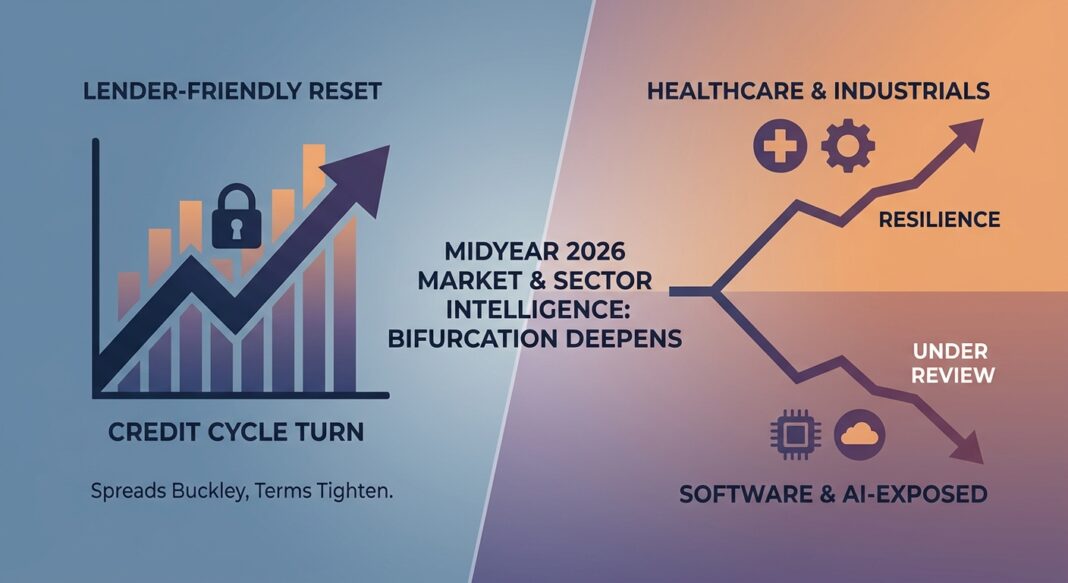
Market Headline: The Credit Cycle Has Turned, and Lenders Are Reclaiming the Terms
The first half of 2026 delivered a defining inflection point for U.S. credit markets. After a prolonged period of borrower-friendly conditions (compressed spreads, elevated leverage multiples, and covenant erosion) the supply-demand balance has shifted materially in favor of disciplined lenders. Three converging forces drove the reset: (1) the Federal Reserve’s sustained rate pause amid persistent inflation; (2) a broad AI-driven reassessment of software-sector credit quality, which rattled Business Development Company (BDC) portfolios and triggered a wave of redemption requests; and (3) tightening bank lending standards across both commercial & industrial (C&I) and non-depository financial institution (NDFI) loan categories, pushing more middle-market borrowers toward private credit on lender terms.
The result is a credit environment defined less by uniform spread widening and more by growing bifurcation. Chicago Atlantic’s Q2 2026 update captures the dynamic precisely: risk markets recovered sharply on the surface (the S&P 500 gained roughly 14% in Q2 and high-yield spreads retightened into the mid-200 basis-point range) yet beneath that recovery, the gap between credits with strong fundamentals and those with legacy, AI-exposed, or structurally weak profiles continued to widen. For institutional investors and operators, this is not a uniform lending environment. It is one demanding granular sector intelligence, vintage awareness, and covenant vigilance.
Quantitative Market Snapshot
The table below consolidates current cross-market spread and credit KPI data, sourced from public filings, regulatory surveys, and institutional research as of Q1–Q2 2026.
| Metric | Current Level (Q2 2026) | Prior Period | Direction | Source |
|---|---|---|---|---|
| Private Credit (Direct Lending) New-Issue Spreads | ~S+500 bps (Q1 2026); +50–100 bps vs. late 2025 | S+400–450 bps range (late 2025) | ↗ Widening | 9fin / PitchBook LCD; Lord Abbett |
| Leveraged Loan (BSL) Nominal Spread | ~312 bps (index nominal) | ~334 bps average new-issue single-B (Q1 2025) | ↔ Mixed / Bifurcated | Morgan Stanley Floating Rate Loan Monitor Q2 2026 |
| High-Yield Bond Spreads (OAS) | ~250 bps (mid-200s, Q2 2026) | ~350 bps (widened post-Liberation Day, Feb–Apr 2026) | ↘ Retightened | Chicago Atlantic Q2 2026 |
| Investment-Grade Spreads (OAS) | ~70 bps | ~90–100 bps (Q1 2026 tariff-driven widening) | ↘ Tightened | Chicago Atlantic Q2 2026 |
| Fed SLOOS: Banks Tightening C&I Standards (Large & Mid-Market Firms) | Net +8.1% (Q2 2026); large banks at +10.0% | Tighter through consecutive quarters since Q4 2025 | ↗ Tightening | Federal Reserve FRED / April 2026 SLOOS |
| Private Credit Default Rate (Direct Lending) | 2.73% (Q1 2026, Proskauer Index; 697 loans, $189.2B) | 1.84% (two quarters prior) | ↗ Rising | Forbes / Proskauer Private Credit Default Index |
| BDC Non-Accrual Rate | ~1.4% of cost (Q1 2026) | ~1.3% (Q4 2025) | ↗ Edging Higher | Heron Finance Q2 2026 Benchmark Report |
| Weighted-Avg. Direct Lending Loan-to-Value (LTV) | ~38–40% (sponsor-backed first-lien) | Broadly stable; no material deterioration reported | ↔ Stable | Heron Finance; CT Acquisitions BDC Report |
| BSL Discounted Spread (3-Year Life) | 495 bps | Compressed below 450 bps through much of 2024–2025 | ↗ Widening | Morgan Stanley Floating Rate Loan Monitor Q2 2026 |
| U.S. PE Deal Value (Q1 2026) | $257.4B across 2,374 transactions | $320.4B (Q4 2025); $339.3B (Q3 2025) | ↘ Declined | Capstone Partners / PitchBook Q1 2026 |
KPI Context: On fixed charge coverage ratios (FCCR) and interest coverage, Morgan Stanley’s midyear private credit outlook notes that EBITDA-to-interest coverage ratios have moved modestly higher across the leveraged loan universe, with consensus forecasts calling for an EBITDA rebound among borrowers over the next four quarters. However, the software sector remains an outlier: Morgan Stanley has separately flagged that software loans carry the highest leverage and the lowest coverage ratios across major private credit sectors, with potential direct lending default rates approaching 8% if AI disruption of software companies accelerates. Heron Finance’s benchmark data confirms that PIK interest marginally decreased to 3.9% in Q1 2026, and that approximately 90% of outstanding loans are first-lien with conservative ~40% LTV ratios, providing meaningful structural protection in adverse scenarios.
Sector Analysis: Appetite, Rotation, and the AI Fault Line
Software / SaaS: Under Structural Review
The defining sector story of H1 2026 is the AI-driven reassessment of software credit. The Bank for International Settlements’ March 2026 Quarterly Review documents that SaaS loans grew from under $8 billion in 2015 to over $500 billion (or 19% of total direct loans) by end-2025, with a third of private credit funds now carrying SaaS exposure. Software stocks collapsed by nearly 30% between October 2025 and February 2026, and BDCs with high software concentrations underperformed peers by approximately 5 percentage points over that period. Lord Abbett notes that private leveraged finance markets carry approximately 20% software exposure versus roughly 13% in liquid leveraged loan markets, a structural overhang that is now prompting more selective new underwriting and tighter covenant requirements on new originations.
The key vintage risk is concentrated in software transactions originated between 2019 and 2022, when rates were low, capital was abundant, and AI disruption was not yet an underwriting concern. Many of those loans were underwritten to growth assumptions and enterprise value multiples that may not hold in a post-AI competitive landscape.
Healthcare: The Resilience Anchor
PwC’s 2026 midyear PE outlook identifies healthcare as the most resilient sector for PE deployment, with take-privates and platform roll-ups continuing at pace. This appetite is well-founded: White & Case’s Debt Explorer reports that U.S. pharma, medical, and biotech buyout deal value totaled $78.9 billion in 2025, the second-highest level in 15 years, and that specialist private credit healthcare funds have posted median net IRRs of 15% versus 11% for generalist U.S. direct lending funds, with lower fund-level leverage (0.3x vs. 1.0x). Lender appetite for healthcare remains high and structurally differentiated.
Industrials, Business Services & Infrastructure: The Emerging Rotation
Bloomberg Intelligence’s April 2026 institutional investor survey (100+ respondents) finds direct lending (58%) and asset-backed finance (46%) as the leading private credit strategies attracting investor interest, while healthcare/biotech and industrial/deep tech are tied as the leading complementary investment themes at 51% each. Business services and industrials mid-market buy-and-builds remain active, per PwC, while private credit is increasingly financing AI-adjacent infrastructure (data centers, power, and cooling systems) often through hybrid and structured capital vehicles that fall outside traditional direct lending.
Lower Middle Market: Defensive Resilience
PitchBook LCD’s 2026 midyear webinar commentary highlights that activity in the lower middle market (companies with $5–$50 million EBITDA) has proven more resilient than the upper middle market, which competes with the syndicated loan market and has the highest software concentrations. A majority of Q2 2026 private credit activity was driven by non-LBO deals including repricings and extensions. Heron Finance confirms that lower middle market funds, while showing higher non-accruals, have delivered consistently low realized credit losses, supported by more conservative debt/EBITDA ratios, stronger FCCR profiles, and more restrictive financial covenants typical of smaller borrower transactions.
Implications for Institutional Investors and Business Operators
For Institutional Lenders and Investors
The H1 2026 reset has structurally improved the risk-reward profile for disciplined private credit deployment. Lord Abbett observes that spreads have widened by 50–100 basis points since late 2025, while new deal structures increasingly feature less leverage, more covenants, fewer PIK structures, and tighter documentation. This makes the current vintage potentially more attractive than the compressed-spread environment of 12 months ago. Investors with dry powder and broad origination capabilities are in a materially stronger negotiating position. However, legacy portfolios with high software exposure and limited covenant protection from the 2019–2022 vintage require active monitoring and may face continued NAV pressure. Morgan Stanley’s midyear view explicitly notes that periods of investor caution have historically coincided with the most attractive lending vintages.
Institutional demand (particularly from pension plans and insurers) remains structurally intact. The first-ever net outflow from perpetually non-traded BDCs in Q1 2026, combined with BDC redemption requests totaling nearly $14 billion in the same quarter, primarily reflects retail and wealth-channel sentiment rather than institutional conviction. Long-term allocators continue to increase private credit allocations for yield, diversification, and risk-adjusted return generation.
For Business Operators and Borrowers
The borrower-friendly era of 2023–2025 is closing. The Fed’s sustained rate pause, paired with tightening bank C&I standards (a net 8.1% of respondents reported tightening standards for large and middle-market firms in Q2 2026, per FRED/SLOOS, with large banks at 10.0%), means that operators who do not lock in flexible financing now face a narrowing window. Borrowers should anticipate greater covenant scrutiny, more rigorous FCCR and leverage multiple diligence, and reduced tolerance for PIK structures on new originations. Software-sector operators in particular must be prepared to articulate clear AI differentiation, demonstrate free cash flow progress, and accept higher pricing and tighter terms than their 2021 peers received. For non-software borrowers in healthcare, industrials, and business services, the environment remains constructive, but lender selectivity is increasing across the board.
Forward-Looking View: H2 2026 and Into 2027
Morgan Stanley projects that the secular uplift in private equity financing demand will accelerate through 2029, with unsold PE assets at end of their theoretical 12-year life potentially nearly doubling to $903 billion. This creates a structural tailwind for flexible and hybrid capital solutions beyond traditional direct lending. Wellington Management’s midyear fixed income outlook underscores that the defining regime shift is a supply-shock world (driven by the Middle East conflict and AI) where rates and credit spreads tend to rise and fall together, reducing duration’s traditional role as a hedge. For credit allocators, this argues for prioritizing carry over spread compression plays, rotating toward high-yield, securitized credit, and asset-backed finance, and maintaining dry powder for opportunistic dislocation. The widest sector dispersion in years is creating a genuine security-selection opportunity for investors with deep underwriting capabilities.
Key Market Insights
- Spread Reset Is Real, Not Transient: Private credit new-issue spreads have widened 50–100 basis points since late 2025 to approximately S+500 bps, according to 9fin/PitchBook LCD and Lord Abbett. Crucially, this is a structural rather than a merely cyclical move: new deals feature better covenant packages, less leverage, and fewer PIK concessions, improving risk-adjusted returns for disciplined lenders beyond what headline spread data alone suggests.
- Bank Retrenchment is Accelerating Private Credit’s Structural Opportunity: The April 2026 Fed SLOOS confirms tighter C&I lending standards across all firm sizes and tighter standards on all NDFI loan categories, including business credit intermediaries and private equity funds. Regulatory pressure and balance sheet constraints are pushing middle-market borrowers toward private capital channels on terms increasingly dictated by lenders.
- Software Vintage Risk is the Dominant Credit Concern: Enterprise software loans originated 2019–2022, underwritten without AI disruption risk, represent the most significant default risk vector in private credit. With software comprising ~20% of direct lending market exposure per Lord Abbett/PitchBook, and private credit default rates rising to 2.73% in Q1 2026 per Proskauer’s index, new underwriting must incorporate AI disruption analysis as a first-order input.
- Healthcare and Infrastructure Are the Rotation Targets: Institutional capital is rotating toward healthcare, which has generated 15% median net IRRs for specialist funds per White & Case/bfinance, and toward AI-adjacent infrastructure and asset-backed finance per the Bloomberg Intelligence institutional survey. These sectors offer non-correlated cash flows, structural demand tailwinds, and superior coverage ratio profiles versus software.
- The Lower Middle Market Offers the Best Risk-Adjusted Entry Point: With upper middle market deal flow still constrained by software reassessment and BSL competition, the lower middle market (EBITDA $5–$50M) is delivering more resilient deal activity, better covenant protection, and lower realized credit losses, despite modestly higher nominal non-accruals. Per Heron Finance, ~90% first-lien concentration and ~40% LTV ratios in this segment support strong recovery in adverse scenarios, while PitchBook LCD confirms relative activity resilience in H1 2026.


