
Private Credit’s Lender-Friendly Reset: Spreads, Standards & Sector Dispersion in Mid-2026
Market Headline: A Structural Repricing Is Underway
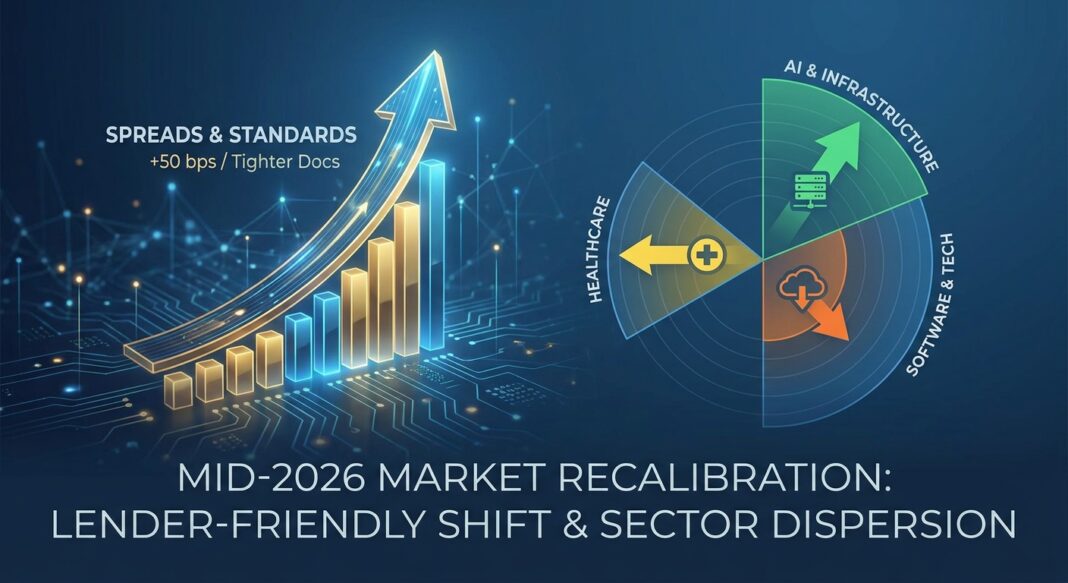
The private credit market is navigating one of its most closely watched inflection points since the post-2008 era. A confluence of geopolitical shocks, AI-driven sector disruption, regulatory deregulation, and redemption pressures has broken the borrower-friendly complacency of 2024–2025 and handed the pricing advantage back to disciplined lenders. The result is a market in active recalibration: widening spreads, tighter documentation, more selective capital deployment, and a bifurcation between premium credits and stressed ones that is widening by the quarter.
The macro architecture underpinning this shift is clear: the Federal Reserve’s target rate remains anchored at 3.50%–3.75%, geopolitical volatility linked to Middle East energy supply chains has sustained upward pressure on inflation expectations, and a higher-for-longer rate environment continues to compress fixed charge coverage ratios (FCCRs) across leveraged capital structures. Meanwhile, a landmark regulatory move (the OCC and FDIC’s rescission of the 2013 Interagency Leveraged Lending Guidance in December 2025) is quietly reshaping the competitive landscape between banks and private lenders, with consequences for underwriting standards across the entire leveraged finance ecosystem.
For institutional investors and corporate operators, the actionable read is this: capital availability has not disappeared, but it has become dramatically more selective, more expensive for marginal credits, and more rewarding for lenders with dry powder and discipline.
Quantitative Market Snapshot
The data as of Q2 2026 paint a consistent picture of spread re-pricing, cautious leverage, and a bifurcating default landscape. The table below captures the key metrics institutional participants are tracking.
| Metric | Current Level (Q2/Q3 2026) | Prior Period | Direction | Source |
|---|---|---|---|---|
| Middle Market Private Credit Spread | S+500 (approx.) | S+450–475 (late 2025 / Q1 2026) | ▲ Widening ~50 bps | Hamilton Lane |
| All-In Yield (New Direct Lending Origination) | ~9.0% (Q2 2026) | N/A (new data point from BXCI 10-Q) | ▲ Base 3.9% + Spread/Fees 5.1% | Blackstone (SEC 8-K, Aug 2026) |
| 3-Month Term SOFR | 3.68–3.69% (June 2026) | ~3.67% (Q1 2026) | ▬ Flat | VRC Q2 2026 |
| 5-Year U.S. Treasury Yield | 4.23% (June 2026) | 3.92% (March 2026) | ▲ +31 bps QoQ | VRC Q2 2026 |
| Middle Market LBO Leverage (Total Debt / EBITDA) | 4.0x–5.5x (unitranche); 5.0–5.5x cap for most borrowers | 6.5x peak (2021); 5.7x (2024, large-cap) | ▼ Disciplined pullback | CT Acquisitions / LCD |
| Private Credit Direct Lending Default Rate (TTM) | 6.0% TTM (Fitch, May 2026); 1.5% by volume (DLD) | 4.5%–5.0% forecast range entering 2026 | ▲ Elevated / Rising | VRC / Fitch Ratings, Q2 2026 |
| U.S. PE Deal Volume (H1 2026) | 3,999 completed transactions | 4,619 deals (H2 2025) | ▼ -13.5% HoH | CohnReznick / PitchBook, July 2026 |
Sources: Hamilton Lane, Valuation Research Corp. (VRC), Blackstone SEC filings, CohnReznick/PitchBook, CT Acquisitions/LCD, Fitch Ratings. Data as of Q2/Q3 2026 unless otherwise noted.
Key Rate & KPI Context
The critical KPI conversation for operators is around Fixed Charge Coverage Ratios. With all-in yields on new direct lending originations averaging approximately 9.0% (3.9% base + 5.1% spread/fees per Blackstone’s Q2 2026 SEC disclosures) and leverage sitting at 4.0x–5.5x EBITDA, companies with normalized EBITDA margins below 20% are increasingly failing to clear minimum FCCR thresholds of 1.10x–1.25x that lenders now apply. The earlier rate shock era (2022–2024) demonstrated the damage vividly: a company carrying $650M in floating-rate debt saw its annual interest bill more than double from 2021 to mid-2023, with interest coverage collapsing from 3.8x to 1.7x for a $100M EBITDA business at comparable leverage. That historical lesson is now baked into current underwriting.
Sector Analysis: Winners, Losers & Structural Shifts
Software & Technology: Acute Stress, Maximum Scrutiny
No sector has been hit harder by the 2026 repricing than enterprise software. Secondary spreads for software credits are approximately 245 basis points wider than year-end 2024 levels and roughly 229 basis points above the broader B-rated loan index, driven by AI-disruption concerns, a bifurcation that the market had not priced at deal origination for the large cohort of software transactions financed between 2019 and 2022. Many of those companies had strong revenue growth but had not yet achieved meaningful free cash flow. With rate-driven FCCR compression now meeting AI-driven revenue risk, lenders are applying the sharpest underwriting scrutiny to this cohort of any sector in the market.
Healthcare: Still Favored, but With Subsector Nuance
Healthcare led all sectors for private credit deal volume in 2025, accounting for 19% of all direct lending deals, according to Octus Data. Demographic tailwinds and non-cyclical service models continue to attract lenders seeking stable, predictable cash flows. However, the sector is not monolithic: healthcare practice roll-ups, which proliferated in the 2020–2022 low-rate era, carry disproportionately high CCC-or-lower credit assessments per KBRA research, with the highest percentage of companies at highest default probability within the broader Health Care Services and Technology sector. Lenders are differentiating aggressively between well-capitalized integrated health systems and leveraged roll-up platforms with execution risk.
Infrastructure & AI Data Centers: The Growth Engine
The structural opportunity of this credit cycle is infrastructure-linked lending, particularly AI data center buildouts. Morgan Stanley estimates that private credit could supply more than half of the $1.5 trillion needed for global data center construction through 2028. AI-related private credit loans reportedly nearly doubled in the twelve months through early 2025, according to UBS. Infrastructure debt, real estate credit, special situations, and other asset-backed strategies now represent a growing share of private credit AUM: by Q1 2026, direct corporate lending’s share of fundraising had fallen to 31% of total private credit fundraising, down sharply, as capital rotated into these alternative strategies.
Commercial Real Estate: Early Signs of Recovery
The July 2026 SLOOS showed banks easing CRE lending standards at the most aggressive pace since early 2022, a meaningful signal that some institutional risk appetite is returning to the sector. However, the recovery is highly selective. Lenders are focused on assets with strong in-place cash flow, experienced sponsors with demonstrated equity injection capacity, and funded capex plans. Office remains a structural outlier on the negative side, with lenders demanding detailed tenant improvement and leasing cost projections before committing to new term debt.
Industrials & Energy: Stable Demand, Cautious Capital
Activity in industrials and energy is broadening, supported by infrastructure and defense spending tailwinds in both the U.S. and Europe. PwC’s 2026 Private Credit Survey notes increasing deal opportunities in energy and infrastructure on the continent, as European nations accelerate capital expenditure and private credit fills the gap ahead of Basel IV’s expected structural shift away from bank lending, which currently accounts for approximately 70% of European total lending.
Regulatory & Structural Shift: Leveraged Lending Deregulation
The most consequential regulatory event for the leveraged finance market in over a decade was the OCC and FDIC’s rescission of the 2013 Interagency Leveraged Lending Guidance on December 5, 2025, effective immediately. The agencies explicitly acknowledged that the prior guidance had played a role in pushing leveraged lending activity outside the regulatory perimeter, toward private credit and non-bank markets. Under the new framework, banks are expected to manage leveraged lending using general principles for safe and sound lending, without reference to numerical leverage thresholds or prescriptive repayment metrics.
The practical consequence is nuanced. Regulatory flexibility for OCC- and FDIC-supervised banks increases in principle. However, as market observers note, competitive dynamics, rather than prescriptive guidance, have been the primary driver of private credit’s growth. Banks continue to face capital requirements, liquidity considerations, and investor appetite constraints that private credit platforms do not. Private credit lenders, for their part, now have greater flexibility to develop institution-specific definitions of “leveraged loan” and to underwrite a broader range of transactions. This regulatory environment is incrementally positive for deal supply, particularly at the upper middle market, as banks gradually re-enter the space, a trend visible in Q2 2026 as banks returned to upper middle market origination, helping alleviate some spread pressure.
Separately, the SEC has opened inquiries into large private credit managers, and the Treasury Department is examining BDC business models, adding a layer of regulatory uncertainty around valuation standards, redemption policies, and disclosure frameworks that will define governance norms for the sector over the next 12–24 months.
Implications for Institutional Investors & Operators
For Borrowers & Operators
- FCCR is the gating metric. With all-in yields averaging approximately 9.0% on new originations and leverage caps at 4.0x–5.5x EBITDA for most credits, borrowers must demonstrate FCCR above 1.10x–1.25x to access competitive terms. Businesses with thin EBITDA margins or lumpy revenue recognition will find lender appetite limited to more expensive, highly structured solutions.
- Equity contribution requirements have increased. Sponsors are now benchmarked at 45%–55% equity as a percentage of purchase price, meaningfully higher than the 35%–40% standard of prior cycles. Fresh equity injection is a near-prerequisite for refinancings of distressed or transitional credits.
- Document quality matters. Covenant packages, information rights, and financial maintenance tests are all tightening as lenders with dry powder regain negotiating leverage. Borrowers who pre-emptively offer tighter documentation will find more flexible pricing in return.
For Institutional Lenders & Investors
- The lower middle market offers differentiation. As of Q1 2026, 80% of lower middle market issuers (sub-$40M EBITDA) remain unique to a single portfolio, versus just 39% of upper middle market issuers. Lower concentration means genuine alpha generation remains available for disciplined lower-market lenders.
- Secondary market activity is an emerging opportunity. JPMorgan reported trading approximately $2 billion in private credit secondary loans as of mid-May 2026, exceeding all prior years combined, as redemption pressures forced managers to list loans at par or at discounts of 3 to 10+ cents. For well-capitalized buyers, secondary loan purchases represent a meaningful return enhancement opportunity.
- Sector rotation into asset-backed and infrastructure strategies is accelerating. Investors are reallocating from plain-vanilla corporate direct lending (down to 31% of fundraising) toward infrastructure debt, real estate credit, and special situations, reflecting both spread compression in core middle market deals and structural secular demand for infrastructure capital.
Forward-Looking View: H2 2026 and Beyond
The second half of 2026 is likely to be defined by dispersion: across sectors, vintages, and manager quality. The maturity wall is actively being managed: as of mid-2026, only 15% of BDC-held debt investments mature in 2026–2027, down from 27% as of Q2 2024, indicating that the most acute refinancing pressure has been absorbed. However, 2022-vintage software and technology loans remain a live stress source as they approach maturity and require refinancing at materially higher rates and wider spreads than they were originated at.
The higher-for-longer rate environment (with the forward curve broadly flat as of June 2026 and 5-year Treasury yields at 4.23%) means all-in borrowing costs for leveraged credits will remain in the 9%–11% range for high-quality middle market borrowers and 11%–14% for mezzanine structures. EBITDA/interest coverage ratios averaging approximately 2.0x across private credit transactions sector-wide reflect the thin margin of safety in aggregate, and any EBITDA deterioration from tariff impacts, AI disruption, or cyclical softening could push a material cohort of credits toward restructuring.
For lenders, the opportunity is real: spreads at S+500 represent a level not seen since the mid-cycle volatility of 2022–2023, covenants are improving, and LBO deal supply, which increased more than 30% year-over-year in Q1 2026 in the U.S., is expected to expand further into H2. Managers with institutional dry powder, sector expertise, and disciplined underwriting are positioned to capitalize. The key risk is the pace and depth of default normalization: with Fitch’s private credit default rate reaching 6.0% TTM in May 2026, investors should ensure they are being adequately compensated for the tail risk embedded in any leveraged credit portfolio.
Key Market Insights
- Spreads have repriced materially. Middle market private credit spreads have widened by approximately 50–100 bps since late 2025 to approximately S+500, reversing two years of borrower-friendly compression. New direct lending originations cleared at a blended all-in yield of 9.0% in Q2 2026 per Blackstone’s SEC filings.
- Regulatory deregulation is a wildcard for bank re-entry. The OCC/FDIC rescission of the 2013 Leveraged Lending Guidance removes numerical leverage thresholds for bank examiners, potentially enabling banks to compete more aggressively in upper middle market origination, creating a competitive headwind for private credit spreads in large-cap deals, while the lower middle market remains insulated.
- FCCR compression is the primary operational risk. With all-in yields near 9%–11% and leverage multiples at 4.0x–5.5x EBITDA, businesses without at least 1.10x–1.25x FCCR headroom face covenant stress. The highest-risk cohort is 2020–2022 vintage technology and software-backed LBOs approaching maturity.
- Sector bifurcation demands active credit selection. AI infrastructure and data center-linked credits offer secular growth and strong collateral support. Enterprise software and healthcare roll-ups represent the highest default probability cohorts. Industrials and infrastructure are the consensus lender-friendly sectors for H2 2026.
- Secondary market liquidity is a new alpha source. Record secondary trading volumes in private credit loans, with some transactions clearing at 3–10+ cents below par, represent a structural opportunity for well-capitalized investors to acquire quality senior secured assets at a discount, particularly from sellers constrained by BDC redemption mechanics.


