
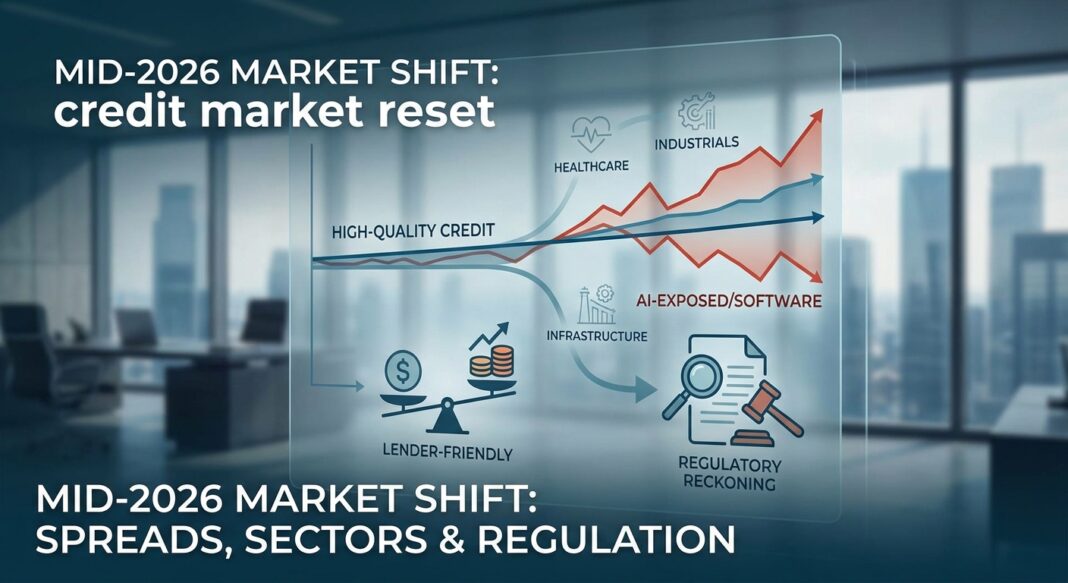
Market Headline: The Lender-Friendly Reset Is Here, But Dispersion Is the Real Story
As of August 7, 2026, the private credit market has passed through a discrete phase transition. After two years of spread compression and borrower-favorable terms driven by abundant dry powder, the macro and geopolitical shocks of early 2026 (renewed Middle East conflict, AI-related disruption fears, and elevated redemption pressure across select private credit vehicles) have rotated pricing power back toward disciplined lenders.
According to PitchBook data cited by Lord Abbett (June 2026), middle-market private credit spreads have widened by roughly 50 to 100 basis points since late 2025, while defensive structural terms have also improved. At the same time, Hamilton Lane’s 2026 Private Credit Focus confirms that spreads in the S+500 context have returned, up from the mid-400 bps level that defined much of the 2024–2025 compression cycle.
Critically, however, spread widening is not uniform. Valuation Research Corporation’s Q2 2026 Private Markets Trends report (June 29, 2026) highlights stark bifurcation: the broader market has stabilized following Q1 volatility, with higher-quality borrowers still commanding competitive terms, while AI-exposed software credits are facing secondary spreads roughly 245 basis points wider than year-end 2024 levels. This divergence, not the headline spread move, is the defining condition for lenders and operators navigating the second half of 2026.
The macro backdrop is equally complex: the Federal Reserve’s July 2026 SLOOS reports basically unchanged C&I lending standards at banks for Q2, a marked improvement from Q1’s tighter stance, with stronger C&I loan demand from large and middle-market firms. Meanwhile, the Financial Stability Board’s May 6, 2026 report has formally flagged systemic vulnerabilities in private credit for the first time at scale, a regulatory development with long-term structural implications.
Quantitative Market Snapshot
The table below consolidates the most current publicly available data points across key credit market metrics as of Q2/early Q3 2026.
| Metric | Current Value (Q2 2026) | Prior Period | Change | Source |
|---|---|---|---|---|
| Middle Market Direct Lending Spread | S + ~500 bps | S + ~450 bps (mid-2025) | +50–100 bps | PitchBook / Lord Abbett, Jun 2026 |
| 3-Month Term SOFR | ~3.68% | ~3.67% (Q1 2026) | +1 bp QoQ | VRC Q2 2026 Private Markets Report |
| 5-Year U.S. Treasury Yield | ~4.23% | ~3.92% (Mar 2026) | +31 bps QoQ | VRC Q2 2026 Private Markets Report |
| BSL Market Spread (SOFR-based, typical range) | SOFR + 300–550 bps | BSL B-rated secondary ~67 bps wider than YE 2025 | Widening from YE24 | CLO Market / VRC Q1 2026, Jun 2026 |
| HY Bond OAS, Technology Sector | 343 bps | ~278 bps (YE 2025 est.) | +0.26% YTD | ICE BofA / Fidelity Institutional, Jun 30, 2026 |
| Software Secondary Spreads vs. B-Rated Loan Index | ~229 bps premium to index | Approx. in-line (YE 2025) | +245 bps vs. YE 2025 | PitchBook LCD / VRC, Jun 19, 2026 |
| Net % Large Banks Tightening C&I Standards (Large & MM Firms) | 10.0% (Q2 2026 SLOOS) | Tighter in Q1 2026 | Easing trend | FRED / Fed SLOOS, May 4, 2026 |
| US CLO Projected Default Rate (Oct 2026) | ~3.0% | 5.3% (Oct 2025) | -230 bps YoY | Moody’s Leveraged Finance & CLO Outlook 2026 |
| Private Credit AUM (Global, End-2024 Est.) | $1.5–$2.0 trillion | ~$1.5 trillion (2023) | Continued growth | FSB Vulnerabilities in Private Credit, May 6, 2026 |
Data current as of sources cited. All spreads are indicative of market conditions; individual deal terms vary by credit quality, structure, and sector.
Key KPI Context: Leverage and Coverage Ratios
Heron Finance’s Q2 2026 State of Private Credit Benchmark Report, analyzing 69 U.S. private credit funds representing over $1 trillion in aggregate AUM, finds that debt-to-EBITDA ratios have remained stable with no material upward drift: suggesting that aggregate underwriting discipline on borrower leverage has held through the 2024–2026 cycle. Encouragingly, borrower interest coverage ratios (EBITDA/interest) improved year-over-year due to some combination of lower interest rates and modest EBITDA growth. Loan-to-value (LTV) ratios also remain conservative across segments.
However, Vanguard’s analysis flags a structural risk to watch: in an environment of substantial dry powder and competitive deal sourcing pressure, the first signs of underwriting deterioration typically emerge through greater leverage, looser covenants, and more aggressive EBITDA add-back assumptions: not in near-term default rates. The AI-software sector stress illustrates this exactly: loans underwritten on optimistic SaaS growth assumptions are now facing performance pressure as those assumptions have been reassessed.
Sector Analysis: Hot, Cold, and Structurally Shifting
🟢 Healthcare: Durable Favorite, Spread Resilience
Octus Data confirms that healthcare led all sectors in private credit deal activity in 2025, accounting for 19% of all direct lending transactions, and was the only major sector not to see significant year-over-year pricing tightening. This dynamic reflects healthcare’s core appeal: non-cyclical service models, demographic tailwinds, and stable free cash flow profiles that lenders prize at this stage of the credit cycle. Wellington Management and others continue to target healthcare as a primary allocation for direct lending, and lender appetite here remains deep and competitive.
🟢 Infrastructure & Digital Assets: Structural Growth Destination
Infrastructure and digital infrastructure are among the fastest-growing destinations for private credit capital. Cleary Gottlieb’s 2026 Outlook notes that private credit has been winning large digital infrastructure deals: including those involving Meta, Rogers Communications, and Intel: by providing sophisticated joint-venture financing structures that avoid consolidation as “debt” on balance sheets. Morgan Stanley estimates private credit could supply more than half of the $1.5 trillion needed for global data center buildouts through 2028. AI-related private credit loans reportedly nearly doubled in the 12 months through early 2025, per UBS. Regulatory infrastructure (per Chambers & Partners 2026) and energy transition projects are similarly attracting deep lender interest, with the OCC/FDIC’s December 2025 rescission of the 2013 Leveraged Lending Guidance providing private credit platforms with greater flexibility to underwrite at deeper leverage levels.
🟡 Industrials & Consumer: Moderate Appetite, Tariff Sensitivity
Industrials remain a target sector for deal flow expansion in 2026, with middle-market M&A activity showing approximately 10.7% year-over-year growth in deal value and exit activity rising 14%, per PitchBook. However, tariff exposure is a meaningful underwriting variable, VRC’s Q1 2026 Update identifies “tariff-exposed assets” as a distinct category commanding higher risk premiums. Consumer-facing businesses with input cost exposure and margin compression risk are receiving greater lender scrutiny on fixed charge coverage ratios (FCCR) and covenant headroom.
🔴 Software & AI-Exposed Technology: Materially Tighter
Software is the clearest underperformer in mid-2026 credit markets. Per VRC (citing PitchBook LCD data as of June 19, 2026), software secondary spreads are approximately 245 basis points wider than year-end levels and roughly 229 basis points above the broader B-rated loan index, reflecting persistent uncertainty around AI-driven disruption of existing SaaS business models. The FSB’s May 2026 report explicitly flags concentration risk in technology and healthcare as a systemic vulnerability, noting that sector-specific shocks could transmit into broader market stress. Lenders are currently requiring significantly higher risk premiums for credits with meaningful AI-disruption exposure, and lending activity in this space has focused on businesses with proprietary data assets, regulatory moats, or high customer interaction barriers as offsetting credit attributes.
Structural Shift: Asset-Based Finance and Hybrid Capital Rise
PwC’s 2026 Private Credit Survey identifies a clear structural rotation: capital is increasingly shifting toward specialist strategies, including asset-backed finance, non-sponsor lending, and selective use of leverage. BlackRock’s 2026 Private Markets Outlook specifically calls asset-based financing “one area of private credit where we expect to see a profound increase in opportunities in 2026.” Hybrid debt-equity instruments are also gaining traction as 2020–2021 vintage deals with capital structure stress turn to blended solutions to realign balance sheets.
Regulatory Forces Shaping the Lending Environment
The regulatory backdrop in mid-2026 is pulling in two directions simultaneously, one toward expanded bank competition, the other toward systemic risk oversight of private credit.
Bank Regulatory Easing: The OCC and FDIC’s joint December 2025 rescission of the 2013 Interagency Leveraged Lending Guidance removes prescriptive leverage ratio limits for bank lenders and allows institutions to develop their own risk appetite frameworks. Per Chambers & Partners (2026), this may enable some private credit platforms to compete at deeper leverage levels than previously permissible. Combined with JPMorgan’s $50 billion expansion of its direct lending business (announced February 2025), banks are reasserting their presence in the upper middle market, particularly for high-quality credits, with banks gradually returning to market in Q2 2026 and alleviating upward spread pressure for select credits.
FSB Systemic Risk Warning: Countervailing this is the FSB’s landmark May 6, 2026 report, which formally identifies four vulnerability clusters in private credit: bank interconnections, borrower credit quality and valuation opacity, concentration and liquidity mismatches, and data gaps. While the FSB does not characterize private credit as an imminent systemic risk, it explicitly stresses that the market has never been tested at its current size and scope in a severe economic downturn. The report proposes a core set of comparable cross-border monitoring metrics, a precursor to potential future regulatory reporting mandates. Institutional operators should anticipate increased LP-level due diligence on fund transparency, non-accrual disclosure, and PIK utilization rates as a consequence.
NDFI Loan Standards (Banks): The April 2026 SLOOS introduced a new category specifically tracking bank lending to non-depository financial institutions (NDFIs), including private credit funds and private equity. The survey found that significant net shares of banks reported tighter standards on NDFI loans over the past year, a structural constraint on fund-level leverage at the largest private credit platforms, with implications for deployment capacity and return on equity.
Strategic & Operational Implications
For Business Operators & Borrowers
- Window for quality borrowers remains open, but narrowing for AI-exposed names. Lender demand remains strong for higher-quality deals with durable cash flows and limited macro exposure. Operators in healthcare, infrastructure, and industrial services with demonstrated FCCR above 1.2x and debt-to-EBITDA under 5.5x remain well-positioned to access competitive terms, including from banks re-entering the upper middle market.
- Expect heightened covenant scrutiny and information requirements. Cleary Gottlieb notes that stricter covenant packages and potentially higher pricing for credits with perceived execution risk are increasingly likely, even as the large-cap market remains competitive. Borrowers with AI-disruption exposure, tariff sensitivity, or cyclical revenue profiles should anticipate expanded due diligence timelines and risk premium pricing.
- Higher base rates persist. With the 5-year Treasury at ~4.23% and 3-month Term SOFR at ~3.68%, all-in costs for floating-rate private credit remain elevated versus the 2020–2021 cycle. Per McKinsey’s 2026 Global Private Markets Report, all-in new-issue direct lending yields averaged ~9.3% in 2025, still materially above historic norms, reinforcing the importance of FCCR stress-testing in capital structure planning.
For Institutional Investors & Lenders
- Dispersion creates alpha opportunity for selective managers. Lord Abbett’s midyear 2026 outlook frames H2 2026 as a period defined by dispersion, favoring managers who can combine dry-powder patience with disciplined credit selection. PwC concurs: the gap between top-performing private credit managers and the rest is expected to widen materially in this environment.
- Lower middle market offers structural yield premium. Cliffwater data, per CT Acquisitions’ BDC Performance Report, consistently shows that lower-middle-market direct lending delivers 100–200 bps of yield premium over upper-middle-market direct lending with comparable or lower realized loss rates, the result of less origination competition. LMM-focused BDCs (with non-accruals below 1.5% at fair value) continue to demonstrate cycle resilience.
- Asset-based finance and hybrid capital are the growth vectors. BlackRock and PwC both flag asset-backed finance as the fastest-growing sub-strategy, with Preqin projecting a near 28% annualized surge in distressed debt fundraising by 2030. Investors seeking diversification beyond corporate direct lending should evaluate infrastructure debt, real estate debt, and specialty finance as portfolio complements.
- Monitor FSB metrics as a leading indicator of regulatory change. The FSB’s proposed “core” monitoring metrics framework for cross-border oversight (covering market size, bank linkages, leverage, liquidity features, and borrower credit quality) signals the direction of future regulatory disclosure requirements. Institutional allocators should factor potential reporting-cost and transparency implications into manager selection criteria, particularly for funds offering retail or semi-liquid access.
Forward View: Liquidity & Lending Dynamics (H2 2026 – Q1 2027)
The credit cycle narrative entering H2 2026 is one of mid-cycle recalibration rather than late-cycle deterioration. Moody’s projects U.S. CLO collateral default rates to fall to approximately 3.0% by October 2026, down from 5.3% a year earlier, supported by lower funding costs and active refinancing. Northleaf Capital emphasizes that well-capitalized lenders with institutional backing are positioned to take share at attractive terms during periods of broader disruption, structurally similar to the 2022 BSL dislocation that saw direct lending volume surge 188%.
Preqin’s 2026 outlook forecasts that private credit fundraising will accelerate in 2026, with 2025 data suggesting investor demand is firming. Preqin projects private credit AUM to more than double to $4.5 trillion by 2030, with evergreen and semi-liquid funds accounting for approximately $1.4 trillion of that total. The broader market for direct lending now matches the broadly syndicated loan market at $1.5–$2 trillion and is forecast to reach $3 trillion by 2028 (Cleary).
The principal risk to this constructive outlook is deployment-pressure-driven underwriting erosion. Capstone Partners (May 2026) notes that lenders report difficulty sourcing quality deals and that many firms risk falling short of deployment budgets absent a meaningful pickup in M&A volume. If that pressure mounts through Q3–Q4 2026, covenants and documentation quality, rather than stated spread levels, are the metrics to watch for early-cycle deterioration signals.
Key Market Insights: Five Actionable Takeaways
- Spreads have reset wider, but quality still commands a premium. Middle-market direct lending spreads are back in the S+500 context, 50–100 bps wider than late 2025, but the reset is not uniform. High-quality credits with stable FCCR and limited sector-specific risk continue to attract competitive pricing. The operative variable is no longer market-wide spread level; it is individual credit quality relative to sector comps. (Source: PitchBook / Lord Abbett, Jun 2026)
- The Fed SLOOS signals a stabilizing bank credit environment, a key competitive dynamic. The July 2026 SLOOS confirms C&I standards were basically unchanged in Q2, with stronger C&I demand from large and middle-market firms. Banks re-entering the upper middle market compress spreads for well-capitalized borrowers but reinforce the structural advantage of private credit in lower-middle-market, complex, and covenant-required transactions. (Source: Fed SLOOS, July 2026)
- AI/software credit stress is sector-specific, not systemic, but warrants active portfolio monitoring. Software secondary spreads are ~245 bps wider than year-end 2024, driven by AI disruption repricing rather than macro credit deterioration. Portfolios with material SaaS exposure should be stress-tested against scenarios of revenue compression and covenant breaches, with particular attention to EBITDA add-back assumptions that may have been underwritten on 2021-vintage growth expectations. (Source: VRC / PitchBook LCD, Jun 2026)
- The FSB’s May 2026 report is a regulatory inflection point, not yet a constraint, but a harbinger. The formal identification of four systemic vulnerability clusters in private credit, combined with a proposed cross-border metrics framework, signals that regulatory reporting and transparency requirements for private credit funds will tighten over the next 24–36 months. LPs, GPs, and institutional operators should begin aligning internal reporting with FSB-proposed metrics now to reduce compliance friction when mandates arrive. (Source: FSB, May 6, 2026)
- Asset-based finance and infrastructure debt are the structural growth trades for the next 24 months. With corporate direct lending increasingly competitive and commoditized at the upper end, capital flows are migrating toward asset-backed finance, digital infrastructure, and real estate debt strategies, areas where private credit retains structural advantages over banks and where the total addressable market exceeds $30 trillion. Healthcare and infrastructure continue to offer the most favorable combination of spread, covenant protection, and cash flow durability for the current credit cycle phase. (Source: BlackRock Private Markets Outlook 2026; Wellington Management 2026)


