
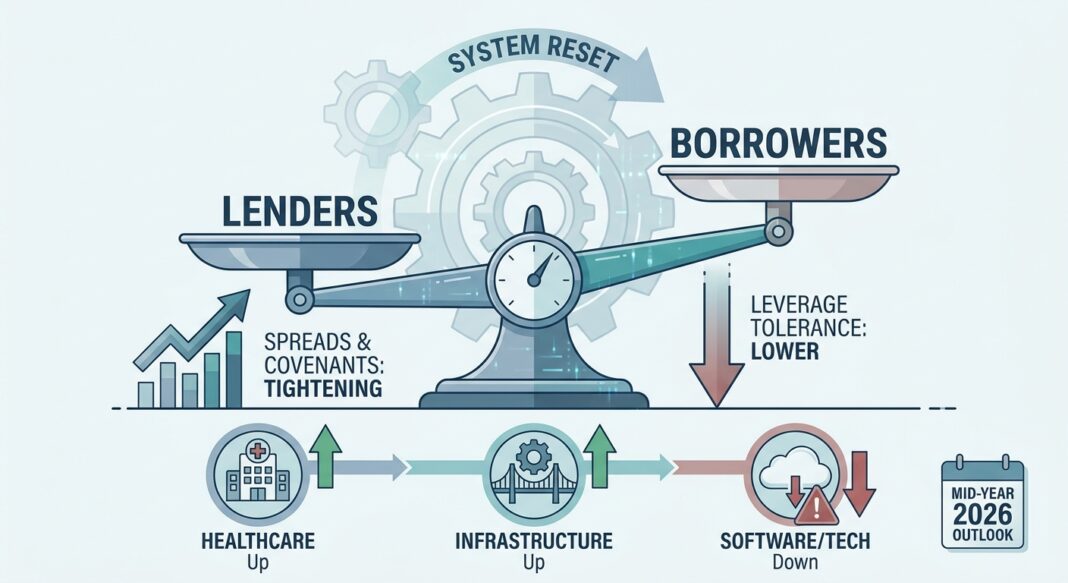
Market Headline: A Cycle Reset Underway
As of mid-year 2026, the private credit market is undergoing what analysts at Lord Abbett are calling a “lender-friendly reset”: a structural rebalancing that is shifting pricing power, documentation standards, and capital selectivity decisively toward disciplined lenders after years of borrower-favored conditions. The forces driving this transition are multi-layered: rising M&A volumes have expanded the deal opportunity set; AI-driven disruption concerns have made some capital providers more cautious and selective; redemption pressures in retail-oriented vehicles have reduced the pool of aggressively competing capital; and bank C&I lending standards have continued to tighten through Q2 2026. Together, these dynamics are creating an environment where spreads have moved higher, covenants are tightening, and documentation has improved: all constructive signals for disciplined credit deployment heading into the second half of 2026.
This report synthesizes data from the Federal Reserve’s April 2026 SLOOS, McKinsey’s Global Private Markets Report, PitchBook/LCD, Cliffwater, Northleaf Capital, Valuation Research Corporation (VRC), Hamilton Lane, and multiple institutional managers to deliver an integrated, actionable view of current credit conditions for institutional investors and corporate operators alike.
Quantitative Market Snapshot
The table below presents key current market metrics across public and private credit markets. All data points reflect the most recently available figures as of Q1–Q2 2026.
| Metric | Current Value (Q1–Q2 2026) | Prior Period Comparison | Source |
|---|---|---|---|
| Middle Market Private Credit New-Issue Spread | SOFR + ~500 bps (S+500 context) | Mid-400 bps level in late 2025 | Hamilton Lane, April 2026 |
| Global Direct Lending New-Issue Median Spread | ~544 bps (YE 2025 baseline); up ~50–100 bps since late 2025 | 596 bps at YE 2024; 666 bps at YE 2023; peaked at 716 bps (March 2023) | McKinsey / Kroll StepStone, June 2026 |
| All-In New-Issue Direct Lending Yield | ~9.3% (2025 full-year avg.); floor projected at 8.0%–8.5% for 2026 | ~10.5% in 2024 | McKinsey, June 2026; Morgan Stanley IM |
| Leveraged Loan LTM Default Rate (by Issuer Count) | 1.36% (Feb. 2026); 3.54% including distressed exchanges | 10-yr avg.: 1.71%; distressed exchange-adj. avg. in 2025: 4.24% | Hamilton Lane / S&P, April 2026 |
| Fed SLOOS, Net % Banks Tightening C&I Standards (Large/Mid-Market Firms) | +8.1% net tightening (Q2 2026); large banks: +10.0% | Tightening also reported in Q4 2025 (Jan. 2026 SLOOS) | Fed SLOOS / FRED, May 4, 2026 |
| Private Credit vs. Public High Yield Spread Premium | ~150–200 bps over comparable high-yield (compressed from ~350 bps in 2019); broader spread cited at ~300 bps in other segments | ~350 bps premium in 2019 | Owners.pe / HedgeCo, April 2026 |
| Leverage (Debt-to-EBITDA), New Transactions | 5.0x–6.0x for high-quality transactions; “true” leverage closer to ~7x when EBITDA add-backs considered | Higher leverage and fewer covenants prevailed through mid-2025 | VRC Q2 2026; FSB Report, May 2026 |
| Interest Coverage (FCCR / Weighted Average) | FCCR underwritten above 2.0x on recent transactions; select BDCs reporting 2.6x weighted avg. interest coverage | Near or below 2.0x on 2023–early 2024 vintages | VRC, June 2026; Barings Private Credit, SEC Filing 2026 |
| Private Credit AUM (Global) | Exceeding $2 trillion (2026 est.) | ~$1.8–2.0 trillion in 2024; projected to approach $4 trillion by 2030 | Moody’s, January 2026 |
Sources: Federal Reserve SLOOS (May 4, 2026); McKinsey Global Private Markets Report (June 2026); Hamilton Lane (April 2026); Kroll StepStone via McKinsey; VRC Q2 2026; Morgan Stanley IM; Barings Private Credit SEC Filing; FSB Report on Private Credit Vulnerabilities (May 6, 2026); Moody’s Private Credit Outlook 2026.
The Macro & Regulatory Backdrop: Banks Tighten, Lender Guidance Changes
The Federal Reserve’s April 2026 Senior Loan Officer Opinion Survey (SLOOS) confirmed that a net 8.1% of domestic banks tightened standards on C&I loans to large and middle-market firms in Q2 2026, with large banks tightening at a 10.0% net rate. Banks cited a “less favorable or more uncertain economic outlook, the worsening of industry-specific problems, and a reduced tolerance for risk” as primary reasons. Notably, the January 2026 SLOOS revealed that a major net share of banks reported being less likely to approve C&I loans to firms adversely affected by AI, representing a new and structurally significant underwriting variable for lenders in technology-adjacent sectors.
On the regulatory front, a meaningful deregulatory shift occurred on December 5, 2025, when the OCC and FDIC jointly rescinded the March 2013 Interagency Guidance on Leveraged Lending. This opens the door for private credit lenders to apply institution-specific definitions of leveraged loans and to underwrite a broader range of transactions at deeper leverage levels that would previously have been restricted, potentially intensifying competition between banks and non-bank lenders at the upper end of the market.
Meanwhile, publicly syndicated markets (broadly syndicated loans (BSL) and high-yield bonds) have seen spreads widen by roughly 15–30 bps on new issues from Q4 2025 to Q1 2026. Private credit spreads have adjusted more slowly but are pricing ~25 bps higher on new transactions. The IG corporate bond OAS widened 11 bps in Q1 2026 to +89 bps, after hitting its tightest level in 20 years in January, a signal that public fixed income valuations remain stretched, reinforcing the relative appeal of private credit’s income profile.
Sector Analysis: Where Lender Appetite Is Expanding, and Retreating
🟢 Healthcare: High-Volume, Premium-Priced, But Cracks Emerging
Healthcare led all sectors in 2025 direct lending deal volume, accounting for 19% of all direct lending deals, according to Octus data. It was the only major sector to avoid significant year-over-year spread tightening, with Q4 2025 spreads landing at approximately SOFR+500 bps: a meaningful premium reflecting lenders’ recognition of sector complexity and regulatory risk. Deal flow in healthcare M&A is expected to remain solid into H2 2026. However, Morgan Stanley Investment Management has flagged healthcare as the sector that has led all sectors in loans placed on non-accrual status over the past year, warranting nuanced underwriting rather than blanket sector enthusiasm.
🔴 Software / Technology: Disruption Risk Reshaping Credit Appetite
Software (once the favored private credit sector due to sticky subscription revenues and high margins) is now facing a structural reassessment driven by AI disruption fears. The concern is that AI is lowering barriers to entry and enabling customers to build competing tools internally, threatening the very fundamentals (stable recurring revenue, high switching costs) that justified tight spreads and high leverage. Redemption pressure in several BDCs has been disproportionately linked to software sector concentration, and VRC data shows that 2021-vintage software and technology loans now carry leverage approximately 0.9x higher than at origination, while adjusted cash interest coverage has declined roughly 0.4x as of Q1 2026. Many lenders are now limiting or pausing incremental software exposure, and the Fed’s January 2026 SLOOS confirmed that banks are explicitly less likely to approve C&I loans to AI-adversely-affected firms. Critically, analysts distinguish between profitable, mission-critical software businesses and pre-profitability ARR borrowers, the latter facing the most acute risk.
🟡 Aerospace, Defense & Infrastructure: Emerging Structural Opportunity
Aerospace, defense, and government services have been identified as a bright spot for M&A activity and credit deployment, particularly given sustained government spending tailwinds. Direct lending volume in capital goods (including A&D) slipped to ~13% of deals in 2025 from ~15% in 2024, but deal advisors flagged high advisory activity in the sector in late 2025. The AI-driven data center buildout represents a significant adjacent opportunity: Morgan Stanley estimates private credit could supply more than half of the $1.5 trillion needed for global data center buildouts through 2028, a structural financing need that neither public markets nor traditional bank lending can fully address at scale.
🟢 Asset-Based Finance (ABF): Fastest-Growing Sub-Strategy
Asset-based finance is scaling rapidly as both a portfolio diversifier and a higher-yielding alternative to core direct lending. Specialty finance fund launches as a share of all funds in development rose from 23% in 2024 to 34% in 2025, and the 10 largest specialty finance funds in market are collectively targeting ~$35 billion. As banks continue to de-risk via forward-flow agreements and synthetic risk transfers, ABF is expected to capture an increasing share of private credit capital deployment, potentially challenging or overtaking direct lending over a longer horizon.
Implications: What This Means for Borrowers and Institutional Investors
For Borrowers & Operators:
- FCCR floors are back in focus. After years when covenant-light structures were negotiable, lenders are now re-emphasizing fixed charge coverage ratios above 2.0x on new transactions. Operators with FCCR near 1.0x–1.2x face meaningful refinancing risk, especially on 2021–2022 vintage debt approaching maturity.
- Leverage tolerance is sector-dependent. While 5.0x–6.0x debt-to-EBITDA remains achievable for high-quality sponsor-backed deals, software and consumer-facing borrowers face tighter capacity constraints and heightened scrutiny of EBITDA add-backs, now accounting for 30%+ of reported EBITDA in some cases.
- Refinancing windows are narrowing for weaker credits. The combination of elevated base rates, spread widening, and lender selectivity means that companies with marginal coverage ratios and concentrated sector risk (notably software) may find refinancing options materially more expensive or limited in H2 2026.
- Q2 2026 deal activity is subdued. The U.S. private credit market closed Q2 2026 with “notably subdued buyout and direct-lending activity,” per PitchBook, with private equity deal volumes approximately 5.6% lower year-over-year as of June, driven by higher-for-longer rates and uncertain exit valuations.
For Institutional Investors & Lenders:
- Spread widening creates a selective re-entry opportunity. The ~50–100 bps spread widening since late 2025 (combined with improving documentation, tighter covenants, and lower leverage) represents the most constructive new-deployment environment in several years for disciplined lenders with dry powder.
- The private credit premium over high yield has compressed materially. The illiquidity spread premium over comparable public high yield has narrowed from ~350 bps in 2019 to approximately 150–200 bps today. Investors should recalibrate return expectations accordingly, net returns of 8–10% are the realistic base case for core direct lending, down from 10–12% in prior cycles.
- Portfolio dispersion will widen significantly in H2 2026. Non-accruals, PIK usage, and 2021–2022 vintage exposure are the key differentiation variables. Portfolios concentrated in aggressively financed software credits or with high PIK toggles will face increasing mark pressure as the cycle matures.
- BDC redemption pressure creates tactical entry points. Several public BDCs are trading at discounts to NAV amid redemption waves. For investors with long horizons and fresh capital, these dislocations, particularly in first-lien senior secured vehicles, may represent asymmetric opportunities.
Forward-Looking Perspective: H2 2026 and Beyond
The second half of 2026 is likely to be defined by dispersion rather than direction. The broad market backdrop (M&A volumes recovering, private credit AUM on track to exceed $2 trillion, and projected alternative fund flows of $119 billion into private credit in 2026) remains structurally constructive. However, the credit-level dynamics are increasingly bifurcated. Managers with dry powder, institutional capital bases, and strong origination franchises are well-positioned to capture better risk-adjusted economics. Managers under redemption pressure, with concentrated software exposure or large 2021-vintage books, face headwinds that could widen performance gaps.
KBRA projects the annualized private credit default rate will rise from 1.5% in 2025 to 2.0% by year-end 2026: a modest but directionally important increase. The FSB’s May 2026 vulnerability report flagged that “true” leverage in private credit may be closer to 7x debt-to-EBITDA when EBITDA add-back adjustments are fully accounted for, raising questions about covenant integrity and loss-given-default assumptions across the market. Regulatory scrutiny is intensifying globally, with the Bank of England launching a system-wide scenario exercise for private markets.
For institutional operators and investors, the operational imperative is clear: rigorous FCCR and leverage monitoring on existing portfolios, heightened diligence on sector concentration and AI disruption exposure in new underwriting, and a preference for senior secured, cash-pay, covenant-rich structures as the credit cycle continues its normalization. The reward for discipline, in the current environment, is both real and compounding.
Key Market Insights
- 🔑 Spreads are resetting higher: Middle-market private credit spreads have moved back to approximately SOFR+500 bps in H1 2026, up from the mid-400s in late 2025, while global direct lending median spreads are ~50–100 bps wider since late 2025, creating better entry economics for new deployments.
- 🔑 Bank tightening creates structural opportunity: The Fed SLOOS confirms a net 8.1% of banks tightened C&I standards in Q2 2026, with large banks tightening at 10.0%, reinforcing the structural case for private credit as a gap-filler, particularly for mid-market borrowers who lack BSL market access.
- 🔑 FCCR and coverage ratios are the critical KPI inflection point: Lenders are moving from below-2.0x to above-2.0x FCCR requirements on new transactions; operators with legacy 2021–2023 vintage debt face compression of ~0.4x in coverage as high base rates and EBITDA softening converge.
- 🔑 Sector rotation is accelerating: Healthcare, aerospace & defense, and AI infrastructure finance are absorbing lender appetite migrating away from software and consumer-facing credits; ABF is the fastest-growing sub-strategy, with specialty finance fund launches representing 34% of all funds in development in 2025.
- 🔑 Manager selection is the defining variable for H2 2026: With the private credit premium over high yield compressed to 150–200 bps and portfolio dispersion widening, the performance gap between disciplined, well-capitalized managers and those constrained by redemptions or legacy exposure will be the dominant return driver through year-end.


