
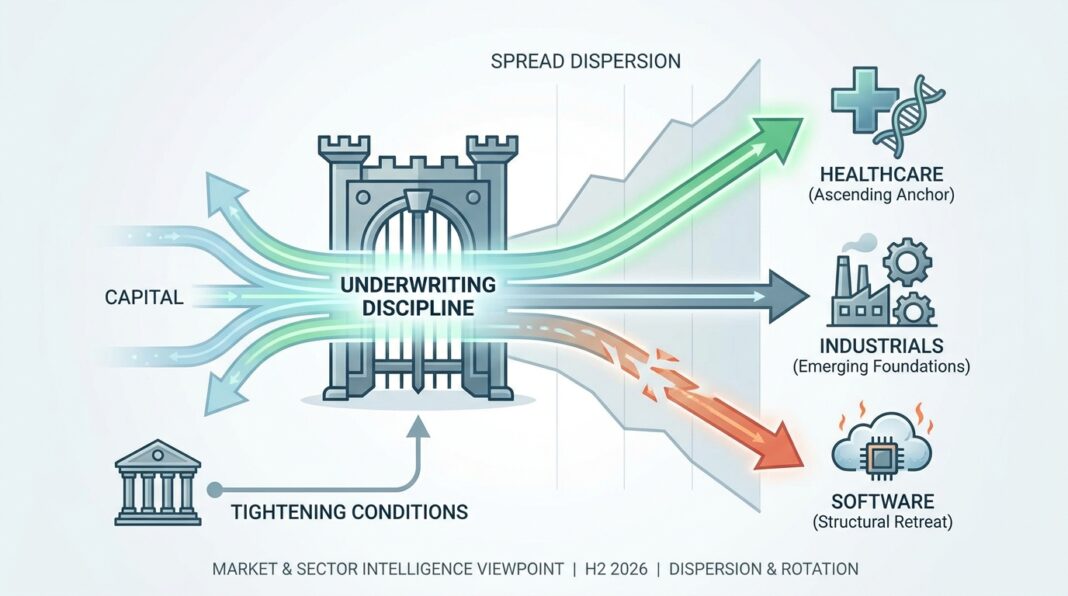
Market Headline: Dispersion Is the New Default
Private credit markets entered the second half of 2026 in a structurally altered state. What began as cyclical caution in Q1 (triggered by AI-driven software disruption, geopolitical escalation, and sticky inflation) has hardened into a lasting regime shift. The operative word across institutional lending desks is now dispersion: capital remains available, but its allocation is being governed by borrower quality, sector selection, and documentation standards to a degree not seen since the post-GFC era.
According to Lord Abbett, citing PitchBook data, spreads in the private credit market have widened by roughly 50 to 100 basis points since late 2025, and the structural terms accompanying new loans have materially improved: featuring less leverage, more covenants, fewer PIK requests, and tighter documentation. This is not simply a repricing; it is a reset of lender leverage in the negotiating process.
Meanwhile, the Federal Reserve’s April 2026 Senior Loan Officer Opinion Survey (SLOOS) confirmed that banks tightened C&I lending standards for firms of all sizes over Q1 2026, the second consecutive quarter of net tightening, citing worsening economic outlooks, reduced risk tolerance, and regulatory concerns. The FRED series shows the net percentage of large domestic banks tightening C&I standards for large and middle-market firms at 10.0% in Q2 2026, reinforcing that bank credit retreat is amplifying opportunity for disciplined private lenders.
Inflation data further complicates the macro backdrop. VRC reports headline CPI rose to approximately 4.2% in May 2026, a multi-year high, while core PCE hit 3.4%. The Fed held rates at 3.50%–3.75% at its June 2026 meeting, and the forward SOFR curve implies rates remaining elevated through 2028. For floating-rate middle market borrowers, this is a structural headwind, not a temporary disruption.
Quantitative Market Snapshot
The table below reflects current pricing, volume, and credit quality metrics derived from Q2 2026 market data. All figures are sourced from institutional market participants and regulatory filings.
| Metric | Current Value (Q2 2026) | Prior Period Comparison | Source |
|---|---|---|---|
| Unitranche Coupon Spread (Middle Market) | SOFR + 475–550 bps | ~SOFR + 450–525 bps at YE 2025 (+~25 bps) | VRC Q2 2026 |
| Senior Secured Unitranche All-In Yield (LMM) | 9.3%–11.3% (SOFR + 500–700 bps) | 8.0%–8.5% trough projected for 2026 (upper half of 12-yr range) | Morgan Stanley IM / CT Acquisitions |
| Secondary B-Rated Loan Spreads | ~43 bps wider than YE 2025; software +245 bps wider than YE 2025 | Peaked ~67 bps wider in Q1 2026; moderated ~20 bps in Q2 | VRC / PitchBook LCD |
| B-Minus Broadly Syndicated Loan Spreads | S + 409 bps (+55 bps YTD) | Higher-rated credits largely unchanged; dispersion widening | Sikich Q2 2026 |
| Direct Lending Deal Volume (Q2 2026) | $29.2B across 138 transactions (through June 22) | Q1 2026: $74.1B across 217 transactions (best quarter in 2 years) | PitchBook LCD / Pitchbook |
| Private Credit Default Rate (Proskauer Index) | 2.73% in Q1 2026 | 1.84% two quarters prior; BDC non-accruals: 1.53% of amortized cost (Top 20 BDCs, YE 2025) | Forbes / Proskauer / Goldman Sachs Private Credit |
| Middle Market Leverage (Debt/EBITDA) | 5.0x–6.0x for high-quality transactions | Stable; no material upward drift in Debt/EBITDA; underwriting more conservative post-March 2026 | VRC Q2 2026 / Heron Finance |
| EBITDA/Interest Coverage (Median) | ~1.6x (Q1 2026 median) | Coverage improved YoY on lower rates + EBITDA growth; above the 2022–2023 trough | Coller Private Credit / SEC |
| Fed SLOOS: Banks Tightening C&I Standards (Large/Mid-Market) | 8.1% net tightening (Q2 2026) | Second consecutive quarter of net tightening; higher premiums on riskier loans, tighter covenants | FRED / Fed SLOOS |
Data current as of mid-July 2026. Sources: PitchBook LCD, VRC, Proskauer, Federal Reserve SLOOS, Morgan Stanley IM, Goldman Sachs Private Credit Corp., Heron Finance, Coller Private Credit, Sikich.
Sector Analysis: Healthcare Ascends, Software Retreats, Industrials Emerge
Healthcare: The New Anchor Sector
The most significant sectoral shift of 2026 is the ascension of healthcare to the top of the private credit deal table. PitchBook LCD data confirms that since the start of 2026, healthcare surpassed technology, which is dominated by software, to take the largest share of new deals by count. In the broadly syndicated loan market, healthcare captured a record 12.4% of institutional loan issuance volume in Q2 2026, becoming the largest sector for the first time since 2015, per Sikich.
The sector’s fundamentals explain the capital migration. According to White & Case Debt Explorer, citing investment consultancy bfinance, specialist private credit healthcare funds have posted median net IRRs of 15%, compared to 11% for generalist U.S. direct lending funds. Pricing reflects the premium lender appetite: a recent $1.2 billion refinancing for Caris Life Sciences by Blue Owl and Blackstone priced at SOFR + 500 bps, while legacy transactions originated in 2023 carried spreads of SOFR + 650 bps, demonstrating meaningful spread compression in the sector despite broader market widening.
That said, not all healthcare lenders are bullish indiscriminately. Morgan Stanley IM maintains a significant underweight to healthcare in its direct lending strategies, noting that the sector led all categories in loans placed on non-accrual status over the prior year: a reminder that healthcare’s complexity, Medicare/Medicaid reimbursement risk, and roll-up structuring hazards require specialist underwriting to extract the sector’s risk-adjusted premium.
Software: Structural Credit Risk, Not Cyclical Noise
Software has experienced the most dramatic sector re-rating in private credit history. Sikich reports software’s share of broadly syndicated loan issuance fell to just 8.8% YTD through Q2 2026, down from 17.6% in 2025 and the lowest level since 2013. In secondary markets, software-sector B-rated spreads are approximately 245 basis points wider than year-end 2025 levels and roughly 229 bps above the broader B-rated loan index, per VRC citing PitchBook LCD.
The driver is structural, not cyclical. AI-driven disruption, specifically the threat to seat-based SaaS revenue models from agentic AI tools, has forced lenders to fundamentally reassess the durability of ARR-based underwriting frameworks. Partners Group flags that lenders are shifting in some cases from ARR- to EBITDA-based frameworks for software, and demanding wider spreads to compensate for uncertainty. The refinancing risk is real: nearly 50% of software loans maturing through 2030 come due by 2028-$30B in directly originated loans and $75B in leveraged loans, placing refinancing pressure beginning in mid-2027.
Industrials, Building Materials & Diversified Services: Quiet Beneficiaries
Capital rotating out of software is finding new homes in sectors with tangible collateral and durable cash flows. PitchBook’s Q2 2026 private credit wrap documents growing deal share for Building Materials, Retail, Food & Beverage, Chemicals, Automotive, and Utilities. Aerospace, defense, and government services are also identified as emerging opportunities, supported by elevated defense spending and procurement activity.
For lenders, these sectors offer maintenance covenant leverage, tangible asset collateral bases, and predictable cash conversion cycles, a welcome counterweight to the covenant-lite, cash-flow-dependent structures that characterized peak-cycle software lending.
Implications for Institutional Investors & Business Operators
For Borrowers and Sponsors
The era of lender concession is over. Lord Abbett characterizes the shift bluntly: new loans are increasingly coming with better credit structures: less leverage, more covenants, fewer PIK requests, and tighter documentation. For operators seeking capital, this translates to direct pressure on three KPIs that lenders are re-emphasizing in underwriting:
- Fixed Charge Coverage Ratio (FCCR): Lincoln International confirmed lenders are now underwriting to a forward-looking FCCR that incorporates expectations for interest rates, directly constraining the amount of debt a company can support. At a federal funds rate of 3.50%–3.75%, floating-rate borrowers must ensure FCCR of at least 1.2x–1.4x under stressed scenarios, not just current-period actuals. Private Equity Bro warns that EBITDA add-backs representing 30%+ of reported earnings are increasingly scrutinized, as they can obscure genuine coverage deterioration.
- Debt/EBITDA: VRC reports leverage of 5.0x–6.0x remains achievable for high-quality transactions through Q2 2026, but underwriting standards have become more conservative since March. Lenders are shifting from aggressive EBITDA add-back reliance, and the FSB notes that 10% of middle-market CLO borrowers lacked sufficient cash flow to cover interest payments, flagging the tail risk embedded in highly levered legacy portfolios.
- Loan-to-Value (LTV): Heron Finance’s Q2 2026 benchmark report confirms LTV ratios remain conservative and stable across segments, with lenders maintaining first-loss capital cushions: a signal that collateral quality, not just cash flow projection, is re-entering the underwriting conversation.
Sponsors that have used the slower deal environment to strengthen financial reporting, improve operating performance, and present a credible long-term growth strategy continue to find capital available, per Sikich. Those waiting for a return to borrower-friendly conditions may find the cycle has durably shifted.
For Institutional Lenders and Investors
Lord Abbett argues that today’s environment is potentially more attractive for disciplined lenders than the tighter conditions that prevailed six months ago, particularly in the core middle market, where lenders have more time to conduct diligence and more ability to influence documentation. Morgan Stanley IM projects that asset yields on directly originated first-lien loans will trough in the 8.0%–8.5% range, still in the upper half of the 12-year historical yield range.
The private credit CLO market is functioning as a structural release valve. Benzinga reports that middle-market CLO issuance totaled $17.3B through mid-June 2026, roughly matching the prior year pace, with AAA tranches from major platforms pricing around 148 bps over benchmark. Institutional capital has remained stable and in some cases increased as wider spreads create more attractive entry points, per Partners Group. It is wealth-channel, retail-oriented capital, concentrated in non-traded BDCs, that has experienced the redemption pressure, not institutional allocations.
The April 2026 SLOOS also revealed a significant new dynamic: banks reported tighter standards for all categories of NDFI loans, including business credit intermediaries, private equity funds, and consumer credit intermediaries, over the prior year, with higher risk premiums, stricter covenants, shorter maturities, and tighter collateralization requirements. This tightening in bank-to-fund lending is a material constraint on BDC leverage capacity and will structurally advantage well-capitalized, institutionally backed platforms with less reliance on bank subscription lines.
Forward-Looking View: H2 2026 and Beyond
The defining question for H2 2026 is not whether rates fall, but whether deal supply recovers enough to absorb available capital. Sikich’s Q2 2026 credit market update frames this directly: refinancing risk, sector selection, and borrower quality (not expectations of lower rates or a rebound in M&A) are likely to define credit markets in the second half of the year.
Morgan Stanley IM argues that new deal demand together with a large refinancing wave will gradually overtake private credit supply, creating an imbalance that allows lenders to preserve discipline, strengthen terms, and capture the illiquidity premium to public markets. The ~$75B software refinancing wave approaching mid-2027 will be a defining test of lender discipline and sector-specific underwriting capability.
Private credit AUM continues to expand. ABF Journal reports global private credit AUM has reached roughly $2.1 trillion, up from approximately $1.5 trillion a year earlier, with direct lenders now funding an estimated 85% of leveraged buyouts. Creative Planning notes Moody’s projects the market will more than double to $3 trillion+ AUM by 2028, but the pace of that growth will now be governed by underwriting discipline rather than deal volume alone. The managers who emerge strongest from this cycle will be those who combined patience, selectivity, and structural rigor when others chased volume.
Key Market Insights
- Spreads have reset lender-favorably. Middle market private credit spreads widened 50–100 bps since late 2025, with unitranche coupons now running SOFR + 475–550 bps and all-in yields of 9.3%–11.3%. This is the widest non-crisis margin environment in over a decade, creating compelling entry points for new vintage deployment. (Lord Abbett / CT Acquisitions)
- Healthcare is the new structural anchor sector. Healthcare surpassed technology in new deal count and captured a record 12.4% of institutional loan issuance in Q2 2026. Specialist healthcare credit funds are generating median IRRs of 15% vs. 11% for generalist funds, but underwriting complexity demands sector-specific expertise. (PitchBook / White & Case)
- Software risk is structural, not cyclical. With secondary software spreads ~245 bps above the broader B-rated loan index and a $105B refinancing cliff approaching 2027–2028, AI-driven revenue model disruption is a credit fundamental, not a sentiment event. Lenders are migrating from ARR- to EBITDA-based underwriting frameworks. (VRC / Partners Group)
- FCCR and covenant quality are the new terms battleground. With the Fed holding at 3.50%–3.75% and SOFR elevated, lenders are underwriting forward-looking FCCR, not backward-looking actuals, and demanding maintenance covenants, tighter collateral packages, and scrutiny of EBITDA add-backs that in some portfolios represent 30%+ of adjusted earnings. (Lincoln International / Private Equity Bro)
- Institutional capital is stable; wealth-channel capital is the stress vector. Q1 2026 BDC redemption requests jumped to nearly five times the prior four-quarter average, concentrated in wealth-oriented, semi-liquid vehicles. Institutional allocators have remained steady (or increased exposure) signaling that the structural integrity of the private credit market is intact at the institutional layer, while retail-channel vehicle design represents the key systemic risk to monitor. (Partners Group / PitchBook)


