
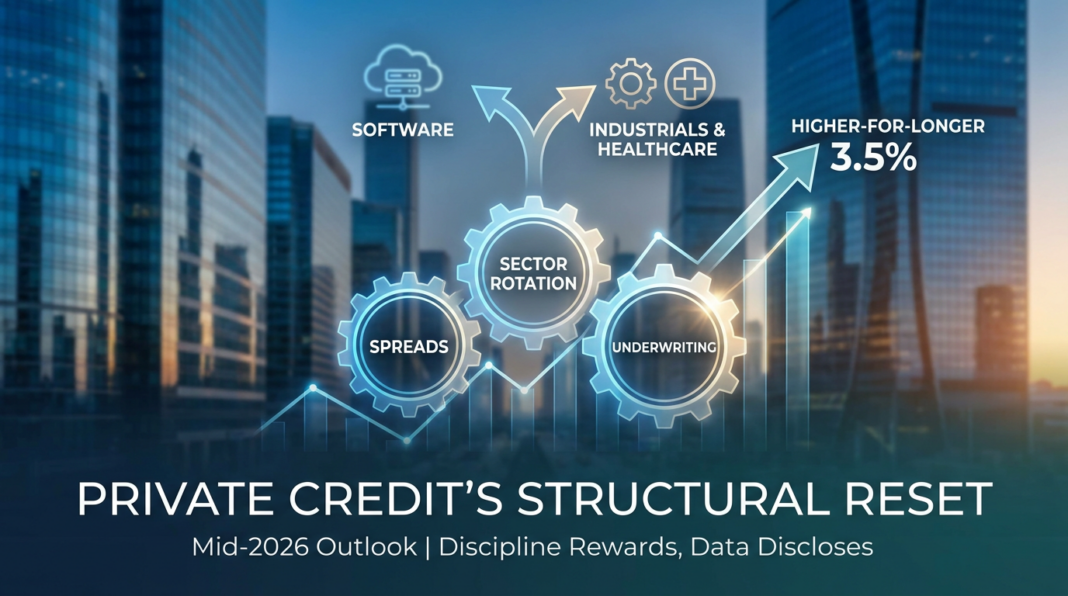
Market Headline: The Lender-Friendly Reset Is Here, And It Carries Risk on Both Sides
Credit markets at mid-2026 are undergoing a structural repricing that is simultaneously rewarding disciplined lenders and exposing the excesses of the prior cycle. The defining dynamic is not a single shock but a convergence of three forces: a Federal Reserve locked into a higher-for-longer posture with the fed funds target at 3.50%–3.75%, AI-driven disruption triggering the most severe sector-specific dislocation in the private credit asset class’s modern history, and geopolitical risk from the Middle East conflict sustaining upward pressure on energy prices and inflation expectations.
The direct result is a private credit market that has pivoted sharply in favor of lenders after years of borrower-friendly conditions. According to PitchBook data cited by Lord Abbett, spreads have widened by roughly 50 to 100 basis points since late 2025, and new loans are increasingly structured with less leverage, more covenants, fewer PIK requests, and tighter documentation. That structural improvement arguably matters more than the spread movement itself.
Yet the reset is not costless. Valuation Research Corporation’s Q2 2026 update confirms that software-sector secondary spreads are approximately 245 basis points wider than year-end 2025 levels, roughly 229 basis points above the broader B-rated loan index, as AI-driven uncertainty reprices an entire lending category. Meanwhile, ABF Journal reported that BDC redemption requests jumped 217% quarter-over-quarter through mid-June 2026, even as fund gates capped actual payouts near customary 5% of NAV levels. The message for institutional allocators and borrowers alike: the opportunity set is widening, but the margin for underwriting error has narrowed considerably.
Quantitative Market Snapshot
The following data table synthesizes the most current observable market metrics across public and private credit instruments as of Q2 2026, drawing on multiple independent data sources. All figures reflect the most recently available observations and are cited to primary or institutional sources.
| Metric | Current Level | Prior Period | Direction | Source |
|---|---|---|---|---|
| Unitranche Coupon Spread (Middle Market) | SOFR + 475–550 bps | SOFR + 450–525 bps (YE 2025) | ↑ Wider ~25 bps | VRC, Q2 2026 |
| Healthcare Direct Lending Spread | SOFR + ~500 bps | SOFR + ~500 bps (Q4 2025) | ↔ Stable (no tightening) | Octus / Octus Data |
| Software Sector Secondary Spread (vs. B-rated index) | ~+229 bps premium to index | At-index (YE 2025) | ↑ Significantly wider | PitchBook LCD via VRC, June 19, 2026 |
| US High Yield OAS (ICE BofA Index) | 267 bps (Jul 7, 2026) | ~284 bps (Apr 2026 peak) | ↓ Modestly tighter from peak | Convex / FRED, Jul 7, 2026 |
| S&P Leveraged Loan Index Spread | ~500 bps | ~457 bps (YE 2025 approx.) | ↑ Wider | Nuveen / S&P Index, July 2026 |
| Fed SLOOS: Net % Banks Tightening C&I Standards (Large/Mid-Market Firms) | +8.1% net tightening (Q2 2026) | Tighter Q1 2026 (positive net) | ↑ Continued tightening | FRED / Fed SLOOS, May 4, 2026 |
| Direct Lending Leverage Multiples (High-Quality Transactions) | 5.0x–6.0x Debt/EBITDA | Up to 6.5x+ (2024–early 2025) | ↓ More conservative post-March | VRC, Q2 2026 |
| Interest Coverage (FCCR proxy): New Transaction Underwriting | >2.0x (most new deals) | Near or below 2.0x (2023–early 2024) | ↑ Improving | VRC, Q2 2026 |
| Private Credit AUM (Global) | >$2.2 trillion | ~$1.5–$2.0 trillion (end-2024) | ↑ Continued growth | Preqin via PwC Mid-Year 2026 |
| Private Credit CLO Issuance YTD (mid-June 2026) | $17.3 billion | Similar pace vs. same period 2025 | ↔ Resilient | PitchBook via Benzinga, July 2026 |
Note: All spread data is as of most recently available public reporting. BDC-level data may differ from fund-level private credit metrics. Sources cited above.
Rate & Policy Context
The Federal Reserve held its target range at 3.50%–3.75% through Q1 and Q2 2026, citing elevated inflation and geopolitical uncertainty. VRC notes that headline CPI reached approximately 4.2% in May 2026, a three-year high, while core PCE rose to 3.4%. The 10-year Treasury finished the week of June 13 near 4.53%, close to a one-year high, per ABF Journal. Northleaf Capital reports that market projections now imply an average base rate of approximately 3.5% over the remainder of 2026–2028, approximately 20 bps higher than expectations just one quarter earlier. For floating-rate middle-market borrowers, the implication is direct: debt service relief through rate cuts has been deferred, not delivered.
Nuveen’s most recent fixed income commentary reports that markets are pricing approximately two Fed rate cuts by mid-2027, with 10-year Treasury yields expected to range between 4.25% and 4.50% at year-end. Against this backdrop, Morgan Stanley Investment Management forecasts direct lending asset yields will trough in the 8.0%–8.5% range in 2026 even after accounting for modest spread compression, still elevated by historic standards and in the upper half of their 12-year range.
Regulatory & Bank Lending Standards: The Dual Tightening Signal
Two converging forces are reshaping the bank lending landscape and reinforcing private credit’s structural opportunity. First, the Fed’s Q2 2026 SLOOS data confirms that 8.1% net of domestic banks tightened standards for C&I loans to large and middle-market firms in Q2 2026, marking the second consecutive quarter of net tightening. For large banks specifically, the net tightening figure reached 10.0%. The April 2026 SLOOS also introduced, for the first time, a dedicated module on nondepository financial institution (NDFI) lending, and the findings were notable: banks reported tighter standards across all NDFI loan categories over the prior year, including stricter covenants, shorter maturities, higher premiums on riskier loans, and lower maximum credit line sizes.
Second, the regulatory environment for banks is simultaneously creating new capital capacity in some areas while constraining others. Columbia Threadneedle notes that NDFI loans have risen from roughly $200 billion a decade ago to approximately $1.5 trillion in Q4 2025, representing around 11% of total U.S. bank loans, driven in part by favorable Basel III risk-weight treatment (20%–30% for NDFI loans versus 100% for traditional C&I loans). In December 2025, U.S. regulators rescinded the 2013 Leveraged Lending Guidance, a move that HL Hunt Research notes could allow banks to underwrite riskier credit more freely across the leverage spectrum and compete more directly with private credit in the upper middle market, though actual re-entry has been gradual.
Sector Analysis: Capital in Motion
Software & Technology: Structural Repricing, Not Temporary Volatility
The most consequential sector-level development in 2026 is the forced repricing of software and SaaS exposure across private credit portfolios. Morningstar LSTA data shows that a record $25 billion in software-sector loans now trade below the distress threshold of 80 cents on the dollar in the leveraged loan market. CAIA notes that outstanding loans to SaaS firms grew from roughly $8 billion in 2015 to over $500 billion, or approximately 19% of total direct loans, by end-2025, with roughly a third of private credit funds holding SaaS exposure. The logic was sound during low-rate conditions: predictable recurring revenue, sticky customers, high margins. The AI disruption thesis is now testing those assumptions fundamentally.
The January 2026 SLOOS flagged an important structural signal: banks reported, on net, being more likely to approve loans to firms benefiting from high AI exposure and materially less likely to approve loans to firms adversely affected by AI, a bifurcation that is now clearly visible in credit pricing. Hamilton Lane draws an important distinction: cash flow-based lenders focused on deeply entrenched, mission-critical software offerings with long-term contracts and lower loan-to-value ratios are better positioned than general-purpose or seat-based SaaS lenders. The market is moving from a sector-level view to a company-specific underwriting framework for software credits.
Healthcare: The Durable Core
Octus data confirms that healthcare led all private credit sectors in 2025, accounting for 19% of all direct lending deals, and was the only major industry that did not experience significant year-over-year price tightening, with spreads holding at approximately SOFR+500 bps in Q4 2025. Demographic tailwinds and non-cyclical service models continue to attract lender capital. The Blackstone and TPG acquisition of Hologic, valued at $18.3 billion and cited by PwC’s mid-year M&A report, underscores persistent sponsor appetite for scaled healthcare platforms. The one caveat: Morgan Stanley Investment Management maintains a significant underweight to healthcare within its direct lending portfolios specifically because the sector has led all sectors in non-accrual placements over the past year, confirming that lender selectivity within healthcare at the deal level remains paramount.
Industrials, Infrastructure & "Real Economy" Sectors: The New Lender Favorite
As lenders rotate away from software, PitchBook’s Q2 2026 private credit wrap reports intensifying competition for companies in the industrials segment that appear insulated from AI disruption. PGIM Private Capital’s middle-market direct lending business is explicitly targeting “real economy” borrowers: food and beverage, consumer staples services, value-add industrial distribution logistics, and select healthcare subsectors. Man Group’s credit research describes businesses anchored in the physical economy, with stable recurring demand and limited technological obsolescence risk, as offering “fundamental credit quality that the current AI-dominated narrative is leaving underappreciated.” Healthcare services, industrials, business services, food and beverage, and infrastructure-adjacent sectors are receiving increased lender attention and, in some cases, tighter spread pricing as competition for high-quality credits intensifies.
Digital Infrastructure: The Emerging Growth Vertical
HedgeCo Insights notes that the AI boom has created massive capital needs for data centers, power infrastructure, fiber networks, and cloud capacity, with Apollo’s 2026 credit outlook describing AI as a major source of incremental credit supply as hyperscaler capex has already increased sharply since 2023. Private credit managers (not banks or public bond markets) are positioned to provide the bespoke capital structures these projects require. Asset-backed finance (ABF) and digital infrastructure lending are becoming central to the private credit growth thesis, with Moody’s expecting AUM to exceed $2 trillion in 2026 and approach $4 trillion by 2030, driven meaningfully by ABF expansion.
Credit Quality, KPIs & Underwriting Standards
Leverage Multiples: VRC’s Q2 2026 update confirms that through June 2026, competitive dynamics have supported leverage levels often in the 5.0x–6.0x debt/EBITDA range for high-quality transactions, but underwriting standards have become more conservative since March amid higher base rate expectations and constrained M&A volumes. This compares favorably to the 2023–early 2025 period when leverage frequently exceeded 6.5x.
Fixed Charge Coverage Ratios (FCCR): The same VRC data indicates that during 2023 and early 2024, lenders underwrote deals with interest coverage ratios near or below 2.0x, reflecting expectations for lower SOFR and improving EBITDA. More recent transactions reflect higher coverage levels above the 2.0x historical threshold, supported in part by the approximately 170 bps decline in SOFR since September 2023. Borrowers presenting sub-2.0x FCCR coverage in new deals will face increasingly difficult execution environments in H2 2026.
Default & Non-Accrual Rates: The picture is nuanced. Hamilton Lane reports that the LTM leveraged loan default rate (issuer count basis) stood at 1.36% as of February 2026, below the 10-year average of 1.71%. Including distressed exchanges, the rate was 3.54%, down from 4.24% in 2025. However, the distressed ratio, a leading indicator, reached 8.89% in February 2026, near cycle highs. Moody’s estimates the 2025 private credit default rate was likely in the range of 1.6%–4.7%, while Morgan Stanley has warned that direct lending default rates, currently running near 5.6%, could reach 8%, well above the 2%–2.5% historical average, depending on macro conditions. PIK income as a share of total BDC interest income continues to rise, a leading indicator that the CAIA and others flag as requiring close monitoring in Q2 2026 BDC filings.
Documentation & Covenant Quality: Lord Abbett’s midyear analysis identifies the shift in credit documentation as potentially more important than spread widening itself. New loans are increasingly structured with genuine maintenance covenants, tighter collateralization requirements, and fewer PIK election rights, a meaningful reversal from the covenant-lite, PIK-heavy origination environment of 2023–2025. For institutional lenders deploying new capital, this structural quality improvement is the primary underwriting advantage of the current entry point.
Implications: What This Means for Borrowers and Investors
For Borrowers & Operators
- Software & SaaS borrowers face a structurally altered market. JPMorgan has begun restricting lending to loans associated with software companies in its private credit funds, while secondary market pricing signals that many BDC portfolios have yet to fully reprice equivalent credits. Borrowers in this segment should expect lender scrutiny of AI disruption exposure, seat-based revenue models, customer churn metrics, and loan-to-value ratios, and should proactively address documentation headroom before it is needed.
- Middle-market companies in industrials, healthcare services, and distribution currently occupy the most favorable borrower position in years. With lenders actively competing for non-AI-exposed credits, well-capitalized borrowers in these sectors with clear FCCR headroom (>2.0x), conservative leverage (<5.5x), and strong free cash flow conversion can access capital at competitive terms, though they should expect tighter covenant structures than two years ago.
- All floating-rate borrowers must accept a baseline: with SOFR projected to average approximately 3.5% through 2028 per Northleaf Capital, debt service relief is not imminent. Operators should stress-test coverage ratios at current SOFR levels, not at projected cuts that may not materialize in 2026.
For Institutional Investors & Lenders
- Scaled, disciplined platforms are the primary beneficiaries of the current environment. PwC’s 2026 Private Credit Survey confirms that rising compliance costs, fee compression, and operational complexity are accelerating industry consolidation toward fewer, larger managers with multi-strategy capabilities. Investors allocating to the asset class should prioritize platform scale, origination depth, and demonstrated underwriting discipline over headline yield.
- The semi-liquid vehicle redemption wave is a structural, not temporary, issue. PitchBook’s Q2 wrap notes that private credit secondaries are seeing explosive growth, with more loans being offered at discounts ranging from 3 cents to over 10 cents below par as redemption pressure forces secondary liquidity. Institutional investors with longer lock-ups can capitalize on these secondary dislocations at attractive entry prices.
- ABF and digital infrastructure represent the highest-conviction forward opportunity. Blue Owl Capital notes that the dedicated ABF fund manager universe currently manages less than $500 billion, severely underserved relative to the addressable opportunity, offering scaled platforms the chance to capture meaningful market share with differentiated underwriting capabilities.
Forward Outlook: The Next 3–6 Months
The second half of 2026 will be defined by dispersion, not direction. Wellington Management’s midyear credit outlook identifies the widest sector-level spread dispersion in years, arguing that average index spreads, now returned to historically tight levels, mask the value available in specific sectors and issuers. The defining shift is that supply shocks from both the Middle East conflict and AI disruption affect sectors and issuers unevenly, meaning duration no longer offsets credit risk to the same degree and active credit selection is disproportionately rewarded.
Portage Point Partners’ Q1 2026 credit update notes that despite a slower start to the year, liquidity remains strong, lenders remain active, and borrowers retain multiple execution paths. Institutional loan issuance rebounded to $241 billion in Q1 2026, up 54% sequentially from Q4 2025, though down 32% year-over-year. VRC confirms that middle market PE deal value increased approximately 10.7% year-over-year and exit activity rose 14%, suggesting the M&A recovery that private credit lenders are counting on to expand deal flow is beginning, albeit unevenly and selectively.
The most important forward monitor: CAIA and Morgan Stanley both flag PIK income as a share of total BDC investment income as the single leading indicator of approaching hard defaults. Institutional investors and lenders should treat Q2 2026 BDC 10-Q filings, expected in the coming weeks, as the most informative forward-looking data release of the current cycle.
Key Market Insights
- Spreads are wider, but structure matters more. Private credit unitranche spreads are approximately 25–100 bps wider than year-end 2025 levels, per PitchBook and VRC. More importantly, new loans now carry genuine maintenance covenants, lower leverage multiples (5.0x–6.0x vs. 6.5x+), tighter documentation, and reduced PIK flexibility, a structural quality improvement that may prove more durable than the spread increment itself.
- The software sector faces a multi-year repricing cycle, not a temporary volatility event. With $25 billion in software loans trading below 80 cents on the dollar in the leveraged loan market, AI disruption is driving a fundamental reassessment of SaaS credit underwriting assumptions. Lenders, bank and non-bank alike, are restricting new origination and demanding significantly wider spreads and lower LTVs for software exposures.
- Bank tightening is a private credit tailwind, but only for scaled, institutional-grade platforms. The Fed’s Q2 2026 SLOOS confirms a net 8.1% of banks tightened C&I lending standards for large and middle-market firms, and a new SLOOS module reveals tighter standards for NDFI loans across all categories. Banks’ gradual return to upper-middle-market lending is compressing spreads at the large-cap end while leaving the core middle market as private credit’s most defensible competitive territory.
- FCCR >2.0x is now the effective underwriting floor. VRC’s Q2 2026 data confirms that new transactions are being underwritten at fixed charge coverage ratios above 2.0x, a material shift from the sub-2.0x underwriting common in 2023–2024 when lower SOFR was assumed. Borrowers and operators should treat 2.0x FCCR as the current minimum credible threshold for institutional lender execution; anything below will face structural pushback or significantly wider pricing.
- The highest-conviction opportunities are in "real economy" sectors and ABF, not in chasing headline spread. Healthcare services, industrials, food and beverage, distribution logistics, and digital infrastructure are receiving increased allocator and lender attention. The ABF market, with less than $500 billion in dedicated fund manager AUM against a multi-trillion-dollar addressable opportunity, represents the clearest structural growth lane for private credit capital deployment in H2 2026 and into 2027.


