
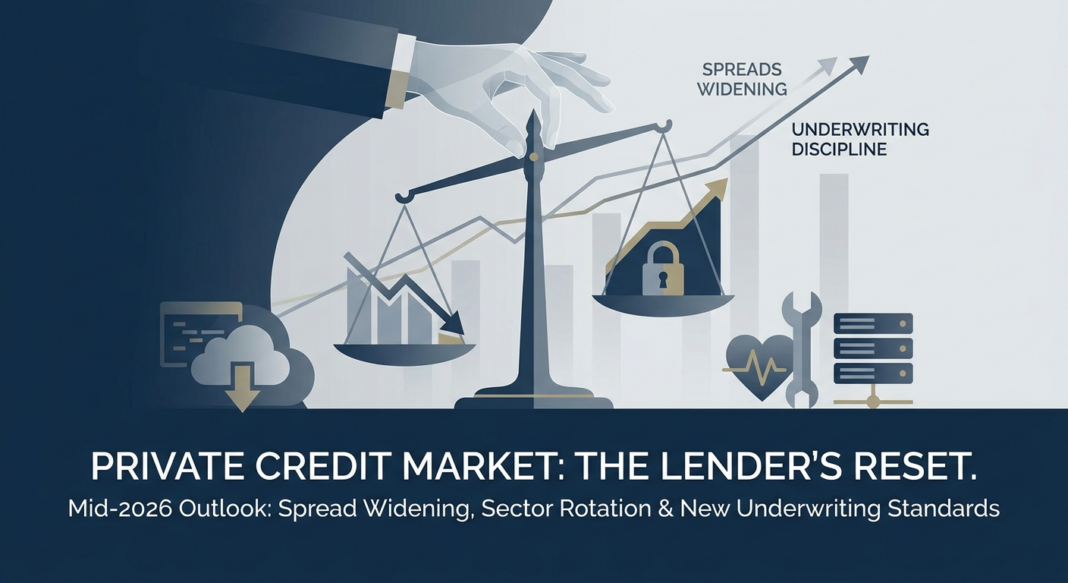
Market Headline: The Pendulum Swings Back to the Lender
Credit markets at midyear 2026 are navigating a regime that few participants anticipated at the start of the year. Three converging forces: sticky inflation that has shut the Federal Reserve’s rate-cut window, an AI-driven rout in software-sector valuations, and geopolitical disruption stemming from the Middle East conflict, have rewritten the terms of engagement between borrowers and lenders.
The headline story is a structural reset. lordabbett.com reports, citing PitchBook data, that private credit spreads have widened by roughly 50 to 100 basis points since late 2025, while defensive structural terms have also improved, marking the most material lender-favorable shift since before the 2022 rate cycle. But spread widening alone understates what has changed: new loans are increasingly structured with less leverage, more covenants, fewer PIK requests, and tighter documentation, a qualitative shift in underwriting discipline that matters as much as price.
Against that backdrop, Q2 2026 direct lending volumes dropped sharply: pitchbook.com (PitchBook LCD) recorded just $29.2 billion across 138 direct lending transactions through June 22, well below the $74.1 billion across 217 deals in Q1, which itself was the strongest quarter in two years by volume. The contraction reflects sponsor paralysis, not lender incapacity. For well-capitalized institutional lenders with dry powder, the combination of wider spreads, tighter structures, and reduced competition represents arguably the most attractive origination environment since 2023.
Quantitative Market Snapshot
The table below consolidates the most current market metrics available as of July 10, 2026. All figures are sourced from primary market data or institutional-grade research.
| Metric | Current Value (Q2 2026) | Prior Period | Change | Source |
|---|---|---|---|---|
| Middle Market Unitranche Spreads | SOFR + 475–550 bps | SOFR + 450–525 bps (YE 2025) | +25 bps | valuationresearch.com (VRC) |
| Software Sector Secondary Loan Spread Premium vs. B-Rated Index | ~+229 bps above B-rated index | ~0 bps premium (YE 2025) | +229 bps | valuationresearch.com (PitchBook LCD, June 19, 2026) |
| U.S. High Yield Bond Spread | ~355 bps (end of Q1 2026) | 314 bps (YE 2025) | +41 bps | TPG 10-Q (J.P. Morgan data) |
| Fed SLOOS: Net % of Large Banks Tightening C&I Standards (Large & MM Firms) | +10.0% (net tightening) | Q1 2026: modest net tightening | Continued tightening | FRED / Federal Reserve SLOOS (May 4, 2026) |
| Direct Lending Deal Volume Q2 2026 | $29.2B / 138 transactions (through June 22) | $74.1B / 217 deals (Q1 2026) | -61% QoQ by volume | pitchbook.com (PitchBook LCD) |
| Private Credit AUM | ~$2.1 trillion | ~$1.5 trillion (approx. 1 year prior) | +$600B YoY | abfjournal.com |
| Private Credit Headline Default Rate (LTM by count, Q1 2026) | 3.1% | 3.9% (Q1 2025) | -80 bps YoY improvement | Coller Private Credit Secondaries N-CSR (SEC, FY2026) |
Two additional macro anchors define the financing environment. First, the Federal Reserve’s target rate remains at 3.50%–3.75%, with May 2026 CPI printing at 4.2% year-over-year, a three-year high, effectively foreclosing near-term cuts. valuationresearch.com notes the forward SOFR curve now sits approximately 50 basis points above year-end 2025 levels, pushing all-in direct lending yields materially higher for floating-rate borrowers. Second, the OCC and FDIC’s December 2025 rescission of the 2013 Interagency Leveraged Lending Guidelines has quietly reshaped competitive dynamics: chambers.com reports this change gives private credit lenders greater flexibility to define leverage thresholds on their own terms, potentially allowing deeper underwriting at the margin.
Sector Analysis: Rotation Out of Software, Into Healthcare, Infrastructure, and Hard Assets
The most significant structural market shift in H1 2026 is the collapse of software’s premium status in private credit portfolios, and the capital rotation that has followed.
Software: From Darling to Distressed
Software had been the dominant sector in leveraged lending and BDC portfolios for the prior cycle. That standing has been severely impaired. valuationresearch.com documents that secondary software loan spreads are approximately 245 basis points wider than year-end 2025 levels as of June 19, 2026, and roughly 229 basis points above the broader B-rated loan index. saastr.com cites Morningstar LSTA data showing a record $25 billion of software-sector loans now trading below the distress threshold of 80 cents on the dollar. The April 2026 SLOOS confirmed banks are now explicitly less likely to approve loans to AI-adversely affected borrowers. Lenders are conducting AI-impact assessments on a case-by-case basis, with profitable, mission-critical software businesses receiving meaningfully different underwriting treatment from ARR-dependent pre-profitability names.
Healthcare: The New Volume Leader
pitchbook.com reports that since the start of 2026, the Healthcare sector has surpassed Technology as the leading sector in private credit deal flow. octus.com notes that healthcare led all 2025 direct lending by sector at 19% of deal count, and was the only major sector not to see meaningful year-over-year spread tightening, with spreads landing at an average of approximately SOFR+500 bps in Q4 2025. However, caution is warranted: Morgan Stanley has flagged that healthcare has led all sectors in loans placed on non-accrual status over the past year, specifically citing highly leveraged healthcare roll-ups that were structured in a cheap-money era. Operators with comfortable fixed charge coverage ratios (FCCR) above 1.25x and genuine pricing power command the best terms; leveraged roll-ups trading near covenant minimums face materially tighter lender appetite.
Infrastructure & Hard Assets: The Emerging Beneficiary
spglobal.com notes that U.S. utilities are increasingly engaging private credit providers to help fund large-scale infrastructure and growth capital expenditure, with the sector traditionally reliant on public markets now exploring private credit as a supplementary funding source. This reflects private credit’s expanding mandate beyond middle-market corporate lending into capital-intensive, asset-heavy sectors. Data center infrastructure also attracted significant private credit activity in Q2 2026, including a roughly $500 million loan supporting Cerberus Capital’s acquisition of S+S Industries, signaling that physical AI infrastructure commands strong lender appetite even as software-as-a-service comes under pressure. Office CRE, by contrast, remains firmly out of favor: spglobal.com confirms private credit appetite for office assets has diminished relative to other property and infrastructure-linked segments.
Regulatory Catalyst: NDFI Lending Under New Scrutiny
The April 2026 SLOOS introduced, for the first time, a dedicated set of questions on bank lending standards for nondepository financial institution (NDFI) loans, a direct acknowledgment of how intertwined banks and private credit have become. federalreserve.gov reports significant net shares of banks tightened standards for NDFI loans over the past year, with higher premiums on riskier loans, stricter covenants, shorter maturities, and tighter collateralization requirements. columbiathreadneedle.com contextualizes the scale: NDFI loans have risen from approximately $200 billion a decade ago to roughly $1.5 trillion in Q4 2025, representing approximately 11% of total U.S. bank loans, making these tightening standards a systemic transmission mechanism worth monitoring carefully.
Implications for Borrowers and Institutional Investors
For Borrowers and Operators
The era of borrower-friendly terms is over for most market segments. Operators approaching the debt capital markets in H2 2026 should expect lenders to prioritize FCCR above 1.25x, lower leverage multiples relative to 2021–2024 vintage deals, and tighter covenant packages. abfjournal.com notes that the competitive tension between banks re-entering the upper middle market and private credit lenders is actually healthy for larger, higher-quality borrowers; those who can demonstrate durable EBITDA, strong collateral, and manageable debt-to-equity ratios will retain multiple execution paths. Smaller borrowers and those with material software exposure or covenant-lite legacy structures face a materially harder environment. For any borrower near a covenant threshold, proactive lender engagement, before a breach rather than after, is the operationally critical move.
For Institutional Investors and Lenders
am.jpmorgan.com reports that 51% of institutional investors plan to increase allocations to private credit, and 41% aim to maintain them, even amid the Q1 2026 redemption pressure in retail-oriented vehicles. The bifurcation is sharp: institutional capital locked in closed-end structures is stable, while non-traded BDC redemption requests averaged 9–10% of NAV in Q1 2026, far exceeding the standard 5% quarterly caps. kbra.com (KBRA) maintains Stable Outlooks for the vast majority of its rated BDCs, noting conservative leverage profiles and manageable non-accrual levels. For allocators, the actionable question is not whether to maintain exposure but where: manager selection, sector concentration, and 2021–2022 vintage exposure are the differentiating variables heading into H2.
lordabbett.com frames the opportunity precisely: managers with dry powder can now be more selective about the credits they choose to finance: obtaining better spread, better covenants, and better structural protection than was available six to twelve months ago. That combination represents a meaningful improvement in risk-adjusted return potential for disciplined, patient capital.
Forward-Looking View: Dispersion, Not Dislocation
wellington.com describes 2026 as the year of the widest sector dispersion in years: average spreads have returned to historically tight levels at the index level, but beneath those averages, the gap between winners and losers has widened materially. That framing is the correct lens for H2 2026: this is not a broad credit dislocation, but a highly concentrated stress event in software and leveraged healthcare, running in parallel with genuinely attractive origination conditions in infrastructure, healthcare services with strong coverage, and hard-asset-backed structures.
northleafcapital.com notes that periods of market volatility typically see banks and liquid credit markets retrench, with private equity sponsors turning to private credit for greater execution certainty. With market projections implying an average base rate of approximately 3.5% over the remainder of 2026 through 2028-20 basis points higher than prior estimates, the higher-for-longer rate environment is now embedded in underwriting assumptions. For well-capitalized lenders, this sustains the income premium of floating-rate private credit over public alternatives. ares.com notes private credit has historically delivered returns 200 to 400 basis points above liquid-credit alternatives across multiple rate cycles, a premium that the current reset in structures and spreads reinforces.
The private credit secondary market is also evolving rapidly as a release valve: pitchbook.com reports that liquidity pressures have prompted private credit managers to list more loans in a secondary capacity than ever before in 2026, with some trading at par and others at discounts of 3 to over 10 cents below par. This secondary market activity is nascent but growing, and represents a new price discovery mechanism for the asset class that institutional buyers with liquidity should monitor actively.
Key Market Insights
- Spread Widening is a Feature, Not a Bug: Middle market unitranche spreads are 25–100 bps wider than late 2025 levels and new loan structures carry more covenants, less leverage, and tighter documentation, the most lender-favorable origination environment in roughly three years. (Lord Abbett / PitchBook; VRC)
- Software is the Fault Line, Not the System: A record $25 billion of software loans trade below 80 cents on the dollar, and software secondary spreads sit 229 bps above the broader B-rated index, but the stress is sector-specific and concentrated, not systemic. Profitable, mission-critical software credits require separation from ARR-dependent, AI-vulnerable names. (saastr.com / Morningstar LSTA; caia.org)
- Bank Tightening Remains a Private Credit Tailwind: The Fed SLOOS shows a net 10.0% of large banks tightening C&I lending standards for large and middle-market firms in Q2 2026, with the April 2026 survey confirming tighter standards for NDFI loans across all categories, reinforcing the structural lending gap that private credit is positioned to fill. (FRED / Federal Reserve; Federal Reserve April 2026 SLOOS)
- Healthcare and Infrastructure are the Volume Leaders: Healthcare has surpassed Technology as the top private credit sector in 2026 deal flow, and U.S. utilities and data center infrastructure are emerging as new large-scale private credit borrowers. Lenders should distinguish between well-covered healthcare services operators (strong FCCR, stable reimbursement) and over-levered healthcare roll-ups (elevated non-accrual risk). (PitchBook LCD; S&P Global)
- Institutional Conviction Remains High Despite Retail Pressure: 51% of institutional investors plan to increase private credit allocations; BDC leverage profiles remain conservative and KBRA holds Stable Outlooks on the majority of rated BDCs, but the divergence between institutional closed-end capital and semi-liquid retail vehicles is the defining structural tension to monitor in H2 2026. (J.P. Morgan Asset Management; KBRA)


