
The Regime Has Shifted, and the Data Confirms It
Private credit markets entered 2026 on constructive footing: ample dry powder, tightening spreads, and building M&A momentum from the second half of 2025. That narrative has since been overtaken by a sequence of compounding shocks. A sharp AI-driven repricing across software and technology credits, renewed geopolitical tension introducing upside inflation risk, and persistent tariff and trade policy uncertainty have collectively suppressed risk appetite across the capital stack, according to Bond Capital’s Q1 2026 market analysis.
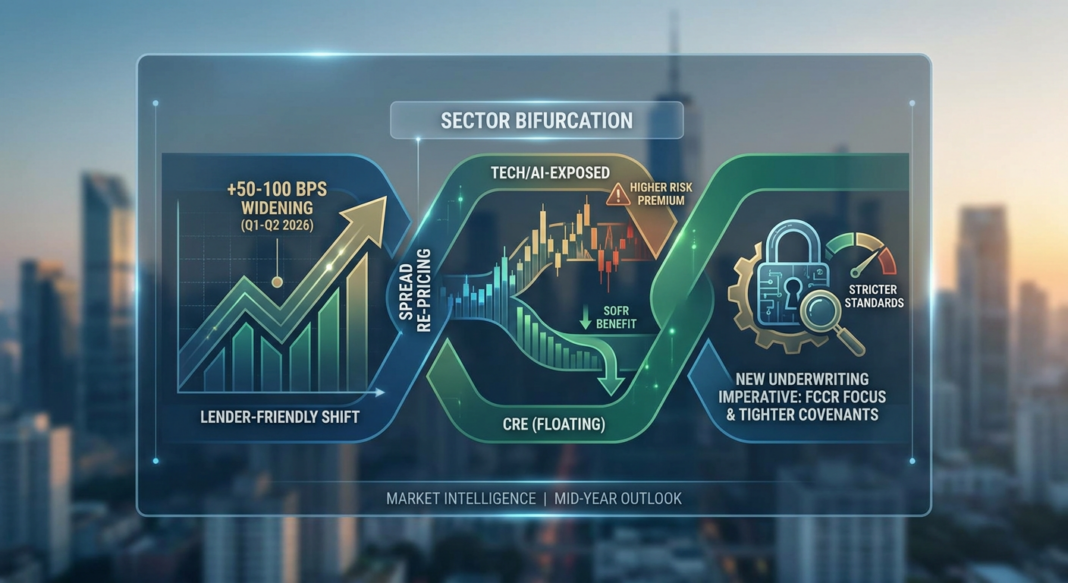
At midyear, the most important development is not simply that macro headwinds remain in place; it is that the private credit market has structurally reset in a more lender-friendly direction. As Lord Abbott’s 2026 Midyear Investment Outlook observes, spreads have widened by roughly 50 to 100 basis points since late 2025, while new loan documentation increasingly features less leverage, more covenants, fewer PIK requests, and tighter collateralization. For disciplined lenders deploying new capital, the current setup is arguably more attractive than the tighter-spread, looser-structure environment that prevailed just six months ago.
The macro transmission mechanism is straightforward: the Federal Reserve’s April 2026 Senior Loan Officer Opinion Survey (SLOOS) confirmed tighter Non-Depository Financial Institution lending standards, including higher premiums on riskier loans, stricter covenants, shorter maturities, and lower maximum credit lines, per Bond Capital’s credit cycle analysis. With base rates anchored near 4.50%, well above the 3% SOFR path that many floating-rate borrowers modeled, debt service is materially heavier than projected, and covenant headroom across the lower middle market is thinning, as ABF Journal’s Middle Market Debt Weekly detailed in its June 6 edition.
Quantitative Market Snapshot
The table below captures the key credit market metrics as of Q1–Q2 2026, benchmarked against prior-period readings:
| Metric | Current (Q1–Q2 2026) | Prior Period (Q3–Q4 2025) | Change | Source |
|---|---|---|---|---|
| Direct Lending 1st Lien Spread (new issue) | ~500–525 bps over SOFR | ~486–497 bps (Oct–Nov 2025) | +25 bps (matrix-wide; more for tech) | Bond Capital / VRC |
| S&P Leveraged Loan Index Spread | ~487 bps | Tighter pre-Liberation Day levels | Near widest since Apr 2025 dislocation | ABF Journal |
| B-Rated Loan Spreads (secondary market) | ~67 bps wider than year-end 2024 | Year-end 2024 baseline | +67 bps YTD | Bond Capital |
| Distressed Loan Ratio (Leveraged Loan Market) | 8.89% (February 2026) | Below 8% through most of 2025 | Highest since rate-hiking cycle began | Bond Capital |
| CRE Floating-Rate Senior Short Spread (lower leverage) | 267 bps over SOFR | Wider in Q4 2025 | Continued tightening; avg all-in -10 bps QoQ | Altus Group |
| SOFR (Q1 2026 quarterly average) | 366 bps | 399 bps (Q4 2025) | -33 bps QoQ; -67 bps YoY | Altus Group |
| Private Credit True Default Rate (incl. selective defaults & LMEs) | ~5% (adjusted) | Headline rate below 2% (multi-year) | Materially higher once LMEs included | Bond Capital |
Sector Analysis: Where Lender Appetite Is Expanding, and Where It Has Retreated
Software & Technology: Effective Credit Rationing for AI-Exposed Borrowers
Software and technology credits represent the most challenged segment of the private credit market heading into mid-2026. According to Bond Capital’s Q1 analysis, spreads in this sector widened approximately 200 basis points from year-end 2025, with lenders imposing an additional AI-risk premium of roughly 75 basis points for borrowers unable to demonstrate a credible AI positioning narrative, either as beneficiaries or as defensively insulated from AI disruption. The launch of Anthropic’s Claude Cowork product was cited as a specific catalyst for accelerated repricing across syndicated loans and publicly traded BDCs. Lower implied enterprise values have simultaneously elevated loan-to-value ratios, forcing lenders away from programmatic underwriting into case-by-case credit review. Borrowers with uncertain AI exposure are, in practical terms, effectively shut out of primary markets.
Commercial Real Estate: A Tale of Two Benchmark Directions
CRE debt markets entered Q1 2026 in a state of transition, according to Altus Group’s Q1 2026 US Debt Capital Market Survey, which captured 1,866 quotes from 110 industry professionals. Quote volume rebounded 24% from Q4 2025’s holiday-depressed levels, and average all-in rates fell 10 basis points quarter-over-quarter and 68 basis points year-over-year. However, the divergence between floating-rate (benefiting from SOFR’s descent) and fixed-rate (facing upward Treasury yield pressure of roughly 10 basis points QoQ) structures is creating a critical decision point for CRE borrowers. Hotel assets are seeing particularly aggressive spread repricing, a segment that would have been considered largely uninvestable by many lenders twelve months ago.
Middle Market Broadly: Pressure Intensifying on Weaker Balance Sheets
Across the broader middle market, the higher-for-longer rate environment is exposing credits that were underwritten to an aggressive easing scenario, per ABF Journal. Full-year 2025 U.S. broadly syndicated CLO issuance reached $472 billion across more than 1,000 transactions, leaving the buy side well-stocked but increasingly selective. Direct lenders with committed, locked-up capital are positioned to take market share from a more skittish syndicated market, particularly for credits requiring hold-through-volatility capital rather than a syndication exit.
The New Underwriting Imperative: FCCR Is Now the Primary Lens
The structural shift in lender behavior has a clear underwriting correlate. The Fixed Charge Coverage Ratio has re-emerged as the primary credit lens: displacing the Interest Coverage Ratio, which, as Bond Capital’s credit cycle analysis details, can be materially distorted by adjusted EBITDA figures that fail to capture true debt service capacity. EBITDA add-backs representing 30% or more of reported EBITDA are not unusual in middle market transactions, and lenders are scrutinizing these adjustments with renewed discipline. Borrowers presenting clean FCCR metrics above 1.2x with limited add-back exposure will command materially better pricing and structural terms in the current environment.
For institutional investors, Lord Abbott’s midyear outlook highlights that non-accruals, PIK usage, sector concentration, and 2021–2022 vintage exposure are the leading portfolio differentiation indicators to monitor as the year progresses. Portfolios with heavy exposure to aggressively financed software-related credits from those vintage years face compounding risk: spread widening, LTV deterioration, and approaching maturity walls simultaneously.
Implications and Forward-Looking View
For Borrowers
The window for covenant-lite structures and aggressive leverage multiples in mid-market deals has materially narrowed. Operators approaching primary markets in the next two to three quarters should prioritize clean cash flow documentation, credible FCCR support, and, critically for technology-adjacent businesses, a clearly articulated AI positioning narrative. Those unable to demonstrate defensibility or beneficiary status should expect either materially wider pricing or restricted access to committed capital.
For Lenders and Institutional Investors
Substantial dry powder remains undeployed across private credit platforms, and the reset in both spread levels and credit structures represents a more attractive deployment environment than late 2025, per Lord Abbott. The Fed’s projected average base rate of approximately 3.3% over 2026–2028, roughly 15 basis points above prior expectations, means all-in yields on senior secured private credit remain attractive in absolute terms. However, the distressed ratio at 8.89% is a leading indicator demanding portfolio stress-testing, particularly for 2021-vintage loans approaching maturity in 2027–2028, per Bond Capital. A stabilization in AI-sector uncertainty or geopolitical tensions could reopen primary markets quickly, rewarding lenders with committed, deployable capital who have maintained underwriting discipline through the current volatility.
Key Market Insights
- Spreads Have Structurally Reset: Direct lending 1st lien spreads are running 500–525 bps over SOFR, up 25+ bps from Q4 2025, with technology credits seeing far larger moves; the S&P Leveraged Loan Index at ~487 bps reflects the broadest risk repricing since April 2025, per ABF Journal.
- Underwriting Standards Are Tightening Across the Board: The Fed’s April 2026 SLOOS confirmed higher risk premiums, stricter covenants, shorter maturities, and tighter collateralization requirements for NDFI lending; this is a regulatory tailwind for lender discipline, per Bond Capital.
- AI Exposure Is Now a Pricing Variable: Lenders are applying an estimated 75 bps AI-risk premium to technology borrowers with unresolved AI exposure, and enterprise value uncertainty is pushing LTV ratios higher, per Bond Capital’s Q1 analysis.
- CRE Offers Relative Value in Floating-Rate Structures: All-in CRE floating-rate costs have declined 68 bps year-over-year as SOFR has fallen, creating relative value for creditworthy borrowers, but fixed-rate structures face headwinds from rising Treasury yields, per Altus Group.
- The True Default Rate Demands Portfolio Vigilance: The headline private credit default rate of below 2% significantly understates credit stress once liability management exercises and selective defaults are included: the adjusted rate approaches 5%, and the 8.89% distressed ratio signals further deterioration ahead, per Bond Capital.


