
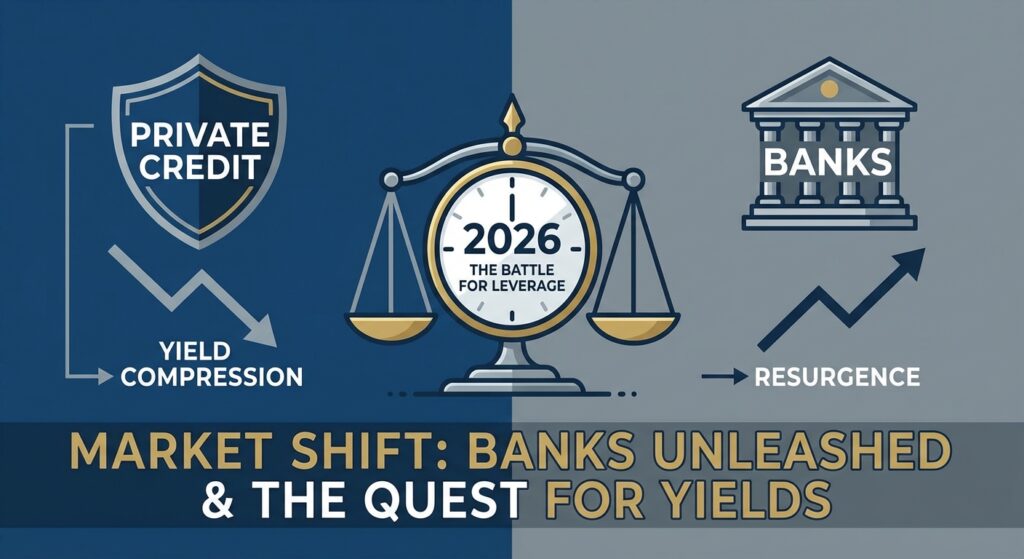
Market Headline: Banks Unleashed and the Yield Compression Squeeze
As we move into Q2 2026, the defining narrative in the private credit markets is the aggressive resurgence of traditional bank lenders. Following the withdrawal of leveraged lending guidelines in December 2025, commercial banks have re-entered the leveraged finance arena with renewed appetite, driving fierce competition against direct lenders. This structural shift has resulted in a tangible compression of spreads and a significant migration of high-quality credits back to the Broadly Syndicated Loan (BSL) market.
For the first time in three years, direct lending all-in yields have dipped below the psychological 10% threshold, driven by a combination of Federal Reserve rate cuts, lowering the top rate to 3.75%, and intense competitive pressure. The “takeout” trend observed in early 2026 has accelerated, with issuers refinancing private unitranche facilities into cheaper bank-led term loans. Consequently, private credit managers are rotating strategies, moving down-market or pivoting toward Asset-Backed Finance (ABF) to maintain yield targets.
Quantitative Snapshot: Q1 2026 Market Data
The following metrics highlight the current competitive landscape and cost of capital adjustments.
| Metric | Current Level (Q1/Q2 ’26) | Trend / Comparison | Source |
|---|---|---|---|
| Direct Lending All-In Yields | < 10.0% | Lowest level in 3 years; compressing due to BSL pressure | CreditSights |
| Federal Reserve Top Rate | 3.75% | Down from 2025 highs following Oct/Dec cuts | McDermott Will & Emery |
| Private Credit AUM | > $2 Trillion | On track for $4T by 2030 despite headwinds | Moody’s |
| BSL “Takeout” Volume | ~$48 Billion (Annualized pace) | BSL market recapturing share from private credit | CreditSights |
| Inflation (CPI) | ~3.0% | Stubbornly elevated, complicating further rate cuts | McDermott Will & Emery |
Sector Analysis: The Rotation to Asset-Backed Finance
Hot: Asset-Backed Finance (ABF) & Data Infrastructure
With corporate lending spreads tightening, capital is flowing heavily into Asset-Backed Finance. Managers are increasingly viewing consumer loans and data infrastructure credit as the new engines of growth. According to Moody’s, ABF is becoming a core component of funding, moving beyond niche status to mainstream allocation. This shift is partly a response to saturation in the corporate direct lending space and the need to diversify collateral pools.
Structural Shift: Tech & Healthcare Concentration
The “Golden Era” of pure-play corporate lending in software and healthcare is facing scrutiny. While these sectors remain dominant, CreditSights identifies them as areas of potential concentration risk. Lenders are becoming more selective, particularly as high-profile liability management transactions (LMTs) reshape covenant protections. The documentation gap between private credit and BSL is narrowing, with “looser” structures bleeding into private deals as managers fight for allocations.
Implications for Market Participants
For Borrowers:
This is a borrower’s market. The removal of regulatory caps on bank leverage allows issuers to pit private lenders against syndication desks more effectively than at any point since 2021. Sponsors can demand not only lower pricing but also greater flexibility in portability and incremental facility baskets. We expect refinancings to dominate Q2 activity as CFOs lock in sub-10% all-in costs.
For Lenders & Investors:
The “easy beta” of private credit is gone. With yields compressing, managers must rely on origination alpha (sourcing proprietary deals in complex sectors like infrastructure or hybrid capital solutions) rather than riding the floating rate wave. Interconnectivity risks are rising; Moody’s notes that deepening ties between banks and private credit funds could heighten contagion risk during a downturn. Investors should scrutinize PIK (Payment-in-Kind) usage, which is rising as a liquidity preservation tool for borrowers facing cash flow tightness.
Key Market Insights
- Bank Competition: The withdrawal of leveraged lending guidelines has unleashed banks to compete at higher leverage points, eroding private credit’s “certainty of execution” premium.
- Yield Compression: All-in yields falling below 10% signals a shift in return expectations; future alpha will come from complexity, not just illiquidity.
- BSL Takeouts: The BSL market has recaptured nearly $50bn in volume from private credit, signaling a functional public market that is hungry for paper.
- Asset Class Evolution: Look for Asset-Backed Finance (ABF) to outperform corporate direct lending in distinct volume growth during 2026.
- Covenant Convergence: Documentation standards are loosening in private credit to match BSL terms, potentially weakening lender protections in the next default cycle.


