
The Credit Cycle Has Turned: Spread Widening Marks the End of the Borrower’s Era
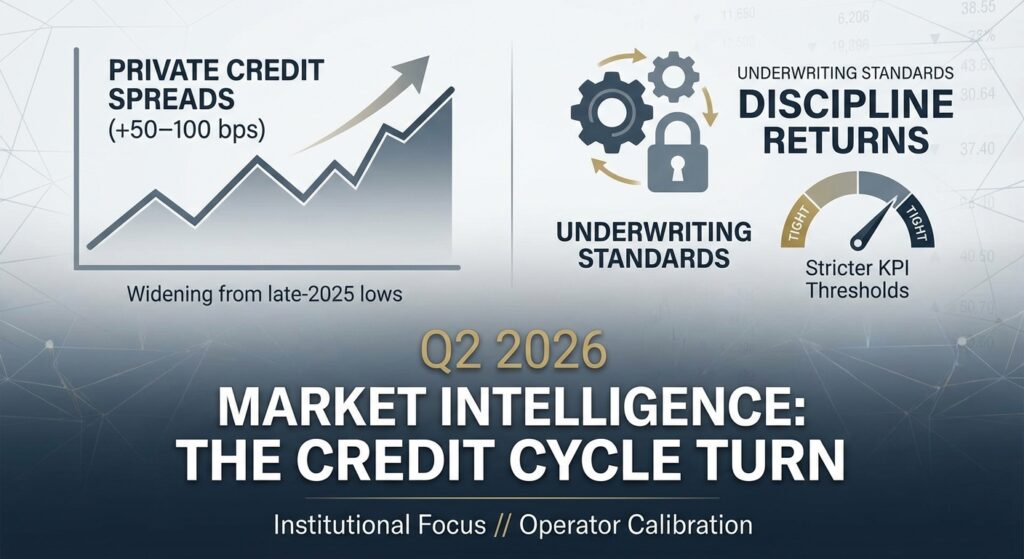
The private credit market entered Q2 2026 in a state of disciplined repricing. After a prolonged period of spread compression that pushed middle-market loan pricing to historic lows, lenders have begun reasserting underwriting standards, and the numbers confirm it. According to ainvest.com, private credit loan spreads have widened by 50–100 basis points from late-2025 trough levels, as concentrated sector vulnerabilities and a post-rate-cut recalibration drive lenders to demand higher risk premiums. This is not a systemic shock, the $1.8 trillion global private credit market remains fundamentally sound, but it does represent a decisive inflection point in the credit cycle.
The macro backdrop reinforces this shift. The Federal Reserve delivered three consecutive 25 bps rate cuts in Q4 2025 (September, October, and December), bringing the top policy rate to 3.75%, per mondaq.com. While lower reference rates compressed all-in yields, spreads have begun to widen in a counterbalancing move: reflecting lender caution around tariff-exposed credits, cyclical borrowers, and enterprise software companies facing AI disruption. Meanwhile, atlaspeakresearch.com identifies a critical structural fault: stress is most acute not in classic closed-end institutional direct lending funds, but in semi-liquid, wealth-channel vehicles (perpetual BDCs and evergreen interval funds) where liquidity mismatches between periodic redemption windows and illiquid underlying loans are creating run-risk pressure. The institutional core of private credit remains stable, but the vehicle structure matters more than ever.
For institutional investors and corporate operators alike, the key signal is clear: the era of indiscriminate spread compression has ended. Capital is being redeployed with greater selectivity, and lender KPI expectations are tightening accordingly.
Quantitative Market Snapshot: Spreads, Yields, and Lender KPI Thresholds
The table below synthesizes current pricing benchmarks across the private and public credit markets, with prior-period comparisons where available.
| Metric | Current Level (Q1–Q2 2026) | Prior Period (Q3–Q4 2025) | Direction | Source |
|---|---|---|---|---|
| Middle Market Credit Spreads (upper-quality band) | S+450 – S+500 bps | S+425 – S+475 bps (with pricing grids stepping to S+425) | ▲ Widening | valuationresearch.com |
| Middle Market Credit Spreads (lower-quality / cyclical band) | S+550+ bps | S+500–S+525 bps | ▲ Widening (+50–100 bps from late-2025 lows) | ainvest.com |
| Original Issue Discount (OID), New Issuance | 98.75 – 99.25 | 98.50 – 99.00 | ▲ Tightening (issuer-favorable shift) | valuationresearch.com |
| Fed Policy Rate (Top of Range) | 3.75% (post-December 2025 cut) | 4.25% (pre-Q4 2025 cuts) | ▼ -50 bps (3 cuts of 25 bps each) | mondaq.com |
| Global Private Credit AUM | ~$1.8T (market estimate); up to $2.5T (BIS AUM basis) | ~$1.7T (2025 estimate) | ▲ Growing | atlaspeakresearch.com |
| Lender Competition vs. Demand Balance | Lender demand outstripping new issuance; majority of deals pricing in low-to-mid spread band | Same imbalance persisted through Q4 2025 | → Persisting | valuationresearch.com |
On the public credit side, pimco.com reports that public corporate bond market liquidity (measured by depth, breadth, and transaction costs via TRACE data) is at its strongest point since the Global Financial Crisis. This creates a meaningful divergence: public credit is liquid and well-bid, while private credit is repricing around illiquidity, manager dispersion, and structural vehicle risk. For operators benchmarking debt options, the public/private spread differential is a live and moving target.
From an underwriting KPI standpoint, lenders are recalibrating minimum thresholds. While exact published floors vary by lender and sector, the directional signal is consistent: Fixed Charge Coverage Ratios (FCCR) of 1.20x or below are receiving heightened scrutiny, leverage multiples above 5.5x are being reserved for top-tier credits with defensive revenue profiles, and pricing grids with step-downs tied to leverage reduction (e.g., S+475 stepping to S+450 upon deleveraging) are now standard in competitive deals, per valuationresearch.com.
Sector-Specific Lender Appetite: Where Capital Is Flowing, and Where It Is Retreating
The spread widening of Q1–Q2 2026 is not uniform. Lender appetite is diverging sharply by sector, and understanding where credit is tightening versus loosening is now a critical competitive variable.
🔴 Under Pressure: Enterprise Software & AI-Disrupted Tech
The sharpest stress is concentrated in enterprise software, where revenue predictability is being challenged by generative AI disruption. atlaspeakresearch.com identifies software as the primary pressure point in private credit underwriting, with lenders demanding wider spreads and tighter covenants on businesses whose recurring revenue assumptions are being stress-tested by AI substitution risk. Deals in this space are gravitating toward the upper end of spread bands (S+550 and above) with lenders requiring stronger FCCR coverage and lower initial leverage.
🟡 Cautious: Cyclical and Tariff-Exposed Industries
According to valuationresearch.com, credits that are highly cyclical, carry significant tariff exposure, or are heavily leveraged are finding it increasingly difficult to access the upper-quality pricing band. These borrowers are being pushed toward the higher end of the spread range or are struggling to come to market at all, a notable behavioral shift from the indiscriminate lending environment of 2024–2025. Manufacturing, consumer discretionary, and import-dependent distribution businesses face the most friction.
🟢 Active: Healthcare, Infrastructure-Adjacent, and Defensive Services
Lender appetite remains robust for defensive sectors with predictable cash flows and low cyclicality. Healthcare services, essential infrastructure-adjacent businesses, and professional services firms with diversified revenue bases are continuing to price in the low-to-mid spread band. M&A and leveraged buyout pipelines in these sectors are benefiting from renewed private equity exit pressure, PE funds are managing hold periods of seven to eight years and are actively seeking liquidity events, per mondaq.com.
Structural Shift: BSL vs. Private Credit Competition Intensifies
The broadly syndicated loan (BSL) market continues to compete aggressively with private credit for upper-quality middle-market deals, driving pricing discipline from both sides. This competition is compressing spreads for the most sought-after credits while simultaneously widening the gap for lower-quality borrowers, creating a bifurcated credit market where top-tier operators have options and distressed borrowers have few.
Implications for Institutional Investors and Business Operators
For Institutional Investors
The widening performance dispersion among private credit managers (a direct consequence of spread volatility and sector-specific stress) makes manager selection the dominant alpha driver in 2026. As ainvest.com notes, skilled underwriters are capturing S+550+ yields in deals where generalist lenders are pulling back. Investors should audit their private credit allocations for vehicle structure risk: semi-liquid, wealth-channel BDCs and evergreen interval funds carry materially higher liquidity mismatch risk than closed-end institutional drawdown funds, per atlaspeakresearch.com. The public credit market, by contrast, offers a currently favorable liquidity profile, with PIMCO’s data showing public corporate bond market depth at post-GFC highs, making it a viable complement or tactical hedge to private credit exposure.
For Business Operators and Borrowers
Operators approaching debt markets in Q2 2026 must present lenders with tighter KPI packages than were required 12–18 months ago. FCCR coverage above 1.25x, demonstrated leverage reduction pathways, and sector defensibility arguments are now table stakes. For borrowers in tariff-exposed or AI-disrupted sectors, expect to absorb wider spreads, tighter covenants, and step-down pricing grids that require active balance sheet management. Conversely, healthcare, infrastructure, and essential services operators with clean credit profiles retain strong negotiating leverage, lender demand continues to outstrip quality deal supply, per valuationresearch.com.
Forward-Looking View: Liquidity and Lending Dynamics Through Q3–Q4 2026
The deal backdrop for the next two to three quarters is best characterized as selectively constructive. The combination of significant private equity dry powder, mounting LP pressure for PE fund distributions, and an improving M&A pipeline (supported by greater tariff clarity and Fed rate cuts) should sustain deal volumes in defensive sectors. However, the repricing cycle is unlikely to reverse quickly: lenders who overcapitalized at compressed spreads in 2024–2025 are now managing credit quality concerns and are unlikely to re-embrace aggressive underwriting standards absent a meaningful macro improvement.
The systemic risk argument remains limited. Private credit’s institutional investor base (pensions, endowments, sovereign wealth funds) provides duration-matched capital that insulates the core market from the kind of rapid redemption pressure that triggered prior credit crises. The risk to monitor is not systemic contagion but rather a slow-burn credit quality deterioration in AI-disrupted and tariff-exposed portfolios, combined with continued NAV credibility questions in semi-liquid vehicles where mark-to-model valuations are under scrutiny, per atlaspeakresearch.com.
For capital allocators and operators alike, the next six months will reward preparation over opportunism: tighter documentation, stronger KPI performance, and vehicle structure awareness will define which participants access the best terms, and which are left competing at the market’s unfavorable margin.
Key Market Insights
- Spread Widening Is Real and Selective: Middle-market private credit spreads have widened 50–100 bps from late-2025 lows, with the sharpest moves in enterprise software and tariff-exposed credits. Top-tier defensive borrowers continue to price in the low-to-mid band. (ainvest.com)
- Lender KPI Thresholds Are Tightening: FCCR coverage requirements are rising, leverage multiples above 5.5x face resistance, and step-down pricing grids tied to leverage reduction are now a standard deal feature. Borrowers must arrive at the table with stronger credit packages than were required 12–18 months ago. (valuationresearch.com)
- Vehicle Structure Is Now a First-Order Risk: Semi-liquid wealth-channel BDCs and evergreen interval funds carry materially higher liquidity mismatch risk than closed-end institutional direct lending funds. Investors should audit vehicle structure alongside manager quality. (atlaspeakresearch.com)
- Public Credit Liquidity Is at a Post-GFC High: PIMCO’s TRACE-based analysis shows public corporate bond market depth, breadth, and transaction costs are all at their best levels since the Global Financial Crisis, creating a meaningful liquidity premium for public credit vs. private alternatives. (pimco.com)
- Manager Selection Is the Alpha Variable of 2026: Performance dispersion among private credit managers is widening. Skilled underwriters are capturing 50–100 bps of additional spread in selective deals. Portfolio rebalancing toward active, high-conviction managers (and away from passive spread exposure) is the actionable portfolio response to the current environment. (ainvest.com)


