
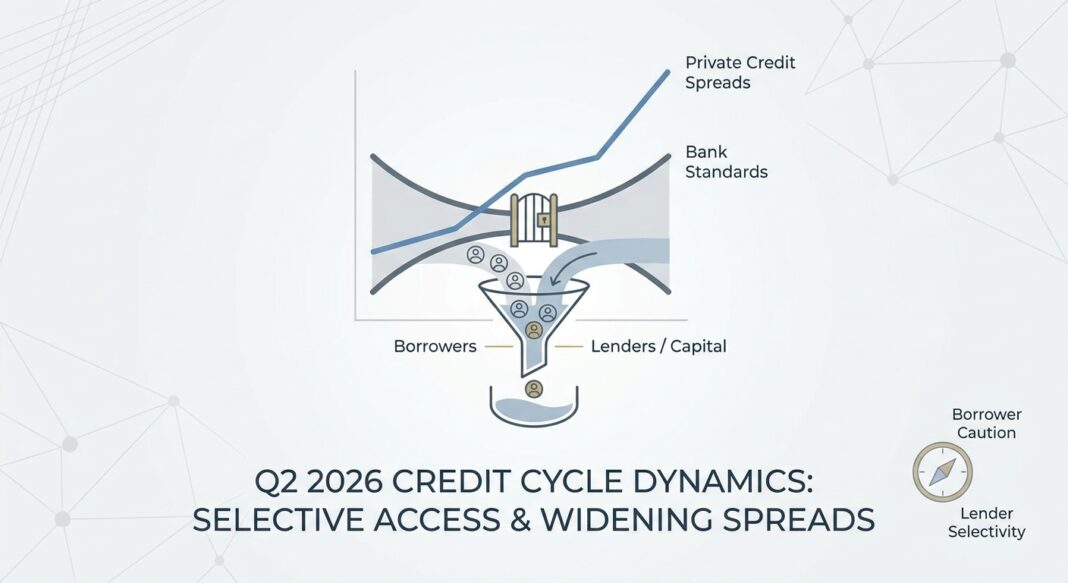
The Macro Signal: A Credit Market That Is Open, But Increasingly Selective
As of May 2026, U.S. credit markets remain technically open, but the operative word is selectively. The Federal Reserve’s April 2026 Senior Loan Officer Opinion Survey (SLOOS) confirmed that commercial and industrial (C&I) lending standards tightened on net in Q1 2026, with banks citing a less favorable economic outlook, worsening industry-specific problems, and reduced risk tolerance as the primary drivers. This is not a broad credit seizure; it is a structural tightening that is concentrating credit risk at the margins and handing private lenders an incremental origination advantage, but on terms that reflect a more sober view of the cycle.
The FOMC has paused its rate-cutting cycle, and market participants are now pricing only a single 25-basis-point reduction (most likely at the September or October 2026 meeting) with a second cut pushed into 2027, according to ABF Journal’s Middle Market Debt Weekly. For floating-rate middle market borrowers currently servicing all-in coupons of 9.5% to 11%, the practical implication is unambiguous: meaningful rate relief is not coming before autumn, and covenant headroom is thinning in leveraged segments of the market. Fixed charge coverage ratios (FCCR), the cornerstone underwriting metric for senior lenders, are under sustained pressure as elevated SOFR, holding near 3.62% on a 30-day average basis as of mid-May, compounds against wider credit spreads.
This macro-to-micro transmission is the defining dynamic of Q2 2026: a rate plateau meeting a spread-widening cycle, compressing borrower FCCR across a broad swathe of middle market portfolios at exactly the moment when lenders are demanding more cushion, not less.
Quantitative Market Snapshot
The table below captures six key credit market metrics as of late May 2026, with prior-period comparisons where data is available. Together, they define the pricing and structural environment that institutional borrowers and lenders are navigating in real time.
| Metric | Current Value | Prior Period | Direction | Source |
|---|---|---|---|---|
| Middle Market Unitranche Spread (competitive) | S+475 to S+525 bps | S+450 to S+500 bps (Q4 2025) | ↑ Widening | abfjournal.com |
| Middle Market Senior Secured Spread (retrenching BDCs) | S+550 to S+600 bps | S+475 to S+525 bps (prior quarter) | ↑ Widening | abfjournal.com |
| All-In Middle Market Coupon (floating-rate) | 9.5% – 11.0% | ~9.0% – 10.5% (H2 2025) | ↑ Higher | abfjournal.com |
| Broadly Syndicated Loan (BSL) Spreads, widening (Q1 peak) | +~100 bps wider (Feb–Mar 2026 vs. Jan 2026) | Cycle-tight levels, Jan 2026 | ↑ Widened sharply | sikich.com |
| High-Yield OAS (broad market) | 283 bps (May 18, 2026) | ~279 bps (prior week) | ↑ Slight widening | lakerockcapitalus.com |
| Investment-Grade OAS (broad market) | 75 bps (May 18, 2026) | 78 bps (prior week) | ↓ Slight tightening | lakerockcapitalus.com |
The spread between investment-grade and high-yield OAS, at roughly 208 basis points, reflects a market still distinguishing sharply between credit tiers. For middle market operators sitting below investment-grade thresholds, the all-in cost of debt remains near cycle highs, with FCCR compression the dominant underwriting concern for both borrowers presenting financials and lenders stress-testing covenant packages.
Sector Analysis: Where Lender Appetite Is Expanding, and Where It Is Retreating
Software & Technology: The Epicenter of Private Credit Stress
Software and technology together represent approximately 25% of all U.S. direct lending exposure, according to ABF Journal. Many of these positions were originated at elevated revenue multiples in 2021–2022 and remain carried near par on BDC balance sheets, a valuation assumption that is increasingly inconsistent with AI-driven disruption to legacy software revenue models. Bloomberg’s April 2026 credit commentary flagged that publicly traded private credit funds dropped to their lowest valuations since 2022, partly attributable to this software concentration risk. Lender appetite in this sector has meaningfully contracted: BDCs previously competing at S+475 to S+525 on unitranche facilities are now repositioning toward senior secured structures at S+550 to S+600, effectively demanding both better pricing and improved structural seniority before committing capital.
M&A-Driven Industrials and Healthcare: Relative Bright Spots
M&A-backed broadly syndicated loan issuance reached its highest first-quarter total since Q1 2022, per Sikich’s Q1 2026 Credit Market Update, with buyout and acquisition financing totaling $74.6 billion, or 46% of institutional loan volume per KPMG’s Q1 2026 Credit Markets Update. However, concentration risk is acute: more than 40% of this volume came from just five mega-transactions, per Sikich. Lender appetite is clearly stronger for BB-rated or better credits in stable cash-flow sectors (healthcare services, business services, and infrastructure-adjacent industrials) where FCCR coverage above 1.5x and predictable debt service remain achievable even at elevated SOFR.
Commercial Real Estate: Structurally Stressed
CRE-specific credit indicators remain acutely stressed. CMBS delinquency reached 7.54% and special servicing hit 11.38% as of mid-May 2026, per LakeRock Capital. The 10-year Treasury closing the week of May 19 at 4.59%, up 21 basis points week-over-week, continues to compress refinance proceeds and debt-service coverage ratios for properties rolling off prior-cycle debt at materially lower rates. The April 2026 SLOOS confirmed that banks reported tighter standards for multifamily CRE loans, while leaving construction and non-residential standards broadly unchanged, a bifurcation within an already stressed asset class.
Implications for Institutional Investors and Business Operators
For Borrowers
Middle market operators should not underwrite SOFR relief before Q4 2026 at the earliest. With floating-rate all-in coupons ranging from 9.5% to 11%, FCCR stress-testing should be conducted at current rates, not projected ones. Borrowers in software and technology verticals face the sharpest repricing: expect 25 to 50 basis points of spread widening on competitive unitranche bids through Q2, particularly for hold sizes above $200 million, per ABF Journal. Operators with near-term refinancing needs, particularly CRE assets with maturities inside 12 to 18 months, should refresh debt-service modeling using current Treasury benchmarks, as models prepared even weeks ago may materially understate refinance pressure, per LakeRock Capital.
For Lenders and Investors
Direct lenders without redemption pressure are positioned to take incremental market share as BDCs managing redemption queues reduce hold-size capacity. Private credit default risk is a rising variable: Proskauer’s 2026 Private Credit Survey found that 39% of private credit lenders believe the U.S. is in or approaching recession within 12 months, and more than a quarter report that 2.5% or more of their portfolios are already in default, per ABF Journal. Morgan Stanley has separately flagged direct lending default rates could approach 8% in a stress scenario driven by AI disruption to software borrowers, well above the 2% to 2.5% historical average. Investors should recalibrate loss reserves and watchlist classifications accordingly.
Forward View: The Next 3–6 Months
The credit market bifurcation visible in Q1 and early Q2 2026 is unlikely to resolve quickly. Bank C&I standards are tightening at the margin while the FOMC holds rates steady, sustaining the structural origination advantage that private credit has built since 2022, but at wider spreads and with tighter underwriting than the prior two years. The BSL market remains the gravity well for upper middle market pricing, and continued BSL spread stability caps the unitranche premium direct lenders can extract on borrowers with $50 million to $100 million of EBITDA, per ABF Journal. The most acute near-term risks are concentrated in software-heavy private credit portfolios, lower-rated BSL borrowers facing maturity walls without refinancing options, and CRE assets that cannot clear DSCR or debt yield thresholds at current Treasury levels. Capital remains available, but in Q2 2026, credit quality, sector selection, and structural seniority determine access more than at any point since 2022.
Key Market Insights
- Bank standards are tightening, not collapsing: The April 2026 SLOOS shows net C&I tightening driven by macro uncertainty and sector stress, a selective contraction that expands private credit’s origination lane without signaling systemic disruption.
- Unitranche spreads are repricing wider: Expect S+475 to S+525 to migrate toward S+550 to S+600 through Q2, particularly for software-exposed credits and larger hold sizes above $200 million.
- FCCR compression is the operational flashpoint: With SOFR near 3.62% and all-in coupons at 9.5%–11%, debt service coverage is thinning across leveraged middle market portfolios: covenant headroom must be stress-tested at current, not forecast, rates.
- Software concentration is private credit’s most acute near-term risk: With roughly 25% of U.S. direct lending in software and technology, AI-driven revenue disruption to legacy borrowers is a live portfolio risk, not a theoretical one, default scenarios toward 8% are now discussed at institutional credit desks.
- CRE refinancing risk is intensifying with each Treasury move: The 10-year Treasury at 4.59% and CMBS delinquency at 7.54% as of mid-May 2026 mean that CRE assets maturing inside 18 months face a materially more adverse refinancing environment than prior-cycle underwriting assumed, operators should act now to pre-clear lender appetite and structural requirements.


