
Market Headline: The Repricing Has Arrived
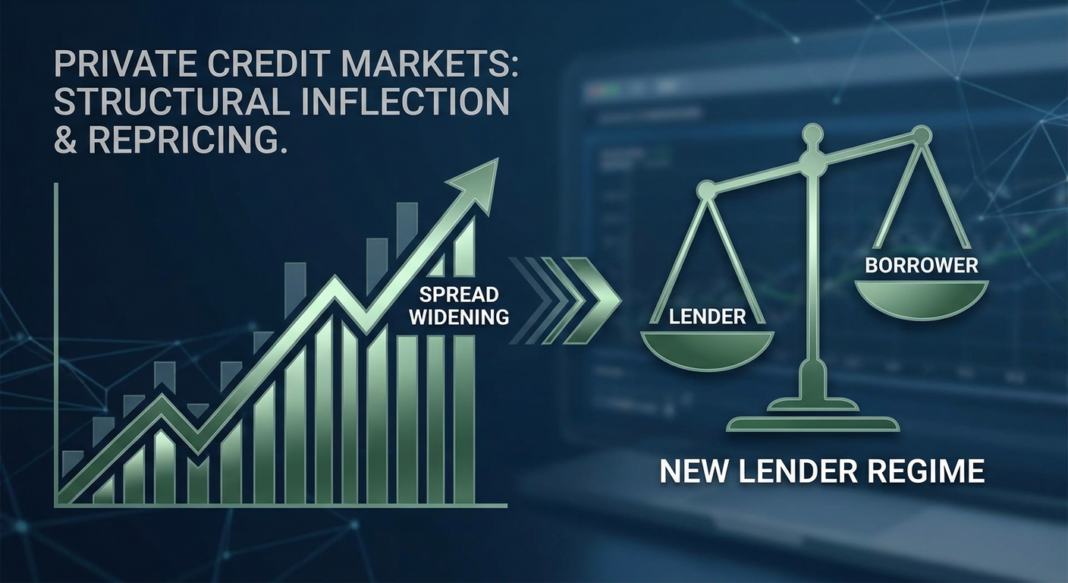
For much of 2024 and into 2025, private credit operated in a state of persistent spread compression, a borrower’s paradise sustained by an excess of capital chasing a constrained deal pipeline. That dynamic is now reversing with meaningful force. Q1 2026 has delivered the clearest evidence yet that credit conditions are shifting structurally in favour of well-capitalised lenders, driven by a confluence of macro disruption, geopolitical shock, and internal pressure on the retail-oriented vehicles that ballooned during the private credit boom.
According to Northleaf Capital’s Q1 2026 Private Credit Market Update, private credit is experiencing a multi-year peak in investor redemption requests from retail-oriented structures, particularly U.S. Business Development Companies (BDCs). As these vehicles contend with liquidity management, institutional-grade capital with consistent allocation mandates is positioned to step into more favourable supply-demand dynamics. Simultaneously, war in the Middle East, oil-price volatility, and growing fears of AI-driven disruption across software and SaaS verticals have introduced episodic risk-off sentiment that is, finally, translating into wider new-issue spreads.
The FOMC’s decision to pause rate cuts in 2026, flagged in KPMG’s Q1 2026 Credit Markets Update, compounds the pressure on borrowers already facing elevated base rates. The forward curve has shifted upward, meaning the long-anticipated rate relief is unlikely to materialise near-term. For credit markets, this is a defining reset moment.
Quantitative Market Snapshot
The following data box captures the current state of key credit market metrics as of Q1 2026, benchmarked against prior-period comparisons where available.
| Metric | Current Value (Q1 2026) | Prior Period | Source |
|---|---|---|---|
| Middle Market Private Credit Spread (plain-vanilla $50M EBITDA, non-cyclical) | S+500–S+550+ (33% of deals) | S+450–S+499 (majority of 2025 deals); only 6% at S+550+ in Q4 2025 | LCD via Yahoo Finance |
| BSL Spread, BB/BB- Rated Term Loans | S+241 (avg. 30 days to Mar 12, 2026) | ~S+191 in January 2026 (approx. +50 bps widening) | LCD via Yahoo Finance |
| BSL Spread, B/B+ Rated Term Loans | S+379 (avg. 30 days to Mar 12, 2026) | ~S+279 in January 2026 (approx. +100 bps widening) | LCD via Yahoo Finance |
| Private Credit Direct Lending, Gross Unlevered Returns | High single digits (unlevered) | Broadly consistent; base rate plateau supporting floor | Northleaf Capital |
| Private Lending Origination Volume, Q1 2026 (DSCR + RTL) | $29.7B (strongest Q1 on record) | ~$28.5B in Q1 2025 (+4.0% YoY) | SFR Analytics / NPLA |
| Private Credit Annualised Default Rate | ~1.5% (2025 realised); 2.0% projected by year-end 2026 | Historically low levels through 2024 | KBRA via Northleaf Capital |
| Leveraged Loan Institutional Volume, Q1 2026 | $173.3B | $138.1B in Q4 2025; $195.1B in Q1 2025 | KPMG Credit Markets Update |
The data reveals a credit market in active recalibration: spreads moving off multi-year lows in both public and private channels, while aggregate volumes remain robust, a combination that historically characterises early-to-mid repricing cycles rather than a full credit contraction.
Sector Analysis: Where Lender Appetite Is Shifting
Technology & Software: Elevated Scrutiny
The technology sector, particularly software and SaaS verticals, is facing the sharpest underwriting reassessment. Northleaf Capital notes heightened focus on AI-driven disruption risk among lenders underwriting information technology credits. Borrowers with revenue models exposed to automation displacement, particularly vertical SaaS with limited switching costs, are being stress-tested against AI substitution scenarios. FCCR floors are being tightened, and lenders are scrutinising recurring revenue quality more aggressively than at any point in the post-2020 cycle. Leverage multiples on software deals that were routinely reaching 7–8x EBITDA in 2023–2024 are reportedly compressing as a result of this repricing pressure, per LCD’s reporting.
Real Estate Private Lending: Bifurcated Demand
The private real estate lending market is experiencing a sharp divergence between product types. According to SFR Analytics’ April 2026 NPLA report, Residential Transition Loan (RTL) originations surged +13.0% YoY in Q1 2026, while DSCR (Debt Service Coverage Ratio) buy-and-hold loan volumes contracted -8.8% YoY to $10.7B. This bifurcation reflects buy-and-hold investors remaining sidelined as they await cap rate expansion, while value-add and transitional capital continues to flow. RTL all-in rates hold in the 9.5–11% range; DSCR rates cluster around a 7% median. Pre-foreclosure rates are rising in specific geographies, notably Florida markets, where 7 of the 10 highest pre-foreclosure rate markets are concentrated, with a nationwide rate of 1.10% of outstanding private lender loans in pre-foreclosure status.
M&A-Backed Leveraged Finance: Bright Spot
The one sector sustaining robust deal flow is M&A-driven leveraged finance. KPMG’s Q1 2026 update reports that M&A-backed institutional loans reached $74.6B, or 46.0% of total institutional loan volume, the highest M&A share since Q1 2022. AI and data-centre-related capital expenditure is also sustaining high-yield issuance as corporates finance infrastructure build-outs. However, the refinancing share of institutional loan volume has declined sharply to 37% from 49% in Q1 2025, signalling that the 2023–2025 refinancing wave has largely run its course.
Implications for Institutional Investors & Operators
For Borrowers
The era of sub-S+500 pricing on middle-market credits is narrowing rapidly. Borrowers who have not yet refinanced or extended maturities face an increasingly costly window. With B- and lower-rated borrowers carrying the heaviest near-term maturity exposure (and refinancing volumes declining) rollover risk is elevated, particularly for credits originated in the 2021 vintage, which Northleaf Capital specifically flags as a pocket of pressure. Operators should stress-test fixed charge coverage ratios (FCCR) under S+550 scenarios and audit covenant headroom proactively. Leverage at the upper end of historical ranges should be treated as a structural risk, not a competitive feature.
For Lenders & Institutional Investors
Well-capitalised institutional lenders (particularly those backed by patient, non-retail capital) are entering a privileged negotiating position for the first time since 2022. Increased BDC redemptions are forcing some large private credit platforms to moderate new deployment, effectively reducing competition on deal terms. LCD reporting cites Goldman Sachs BDC CIO Dan Callahan noting 25–50 bps of OID and coupon improvement already materialising. Lenders with dry powder and stable LP bases should prioritise originating into this repricing window, focusing on defensive sectors with durable cash flows and avoiding over-leveraged technology credits facing AI headwinds.
Forward-Looking View: The Next 3–6 Months
The trajectory for credit markets through H2 2026 is one of continued, but measured, repricing, not systemic dislocation. Default rates, while projected to rise to 2.0% by year-end per KBRA’s estimates cited by Northleaf Capital, remain well within manageable bounds relative to long-term historical averages. Credit stress is idiosyncratic rather than systemic: concentrated in specific sectors, geographies, and deal vintages.
The structural tailwinds for private credit remain intact: banks are not aggressively re-entering the middle market, M&A pipeline activity is building, and the FOMC’s rate pause keeps base rates at levels that sustain high single-digit unlevered returns in direct lending, an attractive premium over public credit. KPMG confirms market access remains open for high-quality issuers, suggesting the repricing is disciplined rather than chaotic. The risk scenario to monitor is a sustained oil-price shock or further Middle East escalation that tips sentiment from cautious to risk-off, which could sharpen spread widening and tighten deal execution windows materially.
Key Market Insights
- Spread Inflection Confirmed: Middle-market private credit spreads have shifted from a 2025 majority of S+450–499 to emerging new-issue pricing of S+500–S+550+, with BSL B-rated spreads widening nearly 100 bps from January 2026 highs, per LCD.
- BDC Redemption Pressure Is Reshaping Supply-Demand: Multi-year-peak retail redemptions from BDCs are pulling significant capital off the table, creating a structural opening for institutional lenders to originate on improved terms, per Northleaf Capital.
- AI Disruption Risk Is a Live Underwriting Variable: Technology and software credits face elevated lender scrutiny on revenue durability and AI substitution exposure, requiring borrowers to demonstrate defensible FCCR and unit economics under disruption scenarios.
- Real Estate Private Lending Is Bifurcating: RTL (transitional/value-add) originations are surging (+13.0% YoY) while DSCR buy-and-hold volumes contract (-8.8% YoY), with geographic pre-foreclosure risk concentrating in Florida markets, per SFR Analytics / NPLA.
- Refinancing Window Is Closing: The share of institutional loan volume driven by refinancing has dropped from 49% to 37% YoY, while B- and lower-rated borrowers carry the heaviest maturity exposure, per KPMG, elevating rollover risk into 2027.


