
The Inflection Point: Private Credit’s Borrower-Friendly Era Ends
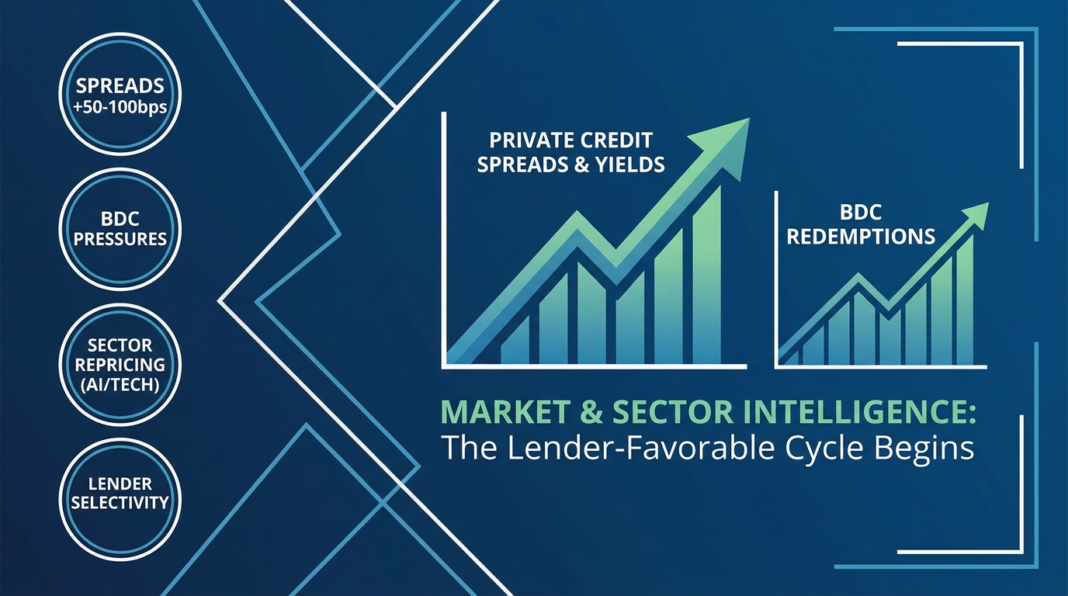
For much of 2023 through 2025, private credit borrowers operated in a structurally advantageous environment: persistent capital formation, compressed spreads, and a supply-demand imbalance that rewarded aggressive refinancing. That regime is now unwinding. Q1 2026 data confirms that private credit markets have entered a meaningful repricing cycle, catalyzed by a confluence of macro shocks, sector-specific credit stress, and structural shifts in the retail capital base underpinning Business Development Companies (BDCs). The result: a market that is measurably more lender-favorable than at any point since 2022, and still in the early innings of repricing.
According to Northleaf Capital, the forward rate curve has shifted upward by approximately 20 basis points relative to Q4 2025 expectations, with the Fed holding its target range at 3.50%–3.75% and limited easing priced in through 2028. The combination of a stickier base rate and widening credit spreads is compressing borrower economics on new originations while presenting institutional lenders with the most attractive gross yield environment in several years.
Quantitative Market Snapshot: Spreads, Yields, and KPI Benchmarks
📊 Data Box: Key Private & Public Credit Market Metrics, Q1 2026 vs. Q4 2025
| Metric | Q1 2026 (Current) | Q4 2025 (Prior) | Change | Source |
|---|---|---|---|---|
| Private Credit (Direct Lending) New-Issue Spread, Core Middle Market | S+500–S+575 | S+450–S+499 | +25–100 bps | Northleaf / Cliffwater |
| Large Unitranche Spread (WWEX Group, $4.8B deal) | S+575 | S+500–S+525 (est.) | +50–75 bps | PitchBook LCD / Yahoo Finance |
| Mid-Market Private Credit Spread, Non-Cyclical, $50M EBITDA (Survey Respondents Pricing at S+550+) | 33% of respondents | 6% of respondents | +27 ppts | PitchBook LCD Q1 2026 Global Private Credit Survey |
| BSL Spread, BB/BB- Rated Term Loans | S+241 (30-day avg. to Mar. 12) | ~S+191 (Jan. 2026 low) | +~50 bps | PitchBook LCD |
| BSL Spread, B/B+ Rated Term Loans | S+379 (30-day avg. to Mar. 12) | ~S+280 (Jan. 2026 low est.) | +~100 bps | PitchBook LCD |
| Total Institutional Loan Issuance, Q1 2026 | $241B | $157B (Q4 2025) | +54% QoQ / -32% YoY | Portage Point Partners |
| Private Credit Annualized Default Rate (Projected Year-End 2026) | ~2.0% | 1.5% (2025) | +50 bps | KBRA DLD / Northleaf |
| Fed Funds Target Rate (FOMC, March 2026) | 3.50%–3.75% | 3.50%–3.75% | Unchanged | FOMC / Northleaf |
Note: All-in yields on direct lending remain in the high single digits on an unlevered basis, reflecting SOFR (~3.5%) plus prevailing spreads. FCCR and leverage covenant benchmarks are tightening incrementally as lender leverage multiples compress on riskier credits.
Sector Analysis: Where Lenders Are Leaning In, and Pulling Back
Software & Technology (AI-Disruption Risk Sector): The most consequential sector-level development in Q1 2026 is the sharp repricing of risk in the information technology and software sectors, driven by investor fears around AI-led disruption of incumbent SaaS business models. The launch of Anthropic’s Claude Cowork accelerated a public market selloff in software names, which in turn drove meaningful spread widening on syndicated software loans, and materially reduced appetite among lenders for new originations in the sector. Per Northleaf Capital, while lower valuations have elevated loan-to-value ratios in IT credits, historically conservative underwriting in the sector provides a degree of downside cushion. Lenders are increasingly bifurcating between companies with deeply embedded products and high switching costs versus those with more commoditized or AI-exposed revenue streams. The Nexthink ($750M, S+550) and WWEX Group ($4.815B, S+575) transactions illustrate this dynamic, sponsors are paying meaningful spread premiums to close deals, and lenders are securing more favorable structural terms.
Industrials & Logistics: Logistics and supply chain infrastructure, exemplified by the WWEX/Auctane combination financed at S+575, is attracting large-club private credit structures. The ability to underwrite freight and global logistics platforms at scale reflects ongoing lender confidence in hard-asset and infrastructure-adjacent cash flows, though tariff and trade policy uncertainty adds a layer of macro sensitivity that lenders are pricing accordingly.
Consumer Sector: Consumer-facing credits are experiencing the most acute lender caution. Northleaf specifically flags the consumer sector, alongside 2021 vintage credits, as an area of elevated default risk. Lenders are tightening FCCR minimums and leverage ceiling thresholds for consumer-dependent borrowers, and deal flow in this segment reflects fewer but larger, higher-quality transactions.
Lower-Rated Credits (B- and Below): Access to capital is narrowing materially for sub-investment-grade borrowers. According to Sikich Corporate Finance, the lowest-rated segment of the BSL market accounted for a historically small share of M&A-related volume in Q1. Maturity refinancing pressure is becoming increasingly concentrated among weaker credits, a dynamic that portends heightened restructuring activity in H2 2026.
Implications for Institutional Investors and Business Operators
For Lenders and Institutional Investors
The structural shift now underway is being characterized by multiple market participants, including Oaktree’s Christina Lee and Goldman Sachs BDC CIO Dan Callahan, as a genuine inflection point rather than a tactical blip. BDC redemption pressure is functioning as an involuntary supply-side constraint on capital deployment among retail-oriented private credit vehicles, while well-capitalized institutional lenders face less competition for assets and more favorable structural terms. Sixth Street Specialty Lending has publicly framed this moment as the beginning of a healthy supply-demand recalibration, with new origination spreads set to widen further as the rebalancing plays out. For direct lending platforms backed by patient institutional capital, the vintage quality of 2026 originations is shaping up to be materially superior to 2024–2025 deployments.
For Borrowers and Operators
Operators seeking debt capital in the near term face a rapidly changing cost structure. Borrowers who refinanced at the trough (S+450 or below) in 2024–2025 have effectively locked in below-market financing for the cycle. Those approaching new refinancings or acquisition financings in 2026 should anticipate all-in costs of S+500–S+575 for core middle market transactions, with lower-rated credits facing incremental spread premiums of 75–100 bps relative to peak-compression levels. Fixed-charge coverage ratios and leverage multiples are tightening in lender underwriting models (particularly in consumer, tech, and 2021-vintage credits) meaning operators in these segments must prioritize EBITDA stability and cash conversion in sponsor narratives.
Forward-Looking View: What to Expect Over the Next 3–6 Months
The directional bias across virtually all market participants surveyed by PitchBook LCD in Q1 2026 is toward further spread widening, not stabilization. With the Fed signaling rates on hold through at least mid-2026, the forward SOFR curve implying an average base rate of approximately 3.5% through 2028 per Northleaf/Chatham Financial, and KBRA projecting default rates rising to 2.0% by year-end, the technical and fundamental backdrop supports a continued lender-favorable environment. Sikich Corporate Finance flags that slowing private equity deal formation and weakening CLO bid-side demand are additional headwinds to credit availability for lower-quality borrowers. M&A-related financing will remain the primary driver of new issuance, but transaction concentration risk, with over 40% of Q1 institutional loan volume attributable to just five mega-transactions, underscores how selectively capital is being deployed. The window of peak lender opportunity is open, but the duration of this cycle will depend heavily on the pace of BDC stabilization and any macro catalysts, including tariff resolution or Fed rate guidance shifts, that might re-tighten spreads.
Key Market Insights
- 🔺 Spreads Are Widening, and the Move Has Further to Run: Middle market private credit spreads have moved from S+450–499 at the 2025 trough to S+500–575 in Q1 2026, with surveyed lenders projecting further widening over the next six months. Per PitchBook LCD, this is characterized as the early innings of a repricing cycle, not its peak.
- 💸 BDC Redemption Pressure Is Structurally Reshaping Supply Dynamics: Elevated redemption requests in non-traded BDCs and interval funds are acting as a market-clearing mechanism, reducing competition among retail-oriented lenders and improving terms for institutional capital with long-dated mandates. Sixth Street’s shareholder letter offers the clearest articulation of this dynamic in the public record.
- ⚠️ AI Disruption Is the Sector-Level Credit Risk of 2026: Software and IT credits are experiencing the most material repricing, with lender underwriting shifting toward businesses with demonstrable switching costs, embedded products, and resilience to AI-driven revenue displacement. Sponsors should expect heightened diligence on technology-dependent revenue assumptions.
- 📉 Lower-Rated Credits Face Materially Restricted Access: B- and below borrowers are experiencing spread widening of up to 100 bps relative to Q4 2025, declining refinancing opportunities, and growing maturity concentration risk. Operators in this cohort should begin addressing 2027–2028 maturities now, before market conditions tighten further.
- 📈 Institutional Lenders Are in the Optimal Deployment Window: The combination of a stable (not declining) base rate, widening spreads, and reduced competition from BDC capital creates the strongest risk-adjusted origination environment for direct lenders since 2022. Q1 2026 deal terms (including OID improvements of 25–50 bps and tighter covenant packages) confirm lender leverage is increasing. Per Portage Point Partners, liquidity remains strong and multiple execution paths persist, but selectivity is the operative mandate.


