
Market Headline: The Buyer’s Market Returns as Banks Shed Chains
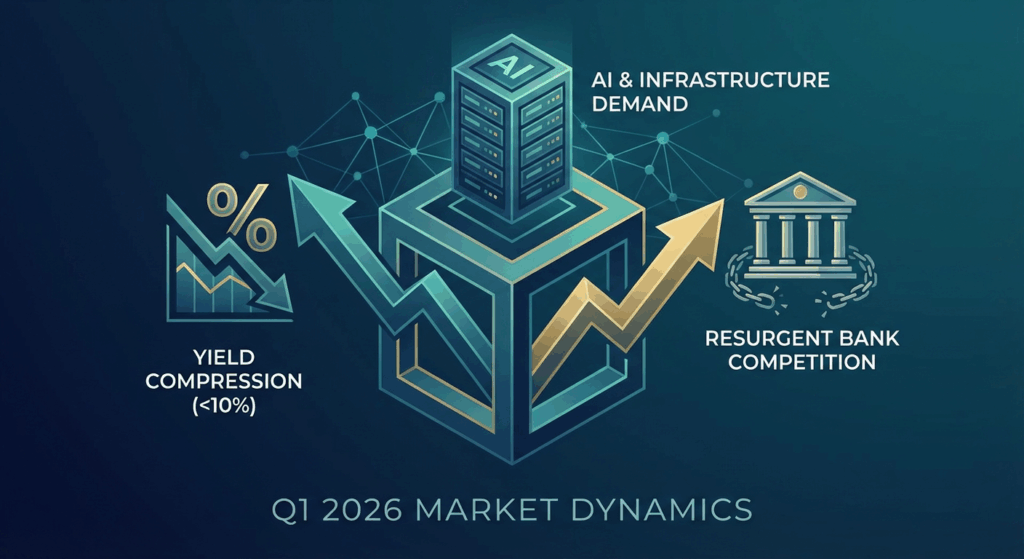
As of mid-February 2026, the scarcity regime that defined private credit for the past three years has officially ended. The market has shifted decisively toward borrowers, driven by a convergence of three powerful factors: the Federal Reserve’s aggressive easing cycle in late 2025, a resurgence in Broadly Syndicated Loan (BSL) competition, and, perhaps most critically, the regulatory unshackling of traditional banks.
Following the Federal Reserve’s rate cuts in Q4 2025, which brought the top rate down to 3.75%, direct lending yields have broken below the psychological 10% floor. Simultaneously, the surprising withdrawal of leveraged lending guidelines for banks in December 2025 has emboldened traditional lenders to compete aggressively on leverage multiples, challenging private credit’s dominance in the middle market.
For private credit managers, 2026 is shaping up to be a year of “selection over scarcity.” While deal flow is accelerating, particularly in AI infrastructure and M&A, the easy returns of the rate-hiking cycle are gone. Lenders are now fighting a two-front war: competing with public markets for large-cap deals and competing with each other for high-quality middle-market borrowers who are demanding (and getting) covenant step-downs and tighter pricing.
Quantitative Snapshot: Q1 2026
Capital costs are compressing rapidly as liquidity floods the market. Below are the critical metrics defining the current credit landscape.
| Metric | Current Level | Trend / Comparison | Source |
|---|---|---|---|
| Direct Lending Yields | < 10.0% | First drop below double-digits in 3 years | CreditSights |
| OID Pricing | 98.75 – 99.25 | Tightened from 98.50 – 99.00 (Q3 ’25) | Valuation Research Corp |
| Fed Policy Rate | 3.75% (Top) | -75 bps via Q4 2025 cuts (Sept/Oct/Dec) | Mondaq |
| BSL Refinancing Gap | $48bn Recaptured | BSL aggressively refinancing private debt | CreditSights |
| Market Volume | ~$140bn (2025) | Deal flow accelerating into 2026 | CreditSights |
Sector Analysis: The AI Divergence
Hot: AI Infrastructure & Data Centers
The most significant capital rotation in Q1 2026 is the massive demand for Asset-Backed Finance (ABF) tied to digital infrastructure. With hyperscalers projected to spend over $2.7 trillion between 2025 and 2029, private credit is becoming the primary financing engine for data centers that banks cannot fully service due to balance sheet constraints. Apollo notes that this is no longer just a capex cycle but a “broad-based financing event,” moving credit supply away from traditional corporate lending toward infrastructure-heavy structured credit.
Hot: Asset-Backed Finance (ABF)
Beyond infrastructure, ABF is displacing generic corporate direct lending as a growth engine. Investment is shifting toward diverse pools of assets, including consumer loans and equipment finance. Moody’s forecasts private credit AUM will exceed $2 trillion in 2026, with ABF leading this expansion as lenders seek collateralized safety amid tighter corporate spreads.
Mixed: Tech & Healthcare (Legacy)
While deal flow is robust, concentration risk is a growing concern. Portfolios heavily weighted toward software and healthcare are under scrutiny for valuation sustainability. Lenders are seeing intense competition here; VRC reports that pricing grids with margin step-downs (e.g., S+475 stepping down to S+450 as leverage decreases) are now standard for high-quality credits in these sectors.
Implications for Market Participants
For Borrowers:
The power dynamic has flipped. With the BSL market wide open and banks freed from leveraged lending guardrails, borrowers can actively play lenders against one another. We are seeing private credit lenders forced to concede on terms (specifically narrowing Original Issue Discounts (OIDs) and agreeing to covenant-lite structures) to retain top-tier assets. Refinancing opportunities for 2023-2024 vintage loans should be pursued immediately.
For Lenders & Investors:
The “Golden Age” of easy 12% yields is over. The withdrawal of bank regulatory guidelines is a structural threat that could erode private credit’s market share in the upper-middle market. To maintain returns, investors must increasingly look to complex, structured capital solutions (like NAV lending and ABF) rather than plain-vanilla sponsor finance. Selection is paramount; the rising tide of 2026 will not lift all boats equally, especially if economic growth remains K-shaped and concentrated in AI-exposed verticals.
Key Market Insights
- Bank Aggression is Back: The December 2025 withdrawal of leveraged lending guidelines allows banks to hold higher leverage levels, directly threatening direct lenders’ hold on LBO financing.
- Yield Floors Broken: With all-in yields dropping below 10%, private credit is losing some of its premium over public high-yield bonds, forcing clear differentiation strategies.
- Step-Downs are Standard: Documentation is converging with BSL standards; borrowers are successfully negotiating automatic pricing reductions tied to deleveraging.
- Refinancing Wave: BSL markets recaptured $48 billion of credit from private funds in 2025; expect this trend to accelerate as spreads tighten further.
- The AI Trade is the Macro Trade: Diversification is becoming harder as “diversified” portfolios turn out to be correlated bets on the AI supply chain (energy, chips, data centers).


