
# Private Credit Fundamentals: The “Dual Borrower” Evolution
**Summary**
* **The “Shadow” Myth is Fading:** New Federal Reserve data from 2025 reveals that private credit is not replacing banks entirely but is becoming the specialized capital provider for term loans, while banks retain dominance in working capital.
* **The Rise of the Dual Borrower:** A growing fundamental trend is the “dual borrower” structure, where companies simultaneously utilize private credit for leverage and bank facilities for liquidity insurance.
* **Scale of Impact:** With the U.S. private credit market reaching $1.34 trillion, it has reached near-parity with the Broadly Syndicated Loan (BSL) market ($1.3T), marking a permanent shift in how American businesses finance growth.
## The Core Idea: Specialization, Not Just Substitution
For the past decade, the prevailing narrative in private markets was one of competition: Private Credit versus Traditional Banking. The assumption was that non-bank lenders were aggressively cannibalizing the commercial banking sector’s market share.
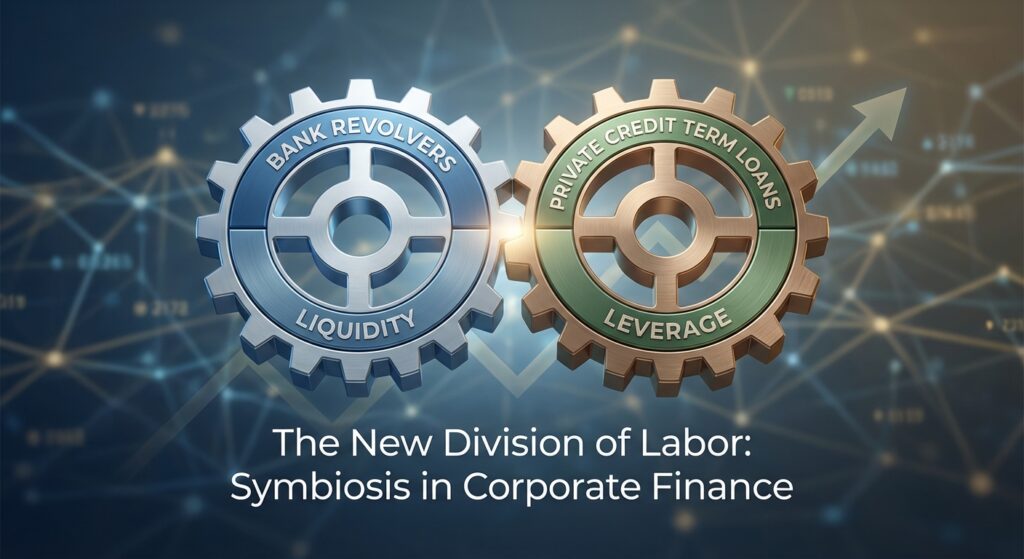
However, 2025-2026 data indicates a fundamental maturation of the asset class. The “Private Credit Fundamentals” have shifted from pure competition to structural functionalism. Private credit is capturing the *term loan* market (providing the heavier, riskier, and more flexible funded debt) while banks are increasingly retreating to their core competency: providing low-risk, low-margin *lines of credit* (revolvers) and deposit services.
This shift has created the “Dual Borrower” phenomenon. Mid-market CFOs are no longer choosing between a bank or a fund; they are increasingly building capital stacks that require both to function effectively.
## What the Evidence Says
Recent research from the Federal Reserve and FDIC clarifies this division of labor. According to a July 2025 working paper, *Private Debt versus Bank Debt in Corporate Borrowing*, there is a high prevalence of borrowers who tap both markets simultaneously.
The evidence highlights three structural distinctions:
1. **Substitution of Term Debt:** Private credit lenders are financing larger, junior, and riskier term loans compared to banks. They are willing to hold this risk on balance sheet in exchange for higher spreads and stronger call protection.
2. **Complementarity of Liquidity:** Banks are not exiting the corporate ecosystem; they are specializing in “liquidity insurance” via credit lines. The research suggests that private debt *complements* the bank’s provision of credit lines. When a borrower secures a private credit term loan, they often secure a bank revolver alongside it.
3. **Risk Segmentation:** Banks are effectively outsourcing the term-risk (drawdown risk and credit production) to private lenders while retaining the transactional relationship and the super-senior revolving exposure.
This data challenges the view that private credit poses an unchecked systemic threat. Instead, it suggests a decentralized stability where long-duration illiquidity risk is moved from highly levered bank balance sheets to committed capital vehicles (funds) that are structured to hold it.
## Data Box: The Scale of the Shift
The following metrics illustrate the size and segmentation of the current credit market.
| Metric | Latest Figure | Why it matters | Source |
| :— | :— | :— | :— |
| **US Private Credit Volume** | ~$1.34 Trillion | Size implies systemic importance; 5x growth since 2009. | [federalreserve.gov](https://www.federalreserve.gov/econres/notes/feds-notes/bank-lending-to-private-credit-size-characteristics-and-financial-stability-implications-20250523.html) |
| **Broadly Syndicated Loans (BSL)** | ~$1.30 Trillion | Private credit has effectively caught up to the BSL market in size. | [bostonfed.org](https://www.bostonfed.org/-/media/Documents/Workingpapers/PDF/2025/CPP-20250521.pdf) |
| **Commercial & Industrial (C&I) Loans** | ~$2.80 Trillion | Banks still hold the largest absolute volume, primarily in investment-grade and lower-leverage assets. | [bostonfed.org](https://www.bostonfed.org/-/media/Documents/Workingpapers/PDF/2025/CPP-20250521.pdf) |
| **High Yield Bonds** | ~$1.60 Trillion | Public markets remain slightly larger but are less flexible for mid-market borrowers. | [bostonfed.org](https://www.bostonfed.org/-/media/Documents/Workingpapers/PDF/2025/CPP-20250521.pdf) |
## Practical Implications
### For Borrowers & Operators
* **Structure the “Ask” Separately:** Do not expect a single lender to solve every problem. Approach private funds for your growth/acquisition capital (Term Loan) and banks for your working capital (Revolver).
* **Intercreditor Awareness:** A “Dual Borrower” strategy requires navigating intercreditor agreements. Understand that your bank will likely demand “super-senior” status on the revolver, even if the term loan is significantly larger.
* **Cost Blending:** While private credit spreads are higher, blending them with cheaper bank lines for working capital can lower the overall Weighted Average Cost of Capital (WACC).
### For Investors & Allocators
* **Risk-Adjusted Returns:** The premium in private credit is derived from holding the term risk that banks no longer want. This is a feature, not a bug.
* **Stability of Collateral:** The presence of a bank revolver alongside a private credit allocation can be a positive signal; it implies the borrower has passed the strict regulatory underwriting standards of a commercial bank for their working capital needs.
* **Liquidity Management:** Investors must recognize that private credit funds are inherently illiquid vehicles designed to match the duration of the underlying term loans (5–7 years).
## Key Takeaways
1. **Symbiosis:** The relationship between banks and private credit is becoming symbiotic, not just adversarial.
2. **Parity:** Private credit (direct lending) volume is now on par with the Broadly Syndicated Loan market ($1.3T+), cementing it as a primary asset class.
3. **Segmentation:** Banks own “Liquidity” (Revolvers); Private Credit owns “Leverage” (Term Loans).
4. **Resilience:** The removal of risky term loans from bank balance sheets may ostensibly lower systemic risk for the banking sector, moving that risk to unlevered (or lower-levered) fund structures.
5. **Growth:** Despite high rates, the absolute growth of the asset class (5x since 2009) proves demand is structural, fueled by the retreat of banks from sub-investment grade term lending.
## Why This Matters Today
* **Regulatory Pressure:** With Basel III endgame and other capital requirements squeezing bank balance sheets in 2025/2026, banks have less appetite for non-investment grade term paper.
* **M&A Readiness:** As M&A activity stabilizes, buyers need certainty of execution. The “Dual Borrower” model offers the speed of private credit with the operational flexibility of bank cash management.
* **Market Maturity:** We are moving past the “Wild West” phase of private credit into a standardized institutional phase where roles are clearly defined.
## Sources Used
* **Bank Lending to Private Credit: Size, Characteristics, and Financial Stability Implications** (May 2025) – Federal Reserve Board | [federalreserve.gov](https://www.federalreserve.gov/econres/notes/feds-notes/bank-lending-to-private-credit-size-characteristics-and-financial-stability-implications-20250523.html)
* **Could the Growth of Private Credit Pose a Risk to Financial System Stability?** (May 2025) – Federal Reserve Bank of Boston | [bostonfed.org](https://www.bostonfed.org/-/media/Documents/Workingpapers/PDF/2025/CPP-20250521.pdf)
* **Private Debt versus Bank Debt in Corporate Borrowing** (July 2025) – FDIC / Federal Reserve Board | [fdic.gov](https://www.fdic.gov/center-financial-research/private-debt-versus-bank-debt-corporate-borrowing.pdf)
* **Private Credit: Characteristics and Risks** (Feb 2024) – Federal Reserve Board | [federalreserve.gov](https://www.federalreserve.gov/econres/notes/feds-notes/private-credit-characteristics-and-risks-20240223.html)
* **Financial Stability Report** (April 2025) – Federal Reserve Board | [federalreserve.gov](https://www.federalreserve.gov/publications/files/financial-stability-report-20250425.pdf)
This content is for educational purposes only and does not constitute investment advice, solicitation, or an offer to buy or sell securities.


