
Credit Cycle Alert: The Market Is Open, But Selectively So
The first quarter of 2026 delivered a clear message to borrowers and institutional investors alike: the era of near-universal credit access is over. What has replaced it is a bifurcated landscape: one where premium, high-quality credits continue to attract aggressive lender interest, while lower-rated, AI-exposed, or cyclically sensitive borrowers face sharply higher risk premiums, constrained deal timelines, and in some cases, market closure altogether. This is not a credit crisis. It is a credit cycle correction, and understanding the mechanics of that correction is now the primary task for any institution with debt on its balance sheet or capital to deploy.
Three structural forces are converging to shape this environment: (1) macroeconomic uncertainty driven by tariff policy and geopolitical tension; (2) an AI-led disruption shock concentrated in software and IT services; and (3) the partial retreat of retail-oriented private credit vehicles amid significant redemption pressure. Together, these forces have pushed credit markets into active price discovery for the first time since the post-pandemic tightening cycle.
Quantitative Market Snapshot
| Metric | Current Level (Q1 2026) | Prior Period (Q4 2025) | Change | Source |
|---|---|---|---|---|
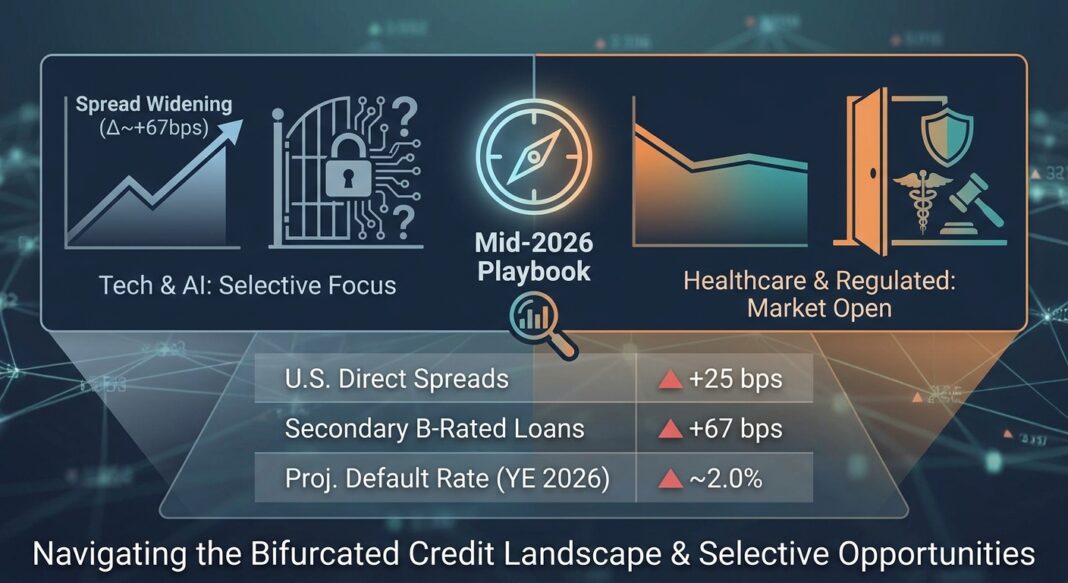
| U.S. Direct Lending Spreads (new issues) | ~25 bps wider | Q4 2025 baseline | ▲ +25 bps | northleafcapital.com |
| Secondary B-Rated Loan Spreads (U.S.) | ~67 bps wider than year-end | Year-end 2025 baseline | ▲ +67 bps | valuationresearch.com |
| European B-Rated Secondary Loan Spreads | ~65 bps wider than year-end | Year-end 2025 baseline | ▲ +65 bps | valuationresearch.com |
| U.S. Software/IT Loan Spreads (secondary) | ~200 bps wider than year-end | Year-end 2025 baseline | ▲ +200 bps | valuationresearch.com |
| Total U.S. Institutional Loan Issuance (Q1 2026) | $241B (+54% QoQ) | $157B (Q4 2025) | ▼ -32% YoY | portagepointpartners.com |
| European Direct Lending Volume (Q1 2026) | €8.3B | €12.4B (Q4 2025) | ▼ -33% QoQ | valuationresearch.com |
| Projected U.S. Private Credit Default Rate (YE 2026) | ~2.0% | 1.5% (2025 actual) | ▲ +50 bps | northleafcapital.com |
| Fed Funds Target Rate (as of Q1 2026) | 3.50% – 3.75% | 3.50% – 3.75% (unchanged) | Flat | northleafcapital.com |
From a KPI underwriting lens, direct lenders are recalibrating minimum fixed charge coverage ratio (FCCR) thresholds, particularly for businesses with floating-rate debt and compressed operating margins. With the forward SOFR curve implying an average base rate of approximately 3.5% through 2028, the all-in cost of new private credit debt remains in the high single digits, sustaining pressure on interest coverage ratios for leveraged borrowers. Lenders are increasingly scrutinizing debt-service coverage headroom, enterprise value support for loan-to-value (LTV) calculations, and the durability of EBITDA in AI-sensitive verticals before committing to leverage multiples.
Sector Analysis: Heat Map of Lender Appetite
Technology & Software (Cold): This sector represents the sharpest inflection point in Q1 2026. Concerns around AI-driven disruption to existing SaaS and IT services business models triggered a broad public market selloff and cascaded into private credit. Secondary spreads for software loans widened by approximately 200 basis points from year-end 2025, and lenders are now applying an additional risk premium of roughly 75 basis points to AI-exposed issuers on new transactions, according to valuationresearch.com. Borrowers with unresolved AI risk exposure remain effectively locked out of primary markets pending full due diligence vetting.
Healthcare, Compliance-Intensive, & Regulated Businesses (Warm-to-Hot): Lenders continue to favor businesses with proprietary data assets, high regulatory barriers, and significant customer interaction complexity, characteristics that provide natural insulation from AI substitution risk. These sectors command tighter spreads and face fewer structural questions during underwriting, as noted by valuationresearch.com.
Consumer & Cyclicals (Cooling): Pockets of credit stress are emerging in consumer-facing sectors, compounded by higher oil prices and persistent inflation. Portfolio monitoring has intensified, particularly for 2021–2022 vintage deals that were underwritten at higher leverage multiples during the post-pandemic low-rate environment. These credits face the most acute FCCR compression and are most likely to require covenant amendments, PIK toggle adjustments, or maturity extensions, per northleafcapital.com.
M&A/LBO-Driven Credits (Selectively Active): U.S. LBO deal volumes in Q1 2026 rose more than 30% year-over-year, but concentration risk is notable, over 40% of institutional loan volume derived from just five mega-transactions, per sikich.com. This reflects pipeline carryover from late 2025 rather than broad-based deal formation momentum. Private equity sponsors are holding back on new launches amid valuation mismatches and extended hold periods.
Implications for Institutional Investors and Operators
For Borrowers: Companies seeking new debt capital in this environment must be prepared for wider spreads, tighter FCCR covenants, and deeper diligence timelines: especially if they have any software, technology services, or consumer cyclical exposure. Investment-grade and upper-middle-market credits rated BB or higher retain meaningful market access, but lower-rated borrowers should engage lenders early and build in extra execution runway. Borrowers with approaching maturities, particularly 2021–2022 vintage leveraged loans, should act proactively rather than waiting for conditions to ease, as refinancing windows for weaker credits are narrowing.
For Lenders and Investors: The partial retreat of retail-oriented BDCs and non-traded structures amid elevated redemptions is creating a structural opportunity for institutional private credit managers with stable, long-duration capital. Well-capitalized lenders with disciplined underwriting and low AI/cyclical exposure in their portfolios are positioned to step into deals on more favorable terms and with stronger documentation protections. The combination of elevated base rates (~3.5% forward SOFR average) and widening spreads is restoring private credit’s unlevered return profile toward the high single digits, a level that justifies increased allocation relative to public credit alternatives, per northleafcapital.com.
Forward-Looking View: The Next 3–6 Months
Credit markets heading into mid-2026 will be shaped by three contingent variables: (1) resolution or escalation of Middle East geopolitical tensions and their impact on oil prices and inflation; (2) the pace at which AI disruption risk is priced and absorbed by the software sector; and (3) the Federal Reserve’s rate path, with market consensus now pricing in 0–2 additional 25 bps cuts by December 2026, per valuationresearch.com.
The structural case for private credit remains intact. Substantial dry powder is available across the institutional lender base, and deal pipelines, while slower than anticipated, remain active. A stabilization in macro conditions could trigger a rapid reopening of primary markets, particularly for M&A-driven issuance that has been queued but not yet launched. However, the bifurcation between high-quality and stressed credits is expected to widen before it narrows, with KBRA projecting the annualized private credit default rate rising from 1.5% in 2025 to approximately 2.0% by year-end 2026. For institutional investors, active portfolio construction, rigorous sector screening, and strong sponsor alignment are the operating imperatives of the moment.
Key Market Insights
- Price discovery is real, not rhetorical: U.S. secondary B-rated loan spreads are ~67 bps wider than year-end 2025, and VRC has raised its middle market credit spread matrix by 25 bps across all instruments, the first meaningful upward repricing since the post-pandemic cycle.
- Software/AI exposure is the defining underwriting variable of 2026: IT and software credits face 200 bps of secondary spread widening and a ~75 bps new-issue premium, functionally shutting out unvetted AI-exposed borrowers from primary markets.
- Concentration risk masks the true state of M&A lending: 40%+ of Q1 U.S. institutional loan volume came from five deals; underlying PE deal formation has slowed materially, with Q1 volumes heavily influenced by late-2025 pipeline carryover.
- Retail BDC redemption pressure is redistributing private credit supply: Non-traded BDC redemption requests hit a multi-year peak, freeing deal share for institutional managers with stable, long-duration capital and creating more favorable lender negotiating dynamics.
- 2021–2022 vintage credits remain the highest-risk cohort: Post-COVID era deals underwritten at peak leverage multiples face the most acute FCCR compression under today’s rate environment, with restructuring, PIK toggles, and covenant amendments increasingly common portfolio management tools.


