
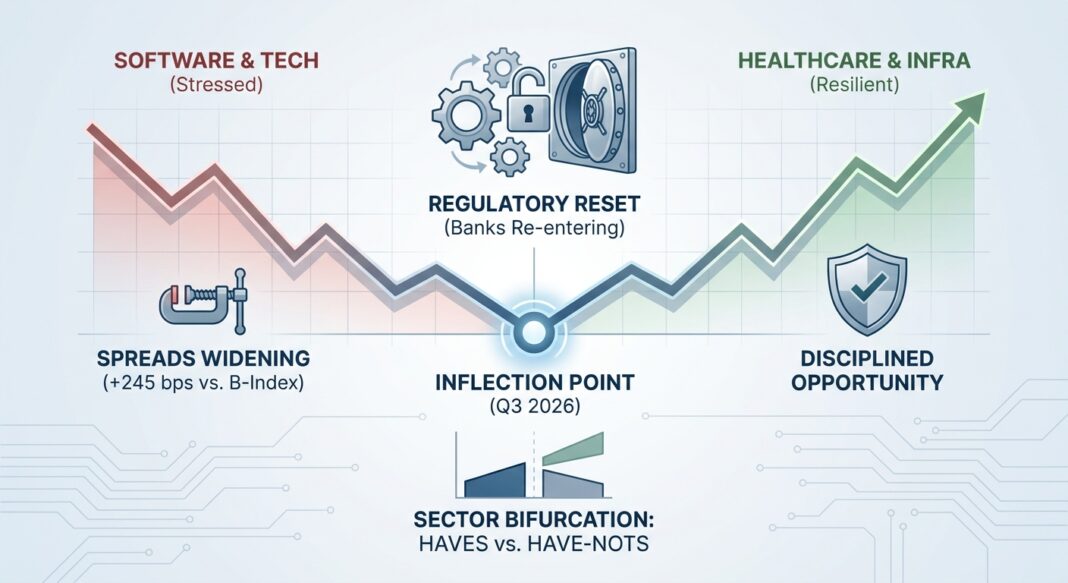
Market Headline: A Lender-Friendly Reset, But Only for the Disciplined
The U.S. credit market in Q3 2026 is defined by a powerful paradox: conditions are simultaneously widening for lenders and tightening for borrowers, yet deal volume is falling and capital is becoming intensely selective. According to Lord Abbett’s 2026 Midyear Investment Outlook (citing PitchBook data), spreads in the private credit market have widened by roughly 50 to 100 basis points since late 2025, while defensive documentation terms have also improved, a dual tailwind for disciplined lenders. On plain-vanilla middle-market direct lending deals, a loan that priced at S+450 in late 2025 is now likely clearing at S+500 or wider, with incrementally more original issue discount (OID), per PitchBook LCD’s Q2 2026 US Private Credit Wrap.
Three converging shocks drove the reset: the U.S.-Iran military conflict in late February 2026, which injected macro uncertainty and upward inflation pressure via oil markets; an AI-driven selloff in software and SaaS credits that exposed sector concentration risk across BDC portfolios; and a wave of investor redemption requests at non-traded business development companies (BDCs) that revealed structural liquidity mismatches in retail-oriented private credit wrappers. Capstone Partners’ Q1 2026 Leveraged Finance Update documented the combined impact: a 22.5% year-over-year decline in overall institutional leveraged loan value in Q1 2026 alone.
The macro backdrop compounds the stress. Valuation Research Corporation’s Q2 2026 Private Markets Report confirms that three-month Term SOFR reached 3.68% by June, essentially flat quarter-over-quarter, while five-year U.S. Treasury yields rose to approximately 4.23% in June from 3.92% in March, reflecting a market that has sharply reduced expectations for Federal Reserve rate cuts. Moody’s places baseline GDP growth at roughly 1.5%, just above the historical stall speed below which defaults tend to accelerate, reinforcing a higher-for-longer rate environment that disproportionately affects floating-rate borrowers.
Critically, this is not systemic collapse. It is differentiation. The lenders with dry powder, sector discipline, and underwriting rigor are gaining negotiating leverage not seen since 2022. The market is bifurcating, sharply, between haves and have-nots at both the borrower and lender levels.
Quantitative Market Snapshot
The following data box synthesizes key market metrics as of Q2/Q3 2026, drawing on primary institutional sources:
| Metric | Current Value (Q2–Q3 2026) | Prior Period | Change | Source |
|---|---|---|---|---|
| Middle Market Direct Lending Spreads | S+500 (plain-vanilla deals) | S+450 (late 2025) | +50 bps | PitchBook LCD, Q2 2026 |
| 3-Month Term SOFR | 3.68% | 3.67% (Q1 2026) | +1 bp QoQ | VRC Q2 2026 Private Markets Report |
| 5-Year U.S. Treasury Yield | ~4.23% (June 2026) | 3.92% (March 2026) | +31 bps QoQ | VRC Q2 2026 Private Markets Report |
| Direct Lending LBO Volume (YTD) | $30.2B (92 deals) | Prior year pace (+21%) | −21% YoY volume; −17% deal count | PitchBook LCD, June 2026 |
| BDC Non-Accrual Rate (Reported, Top 10 BDCs) | 3.95% of total debt at cost (Q2 2026) | 3.75% (Q1 2026) | +20 bps QoQ | PitchBook LCD, August 2026 |
| Private Credit vs. High Yield Spread Premium | ~150–200 bps over public HY | ~350 bps (2019) | Compressed ~150–200 bps over cycle | Owners.pe, April 2026 |
| Software Secondary Spreads vs. Broad B-Rated Loan Index | ~229 bps above B-rated loan index | Year-end 2025 baseline | +245 bps vs. YE 2025 levels | PitchBook LCD via VRC, June 2026 |
Key KPI Context, Leverage & Coverage: GF Data (via VRC Q2 2026) reports that EV/EBITDA buyout multiples for the $100–$250M enterprise value segment declined from 9.4x in 2025 to 8.8x in 2026: a meaningful de-rating for the core lower-middle market. Morgan Stanley Investment Management notes that EBITDA-to-interest coverage ratios have moved modestly higher in recent quarters, with consensus forecasting an EBITDA rebound among leveraged loan borrowers over the next four quarters, a constructive sign for FCCR stabilization. However, Moody’s warns that evolving structures (including covenant-lite documentation, payment-in-kind (PIK) income, NAV-based lending, and layered fund-level leverage) are obscuring underlying leverage ratios across the asset class, complicating true debt-to-equity and fixed charge coverage analysis.
Sector Analysis: Where Lender Appetite Is Growing, and Where It Is Contracting
🔴 Software & Technology Services: Sharp Reassessment Underway
The AI-driven disruption thesis has fundamentally altered how lenders underwrite software credits. PitchBook LCD data (via VRC) shows software secondary spreads approximately 245 basis points wider than year-end 2025 levels and roughly 229 basis points above the broader B-rated loan index as of June 2026, the sharpest sector-specific dislocation in the current cycle. PitchBook’s Q2 2026 Private Credit Wrap reports that the BSL market has taken the majority of LBO financing volume this year, a reversal from recent years when private credit dominated, as direct lenders have pulled back selectively from software-exposed deals. Lord Abbett flags that portfolios with older vintage software-related credits, particularly those from 2021–2022 when leverage was aggressive, are now showing materially higher non-accrual rates and PIK utilization. Critically, S&P Global Ratings estimates private credit’s software concentration exceeds 20% of portfolios, compared to 13.5% in the broadly syndicated loan market, underscoring structural concentration risk.
🟢 Healthcare: The Defensive Anchor, With an Asterisk
RSM US reports that healthcare has become the single largest sector for U.S. direct lending, accounting for roughly 22% of all direct lending issuance year-to-date through March 2026, up from 18% in 2025. Private credit has increasingly filled financing gaps for hospitals, physician platforms, behavioral health providers, and post-acute operators, fueled by healthcare’s defensive demand characteristics and predictable cash flows. Octus Data confirms healthcare led private credit deal flow in 2025, accounting for 19% of all direct lending deals, and was the only major sector not to see significant year-over-year pricing tightening. The asterisk: Morgan Stanley IM maintains a significant underweight to healthcare at the portfolio level, noting it has led all sectors in loans placed on non-accrual status over the past year, a reminder that concentration creates exposure as well as income.
🟡 Infrastructure & AI Data Centers: The Emerging Structural Opportunity
Chambers & Partners’ 2026 Private Credit USA Practice Guide notes that private credit has been leading the development of financing structures for large-scale AI-related infrastructure. Creative Planning cites a Morgan Stanley estimate that private credit could supply more than half of the $1.5 trillion needed for global data center buildouts through 2028, and in infrastructure more broadly, private credit is funding renewable energy developments and large-scale capital projects as bank lending standards have constrained traditional lenders in this space.
🔴 Energy-Intensive Industrials & Manufacturing: Geopolitically Repriced
Capstone Partners reports that lenders have actively tightened underwriting standards for energy-intensive industries and businesses whose leverage was predicated on stable energy costs, following geopolitical-driven oil price volatility. Credit structures for these sectors are now being stress-tested with materially higher base energy cost assumptions, effectively compressing maximum leverage multiples and requiring stronger fixed charge coverage ratios at underwriting.
The Regulatory Force Multiplier: Banks Re-Enter the Leveraged Lending Arena
The most structurally significant development reshaping the competitive dynamics of leveraged credit is regulatory, not macroeconomic. On December 5, 2025, the OCC and FDIC formally rescinded the 2013 Interagency Guidance on Leveraged Lending, the Obama-era framework that had for over a decade constrained bank underwriting of leveraged loans, particularly those with debt-to-EBITDA ratios above 6x. The agencies stated explicitly that the guidance had “resulted in a significant drop in leveraged lending market share by regulated banks and significant growth in leveraged lending market share by nonbanks, pushing this type of lending outside of the regulatory perimeter.”
Mayer Brown notes this rescission should allow banks to better apply enterprise-wide risk management programs to leveraged lending, “potentially creating additional competition in the private credit loan market.” Chambers & Partners observes the change could give private credit lenders greater flexibility to underwrite a broader range of loans and develop institution-specific definitions of leveraged lending. Notably, the Federal Reserve has not yet formally withdrawn its parallel guidance, leaving a residual layer of oversight over Fed-supervised institutions, but market participants widely expect alignment.
In practice, VRC observes that banks began to re-enter the upper middle market in Q2 2026, contributing to increased competition and alleviating some upward pressure on credit spreads for higher-quality deals. The Federal Reserve’s July 2026 SLOOS confirms this: C&I lending standards were basically unchanged in Q2, and banks reported stronger demand for C&I loans from large and middle-market firms: a meaningful shift from Q1’s tighter posture. Furthermore, the SLOOS noted that banks eased CRE lending standards by the most since early 2022. For non-depository financial institutions (NDFIs), the category that includes private credit funds, banks reported tighter standards over the prior year, reflecting a strategic recalibration of banks’ own lending relationships with private credit platforms.
Implications for Institutional Investors and Business Operators
For Institutional Investors & Lenders
- Spread recapture is real, but selectivity determines the alpha. The 50–100 bps widening since late 2025 improves income for new deployments. Lord Abbett argues the most durable advantage will come from better documentation, more conservative leverage, and the time for thorough stress analysis before capital is deployed, not simply from broader market spreads.
- BDC non-accruals demand portfolio-level forensics. PitchBook LCD data shows adjusted non-accrual exposure (counting all debt of borrowers with at least one non-accrual tranche) rose to 3.3% of total debt at cost in Q1 2026, up 116 bps quarter-over-quarter. For the top 10 public BDCs, reported non-accruals reached 3.95% in Q2. Investors should scrutinize PIK income as a share of total investment income, 2021–2022 vintage exposure, and sector concentration, particularly software, as leading indicators of future credit deterioration.
- The private credit vs. high yield valuation argument has narrowed. Owners.pe estimates the spread premium of private credit over public high yield has compressed from approximately 350 bps in 2019 to roughly 150–200 bps today, barely above the implied illiquidity premium of 75–150 bps in normal markets. Investors must re-evaluate whether the current compensation adequately reflects illiquidity, concentration, and valuation opacity risks.
- The H2 2026 opportunity is in discipline and dry powder deployment. Hamilton Lane notes that private credit spreads have returned to the S+500 context, yield-enhancing relative to the mid-400s of late 2025. Managers with uncalled capital and underwriting discipline are best positioned to harvest this vintage.
For Business Operators & Borrowers
- Access to capital is bifurcating by quality. VRC notes that lending activity remains competitive for higher-quality deals, but risk premiums for AI-, tariff-, and cycle-exposed assets have risen materially. Borrowers in software, energy-intensive manufacturing, or with aggressive 2021–2022 capital structures face meaningfully higher all-in costs and stricter covenant demands.
- FCCR and DSCR thresholds are rising at underwriting. With SOFR at 3.68% and credit spreads back at S+500, all-in coupon rates on new middle market unitranche loans are approaching 8.5–9%+. Operators must stress-test fixed charge coverage ratios at current and scenario-elevated rate levels before committing to leveraged capital structures. Lenders are increasingly focused on free cash flow generation and downside EBITDA cases.
- The bank re-entry creates refinancing options, selectively. The OCC/FDIC regulatory deregulation opens a competing channel for higher-quality, non-software credits seeking to refinance private credit obligations at tighter bank rates. Operators with strong FCCRs, non-cyclical revenue, and below-6x total leverage may find newly competitive bank pricing for the first time in years.
Forward-Looking View: H2 2026 and Into 2027
The second half of 2026 will likely be defined by dispersion, not directionality. Lord Abbett describes H2 as a period where investors should focus less on broad asset-class headlines and more on where managers are lending, how loans are structured, and whether portfolios carry the right balance of income, downside mitigation, and selectivity.
A Federal Reserve research note published in August 2026 flagged that deteriorating investor sentiment in the private credit market raises concerns that a contraction in credit availability could curtail the ability of some middle-market firms to obtain financing, reinforcing the importance of monitoring substitution flows between private credit and the broadly syndicated loan market. S&P Global Ratings warns that U.S. maturities for B- and below-rated debt will surge to a peak of $215 billion in 2028, up from $56.6 billion in 2026, creating a mounting refinancing wall that will stress borrower FCCRs and lender underwriting across the credit spectrum over the next 24 months.
The structural growth thesis for private credit remains intact. Cleary Gottlieb estimates that direct lending now matches the broadly syndicated loan market at $1.5–2 trillion in size and is forecast to reach $3 trillion by 2028. The question for 2027 is whether that growth is accompanied by improving underwriting discipline, or whether competition for deal flow, once M&A activity recovers, compresses spreads and loosens covenants all over again.
Key Market Intelligence Takeaways
- Spreads have reset higher: act on it. Middle market direct lending spreads have moved from S+450 to S+500+ since late 2025, with improved covenant protections. Managers with dry powder entering H2 2026 are deploying into the best risk-adjusted new-issue terms since 2022.
- Software is a sector-specific credit event, not systemic. The 245 bps secondary spread widening in software versus year-end levels reflects a targeted AI disruption repricing. Non-software credits with stable FCCRs are being actively competed for by multiple lender types.
- BDC non-accruals are a leading, not lagging, indicator. With adjusted BDC non-accruals at 3.3% of total debt cost in Q1 2026 and rising, portfolio managers should act on early warning signals now, including PIK income creep and vintage concentration in 2021–2022 paper.
- The OCC/FDIC deregulation is a structural competitive variable. Bank re-entry into leveraged lending, enabled by the December 2025 rescission of the 2013 Guidance, will intensify competition for investment-grade-adjacent and upper-middle-market credits, exerting downward pressure on private credit spreads in those brackets over the next 12–18 months.
- Operators: re-underwrite your capital structure against current rates now. With all-in coupons on floating-rate middle market paper in the 8.5–9%+ range and the maturity wall for B- and below-rated debt accelerating toward $215 billion by 2028, proactive refinancing, covenant amendment, and capital structure optimization decisions made in H2 2026 will define credit outcomes in 2027–2028.


