
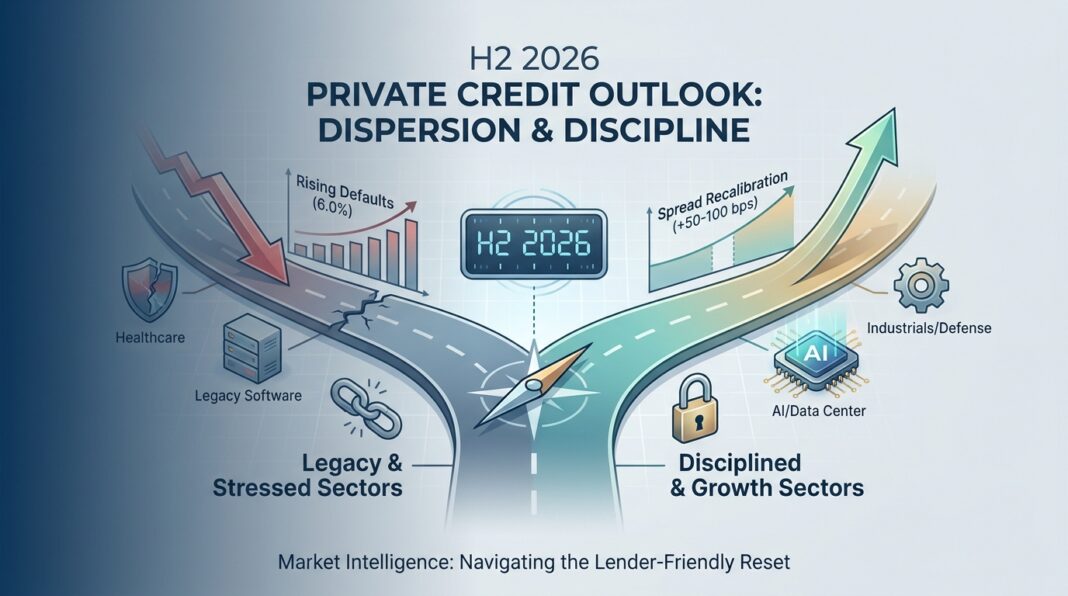
Market Headline: The Lender-Friendly Reset Has Arrived, But Dispersion Is the New Risk
After two years of aggressive spread compression and covenant erosion, private credit markets have entered a decisive recalibration phase in 2026. The macro conditions driving this shift are well-documented: elevated “higher-for-longer” benchmark rates, a geopolitical shock in the Middle East that reignited inflation fears, and a sharp AI-driven devaluation of legacy software and technology-services credits. The cumulative effect has been a market that now unmistakably favors disciplined lenders over borrowers, but one that is testing underwriting vintages of 2021–2022 in real time.
According to PitchBook data cited by Lord Abbett, spreads have widened by roughly 50 to 100 basis points since late 2025, while defensive documentation terms have simultaneously improved. The July 2026 Federal Reserve Senior Loan Officer Opinion Survey (SLOOS) confirmed that bank C&I lending standards remained essentially unchanged in Q2, but critically reported stronger demand for C&I loans from large and middle-market firms, a signal that corporate borrowing appetite is rebuilding even as private credit volumes contract. Against this backdrop, the Fitch-reported private credit default rate reached 6.0% on a trailing twelve-month basis in May 2026, the highest reading in the asset class’s modern history, concentrating stress in technology, healthcare technology, and late-cycle leveraged buyout portfolios.
The H2 2026 narrative is therefore not a market in crisis, but a market in dispersion: capital is available, but it is becoming highly selective. Managers with dry powder, disciplined underwriting, and covenant protections are finding an enlarged opportunity set. Borrowers with weak free cash flow, AI-exposed revenue models, or thin interest coverage are confronting a structurally more expensive and less forgiving financing environment.
Quantitative Market Snapshot
The table below synthesizes the most current available market metrics across public and private credit as of late August 2026. All figures are sourced from institutional data providers and primary market surveys.
| Metric | Current Value (Q2 / Aug 2026) | Prior Period | Change | Source |
|---|---|---|---|---|
| Middle Market Private Credit Spread | S+500 bps (unitranche context) | S+450 bps (mid-2025) | +50 bps | Hamilton Lane, 2026 Private Credit Focus |
| Spread Widening Since Late 2025 | +50 to +100 bps | Late 2025 baseline | Widening | Lord Abbett / PitchBook, June 2026 |
| High-Yield Bond Spreads | ~270 bps (mid-2Q range) | 316 bps (2026 high) | Compressing | Bankers Edge Advisory, August 4, 2026 |
| Investment-Grade Corporate Spreads | ~70 bps | N/A (Q2 snapshot) | Tight / Historically Compressed | Chicago Atlantic, Q2 2026 Update |
| 3-Month Term SOFR | 3.68–3.69% | ~3.67% (Q1 2026) | +1 bp QoQ | Valuation Research Corp., Q2 2026 |
| 5-Year U.S. Treasury Yield | 4.23% | 3.92% (March 2026) | +31 bps | Valuation Research Corp., Q2 2026 |
| Direct Lending Default Rate (Fitch TTM) | 6.0% (May 2026 TTM peak) | ~2.5% (2025 avg) | Sharply Higher | Forbes / Fitch, May 2026 |
| Proskauer Private Credit Default Index (Q2 2026) | 2.51% (716 loans / $195.6B) | ~2.4% (Q4 2025, >$50M EBITDA cohort) | Ticking Higher | Investing.com / Proskauer, August 2026 |
| Direct Lending Origination Volume (Q2 2026) | $33.6B | $74.7B (Q1 2026) | ‑55% QoQ | PitchBook/LCD via Angel Investors Network, Aug 2026 |
| Deal Count (Q2 2026) | 154 transactions | 217 (Q1 2026) | Lowest since Q2 2023 | PitchBook/LCD via Angel Investors Network, Aug 2026 |
| Typical Max Leverage Covenant | ~4.0x EBITDA | Higher leverage accepted in 2021–22 vintages | Tightening | Investing.com, August 2026 |
| Minimum Interest Coverage (FCCR Proxy) | ~2.5x (new deal standard) | Eroded in 2021–22 covenant-lite era | Normalizing Upward | Investing.com, August 2026 |
Key structural benchmark for new direct lending transactions: first-lien senior secured loans, floating rate at SOFR+400–600 bps, 4–6 year term, maximum leverage near 4.0x EBITDA, minimum interest coverage near 2.5x. (Source: Investing.com, August 2026)
With the 5-year Treasury up 31 basis points since March and SOFR essentially flat, the all-in yield environment remains structurally elevated for floating-rate borrowers. The Cliffwater Direct Lending Index posted 3.0% total return for H1 2026 and 7.7% for the trailing twelve months to June 30, still ahead of investment-grade corporates, but meaningfully below the double-digit returns that characterized the 2022–2024 marketing cycle for the asset class.
Sector Analysis: Where Lenders Are Leaning In, and Pulling Back
Healthcare: Dominant but Increasingly Stressed
Healthcare has become the single largest sector for U.S. direct lending, accounting for approximately 22% of all direct lending issuance year-to-date through March 2026, up from 18% in 2025, according to RSM’s Real Economy data. Private credit has filled financing gaps for hospitals, physician platforms, behavioral health providers, and post-acute operators, areas where public capital markets offer inconsistent access. The sector’s defensive demand characteristics and predictable cash flows remain attractive to lenders.
However, concentration risk is now a two-way concern. Healthcare led all sectors in loans placed on non-accrual status over the prior year, per Morgan Stanley’s direct lending team, which maintains a deliberate underweight to the sector in new origination activity. Recovery rates are being tested, and lenders are increasingly scrutinizing provider fundamentals (cash-flow stability, payer mix, labor costs, and governance) before committing new capital. Healthcare operators should expect tighter loan structures, more rigorous borrowing base analysis, and greater emphasis on demonstrable free cash flow margins as a condition of credit approval.
Technology & Software: A Tale of Two Sub-Sectors
The technology sector is experiencing the widest internal dispersion of any industry in the credit market. Legacy software companies (particularly those financed in the 2019–2022 vintage at low rates and without AI-disruption provisions) are under acute pressure. Secondary spreads for software credits are approximately 245 basis points wider than year-end levels and roughly 229 basis points above the broader B-rated loan index as of June 19, 2026, per PitchBook LCD data. These borrowers were often financed on growth multiples rather than cash flow coverage, creating a structural mismatch with a higher-for-longer rate environment.
In contrast, AI-infrastructure and data center-adjacent credits are drawing substantial lender appetite. Morgan Stanley estimates that private credit could supply more than half of the $1.5 trillion needed for global data center buildouts through 2028. The divergence is stark: AI-native or AI-enabling technology businesses with recurring revenue and visible cash flow are accessing capital at competitive terms, while legacy SaaS platforms face widening spreads and lender reluctance. Underwriters in 2026 are explicitly pricing AI-disruption risk as a line-item consideration.
Industrials & Aerospace/Defense: Structural Tailwinds
Industrials (and specifically aerospace, defense, and infrastructure-adjacent manufacturing) represent one of the most active origination environments in H1 2026. PwC’s midyear PE outlook confirms that industrials activity is dominated by mid-market buy-and-build platforms, and Octus data highlights a pipeline of defense-sector M&A processes generating direct lending mandates. Energy is also drawing lender attention as AI-driven power demand creates durable infrastructure investment needs. Lenders in these sectors are finding more predictable cash flow profiles, tangible asset collateral bases, and government-contract revenue streams that support tighter covenant packages at reasonable leverage.
Consumer & Retail: Credit Caution Persists
The PwC Global Private Credit Survey 2026 identified consumer and retail as the sector where managers expect the most acute stress over the next one to two years, cited by 56% of respondents. Automotive credits were flagged by 42% of managers as a near-term stress concentration. Lender appetite in consumer-facing sectors remains constrained by margin compression, tariff-related cost inflation, and weakening end-consumer demand signals. FCCR coverage in many leveraged consumer credits is at the low end of lender thresholds, and new origination for cyclically exposed consumer businesses is meeting more restrictive terms, tighter leverage caps, and enhanced cash-sweep provisions.
Regulatory Forces: The Oversight Arc Tightens
The regulatory environment surrounding private credit has moved from ambient concern to active inquiry. The SEC has opened several inquiries into large private credit managers, while the Treasury Department is reviewing business models for BDCs and semi-liquid fund vehicles amid elevated redemption requests. The Financial Stability Board published a formal report on vulnerabilities in private credit in May 2026, signaling global coordination of oversight efforts. In Europe, Basel IV implementation is expected to accelerate bank deleveraging, pushing an estimated 70% of European lending activity currently on bank balance sheets incrementally toward private debt funds, creating a structural origination opportunity over the next several years.
In the U.S., the most operationally significant regulatory development is the heightened scrutiny of internal fund valuations. The ICI’s April 2026 guidance on valuation governance for private credit assets reinforces the SEC’s fair value rule, requiring fund boards to oversee (and independent specialists to validate) marks on private credit portfolios. For GPs managing BDCs or registered funds, this tightens the governance burden and may constrain the ability to defer loss recognition on stressed credits.
Implications for Institutional Investors and Operators
For Borrowers / Operators
- Benchmark your FCCR proactively. New deal structures are coalescing around a minimum interest coverage ratio of approximately 2.5x. Borrowers approaching refinancing or new capital raises with coverage ratios below this threshold should expect repricing, incremental covenant packages, or structural enhancements (cash sweeps, equity cure rights) as a condition of approval.
- Sector narrative matters more than ever. Lenders are explicitly pricing AI-disruption risk and tariff exposure. Operators in technology services, consumer products, or import-dependent industrials must build a credible, quantified risk mitigation narrative into their credit presentations, or expect to pay a material spread premium.
- Maturity wall management remains a priority. According to PitchBook, only 15% of BDC debt investments are due in 2026–2027 as of mid-year, down from 27% at Q2 2024. Borrowers who proactively refinanced during the 2024–2025 window are well positioned; those who did not face a narrower, more expensive market.
For Institutional Investors / Lenders
- The deployment gap is the defining H2 2026 risk for LPs. Direct lending origination volume collapsed 55% quarter-on-quarter in Q2 2026, to $33.6 billion from $74.7 billion in Q1, per PitchBook/LCD data. With GPs experiencing no difficulty raising capital but facing acute deployment pressure, closed-end fund LPs should monitor capital call pacing closely and assess whether GP pressure to deploy could erode underwriting discipline in Q3–Q4.
- The illiquidity premium is under structural pressure. Historically, private credit yields have run approximately 1.66 percentage points above comparable public loans, as compensation for illiquidity. With high-yield spreads compressing toward near two-decade lows and private credit default rates rising, the risk-adjusted case for private credit requires fresh scrutiny at the portfolio level.
- Specialty finance and asset-based lending are the structural growth allocation. Direct lending’s share of all private debt capital raised globally has declined from 58.4% in 2024 to roughly 31% in Q1 2026, as allocators rotate into infrastructure debt, real estate credit, special situations, and asset-based strategies. Specialty finance (which lends against pools of receivables, equipment leases, consumer loans, and real assets) raised $37 billion in 2025, second only to direct lending, and represents a structurally defensive complement to corporate cash-flow lending in a late-cycle environment.
Forward View: Liquidity and Lending Dynamics, Next 3–6 Months
The H2 2026 credit environment will be defined by three converging forces. First, M&A-driven deal flow recovery: middle market private equity deal value rose approximately 10.7% year-over-year in H1 2026, and exit activity increased 14% over the same period. As sponsor-backed M&A re-accelerates, direct lending origination should rebuild from its Q2 trough, but quality selectivity is expected to persist, with managers declining to deploy at terms that don't adequately compensate for cycle risk.
Second, the bank re-entry dynamic will compress upper-middle-market spreads. Banks have gradually returned to the upper middle market since June 2026, contributing to increased competition for deals above $100M EBITDA and alleviating some upward pressure on spreads in that segment. The core lower-middle market (below $50M EBITDA) is likely to retain wider spreads and stronger covenant protections, as bank appetite is concentrated in larger, more liquid credits. This bifurcation creates a relative value argument for managers focused on the lower middle market.
Third, the regulatory and redemption overhang will keep capital disciplined. With the SEC conducting active inquiries, the FSB intensifying global monitoring, and BDC redemption requests still elevated, private credit GPs face governance and operational constraints that were absent during the 2020–2023 expansion phase. The second half of 2026 is likely to be defined by dispersion: between sectors, between borrower quality tiers, and between managers who built defensively versus those who stretched during the covenant-lite era. As Lord Abbett noted in its midyear outlook, “the opportunity is real, but the potential advantage may go to managers who can combine patience with discipline.”
Key Market Insights
- 📊 Spreads have widened 50–100 bps since late 2025, with unitranche pricing back in the S+500 context, the first meaningful lender-friendly repricing since 2022. New deal covenants are also improving, with leverage caps normalizing near 4.0x EBITDA and minimum interest coverage thresholds near 2.5x. (Hamilton Lane / Lord Abbett)
- ⚠️ Default rates have spiked to cycle highs, with Fitch recording a 6.0% TTM private credit default rate in May 2026: concentrated in technology, healthcare technology, and 2021–2022 LBO vintages where floating-rate burden has overwhelmed interest coverage ratios for many borrowers. (Forbes / Fitch / Valuation Research Corp.)
- 📉 Q2 2026 origination collapsed 55% quarter-on-quarter to $33.6 billion (154 deals), the weakest quarter since Q2 2023, driven by disciplined lenders choosing volume reduction over standard erosion, a constructive credit-quality signal that could reverse under GP deployment pressure in H2. (PitchBook/LCD)
- 🏥 Healthcare dominates origination at 22% of issuance but is simultaneously leading non-accrual rates, creating a two-sided risk for lenders with concentrated sector exposure and urgency for healthcare operators to actively manage lender communications and balance sheet resilience. (RSM Real Economy)
- 🌍 Regulatory pressure is intensifying globally: the SEC has opened inquiries into private credit managers, the FSB issued a formal vulnerability report in May 2026, and Basel IV implementation in Europe is expected to structurally redirect lending away from banks, creating a durable origination opportunity for private debt funds as European bank lending (currently ~70% of total) gradually contracts. (FSB, May 2026 / Capstone Partners / With Intelligence)


