
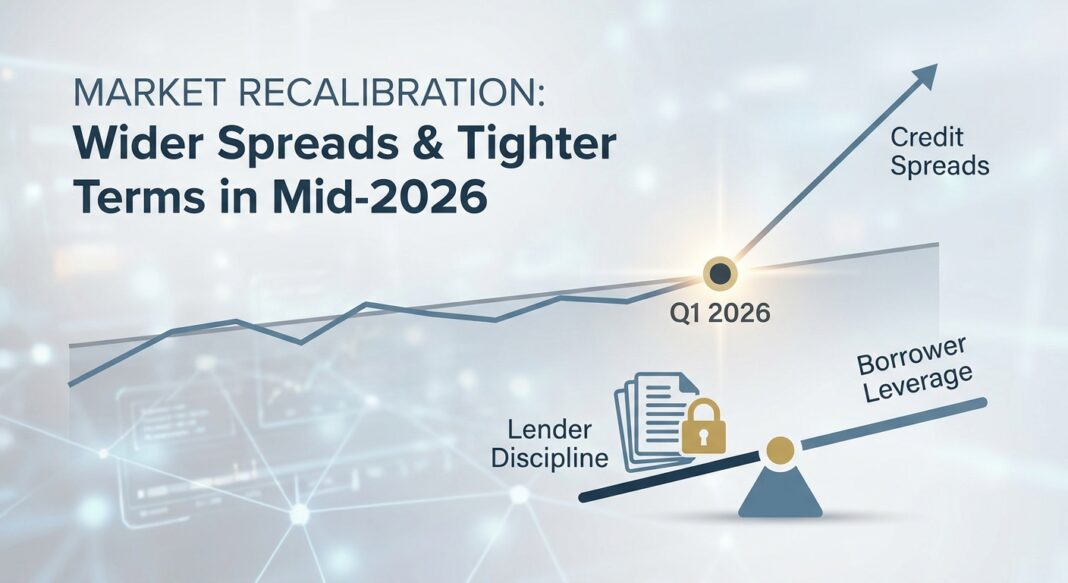
Market Headline: The Credit Cycle Has Turned, Discipline Is Now the Edge
For the first time since the post-2022 rate shock era, private credit markets are undergoing a genuine structural reset in favor of lenders. Three converging forces detonated simultaneously in Q1 2026 (the outbreak of the U.S.-Iran military conflict in late February, an accelerating AI-driven reassessment of software sector credit quality, and a wave of BDC and retail private credit redemption requests) producing what Capstone Partners described as a “22.5% year-over-year decline in overall institutional leveraged loan value in Q1 2026.”
The macro backdrop is unambiguous. Northleaf Capital’s Q1 2026 Private Credit Market Update confirms the Federal Reserve held its target funds rate steady at 3.50%–3.75% through Q1, citing elevated inflation pressures and geopolitical uncertainty, a posture that contributed to a more hawkish forward curve with limited easing priced in for 2026. The April 2026 SLOOS from the Federal Reserve confirmed that bank C&I lending standards tightened further in Q1 2026, continuing a trend established in Q4 2025. Most significantly for operators and borrowers: the era of covenant-lite, borrower-friendly structures is giving way to a market where lenders are back in the driver’s seat.
As Lord Abbett’s 2026 Midyear Outlook states directly, capital has become more selective, spreads are wider, covenants and documentation are improving, and managers with dry powder can be more selective. The H2 2026 story is one of dispersion: between disciplined and undisciplined lenders, between AI-exposed and defensive-sector borrowers, and between institutional capital and gated retail vehicles.
Quantitative Market Snapshot
| Metric | Current Value (Q1–Q2 2026) | Prior Period (Q3–Q4 2025) | Direction | Source |
|---|---|---|---|---|
| Private Credit (Direct Lending) New Issue Spread | ~25 bps wider than Q4 2025; broadly S+500–S+550 range for LBOs | 84.4% of LBO direct lending priced below S+550 | ↑ Widening | Capstone Partners / PitchBook LCD, Q1 2026 |
| Broad Spread Widening (vs. Late 2025) | +50–100 bps across new private credit loans | Spreads at cyclical tights; borrower-favorable docs | ↑ Widening | Lord Abbett Midyear Outlook 2026 |
| BSL & High Yield New Issue Spread Widening (Q4 2025 to Q1 2026) | +15–30 bps on new issues | Historically tight; IG OAS ~80 bps; HY OAS ~285–346 bps | ↑ Widening | Northleaf Capital / PitchBook, Q1 2026; InvestmentGrade.com 2026 |
| Direct Lending All-In Asset Yield (First Lien) | High single digits (8.0%–8.5% trough expected); direct lending generating high single-digit unlevered returns | ~10%+ in 2024–2025 peak rate environment | ↓ Compressing (but elevated historically) | Morgan Stanley Private Credit Outlook 2026; Northleaf Capital Q1 2026 |
| U.S. PE Deal Value (M&A Loan Pipeline) | $257.4B across 2,374 transactions in Q1 2026 (lowest since Q2 2025) | $339.3B in Q3 2025; $320.4B in Q4 2025 | ↓ Declining | Capstone Partners / PitchBook, Q1 2026 |
| Private Credit Default Rate (KBRA Projection) | 2.0% by volume (year-end 2026 forecast); 3.4% by count in Q4 2025 | 1.5% by volume in 2025 | ↑ Rising | KBRA via Northleaf Capital, Q1 2026 |
| Cliffwater Direct Lending Index (CDLI) 2025 Return | 9.3% calendar 2025 (10.4% interest income + 0.7% PIK) | Consistent high single-digit returns 2023–2024 | → Stable but compressing | CTA Acquisitions / Cliffwater CDLI, 2026 |
| "Bad PIK" (Distressed Deferrals) as % of Private Debt Volume | 6.4% of total private debt volume in Q1 2026 | PIK utilized in ~12% of all loans (FSB, Oct 2025) | ↑ Deteriorating | KBRA/Fitch via MarketMinute, March 2026; FSB Report on Vulnerabilities in Private Credit, May 2026 |
| U.S. High Yield Debt/EBITDA (Leverage) | ~4.4x (below 5.3x in 2020) | Post-pandemic lows | → Stable | Coutts CIO Weekly, March 2026 |
Data as of Q1–Q2 2026. Sources cited above. All figures are informational and not investment advice.
Fed SLOOS: Bank C&I Lending Standards, The Regulatory Tightening Dimension
The April 2026 SLOOS (covering Q1 2026 activity) delivered a clear signal: on balance, bank survey respondents reported tighter lending standards and basically unchanged demand for C&I loans to firms of all sizes. For non-depository financial institutions (NDFIs), the category that encompasses private credit funds themselves, banks reported tighter standards for all NDFI loan categories, with the most widely reported changes including higher premiums on riskier loans, stricter covenants, shorter maximum maturities, stricter collateralization requirements, and lower maximum credit-line sizes. This is not simply a corporate borrower problem; it is a funding-stack issue that constrains the leverage private credit funds themselves can deploy.
The January 2026 SLOOS had already flagged banks’ expectation that loan quality for C&I loans to small firms would deteriorate over 2026, while quality for large and middle-market C&I borrowers was expected to hold broadly steady. That bifurcation has significant implications for lower-middle-market operators who straddle both the bank and private credit markets for revolving credit and term debt.
Sector Analysis: Hot, Cold, and Structurally Shifting
🔴 Cold: Software & Technology-Exposed Credits
The most disruptive sector story of 2026 is the AI-driven reassessment of software credit quality. Valuation Research Corporation’s Q1 2026 pricing update increased credit spread ranges across all instruments by 25 bps, with technology and software services loans continuing to price at wider-than-average premiums due to risk-off conditions and lower implied enterprise values, which have driven higher loan-to-value ratios quarter-over-quarter.
The overweight is structural: private leveraged finance markets allocate roughly 20% to software versus approximately 13% in the liquid market, according to PitchBook and the Morningstar LSTA US Leveraged Loan Index (as of December 31, 2025), per Lord Abbett’s midyear analysis. A large cohort of enterprise software transactions financed between 2019 and 2022 (when rates were low and AI disruption was not yet an underwriting concern) now represents the most vulnerable vintage in private credit portfolios. Lenders are evaluating AI-impacted borrowers on a case-by-case basis, with increasing scrutiny on the distinction between mission-critical, cash-generative software and pre-profitability ARR borrowers facing AI substitution risk.
Meanwhile, in private credit CLOs, the FSB’s May 2026 Vulnerabilities Report notes that private credit CLOs, now $155 billion outstanding (16% of the $977B U.S. CLO market): tend to include a higher proportion of CCC-rated loans, a lower weighted-average portfolio rating, and weaker recovery rates versus traditional balance-sheet CLOs. The concentration of software credits in these structures amplifies sector-specific risk.
🟢 Hot: Healthcare, Infrastructure & Defense
Healthcare led all sectors in private credit deal activity in 2025, accounting for 19% of all direct lending deals, with spreads landing at an average of approximately SOFR+500 bps in Q4 2025, the only major sector not to see significant year-over-year price tightening, per Octus data. The demographic tailwind is structural: non-cyclical service models continue to attract lenders seeking stable cash flows. Lenders at the J.P. Morgan Healthcare Conference in January 2026 expressed continued optimism that healthcare M&A would provide ample underwriting opportunities through H1 2026.
Infrastructure and defense are the standout emerging categories. As highlighted by Paul Weiss in its 2025 Year in Review & 2026 Outlook, priority sectors include energy infrastructure, digital infrastructure, defense and national security, and next-generation manufacturing, all requiring patient institutional capital. European infrastructure is also attracting increasing attention: With Intelligence’s 2026 Private Credit Outlook notes that Apollo and Ares have cited a “substantial origination opportunity” on the continent, driven by defense spending ramp-ups and the expected implementation of Basel IV, which could shift European lending further away from bank balance sheets, where banks currently account for approximately 70% of total lending, toward private debt funds.
🟠 Cautious: Consumer & Energy-Cost-Sensitive Industrials
The Northleaf Q1 2026 update identifies consumer-facing credits and 2021 vintage exposures as the two pockets of concentrated idiosyncratic credit risk. The geopolitical shock from the U.S.-Iran conflict introduced persistent energy cost inflation for industrial and manufacturing businesses, causing Capstone Partners to note that lenders have responded by tightening underwriting standards for energy-intensive industries and businesses whose leverage was predicated on stable energy costs. Morgan Stanley’s credit team is maintaining a significant underweight to healthcare in its own direct lending book specifically because the sector has led all sectors in loans placed on non-accrual status over the trailing year, a reminder that lender appetite can diverge sharply from deal volume leadership.
Implications: What This Means for Borrowers, Lenders & Investors
For Borrowers & Operators
The underwriting bar has risen materially. Operators seeking credit in H2 2026 should expect more detailed information requests, stricter covenant packages, and higher pricing for any credit perceived as carrying execution risk or sector exposure to AI disruption or energy-cost volatility. FCCR thresholds are now a front-line negotiating battleground: as the Private Equity Bro covenant analysis underscores, FCCR can appear healthy on paper while leverage quietly rises through accrued PIK interest: making CFO-certified reconciliation of EBITDA add-backs, capex classifications, and debt roll-forwards central to lender credibility. With interest coverage ratios at many mid-market firms under significant pressure, a dynamic MarketMinute attributed to sustained “higher-for-longer” rates, lenders are stress-testing FCCR and net leverage under both base and adverse scenarios before deploying capital. Companies carrying Debt/EBITDA above 5.0x with limited free cash flow conversion face materially reduced access to refinancing capital.
The silver lining for high-quality borrowers: Cleary Gottlieb notes that the debt financing market remains highly competitive at the large-cap end, and borrowers with liquid market alternatives can still exercise negotiating leverage, particularly for strategic M&A. The private credit market now serves the full credit spectrum, from venture-stage to large-cap corporates, with bespoke structures increasingly available for investment-grade issuers in digital infrastructure, as recent deals by Rogers Communications, Intel, and Meta demonstrate.
For Institutional Investors & Lenders
Lord Abbett’s midyear framework articulates the investor imperative clearly: focus less on broad asset-class headlines and more on where managers are lending, how loans are structured, how much free cash flow borrowers generate, and whether portfolios have the right balance of income, downside mitigation, and selectivity. Non-accruals, PIK usage, sector concentration, and 2021–2022 vintage exposure are the four key portfolio health indicators for H2 2026. PineBridge continues to favor lower-middle-market direct lending, targeting companies with EBITDA up to ~$30M, on the basis that Cliffwater data shows this segment delivers 100–200 bps of yield premium over upper-middle-market lending with comparable or lower realized loss rates, attributable to less origination competition.
Regulatory pressure is intensifying. The PwC Global Private Credit Survey 2026 (120+ credit portfolio managers surveyed January–March 2026) confirms regulators are increasingly focused on transparency and governance: the FSB is scrutinizing private credit vulnerabilities; the NAIC is reviewing internal credit ratings for insurance capital charges; and the EU’s AIFMD II is requiring private credit managers to operate more like regulated lenders. For U.S. managers, the Trump administration’s August 2025 Executive Order opening 401(k) plans to alternative assets unlocks the $13 trillion defined contribution market, but also invites heightened regulatory scrutiny of retail-facing structures.
Forward-Looking View: H2 2026 and Into 2027
Morgan Stanley’s private credit team anticipates that new deal demand and a large refinancing wave will gradually overtake private credit supply into late 2026 and 2027, creating a structural imbalance that favors lenders to preserve discipline, strengthen terms, and capture the illiquidity premium to public markets. Lord Abbett expects the gap between stronger and weaker portfolios to widen through H2, with managers carrying older vintages and aggressively financed software credits showing greater visible stress. Spread forecasts from Capstone Partners / PitchBook suggest spreads could widen an additional 25–50 bps from current levels for lower-quality or difficult-to-finance sector credits over the next six months, while Morningstar’s fixed-income analysis places high-yield spreads at 3.46 percentage points with potential widening to 4.50–5.00 points under a prolonged geopolitical stress scenario.
Key Market Insights: Actionable Intelligence for Bond Capital Clients
- Spreads have reset 50–100 bps wider and are expected to widen a further 25–50 bps for sub-investment-grade credits: New private credit loans are pricing ~25 bps higher than pre-volatility levels per Northleaf/Cliffwater data, and Capstone/PitchBook project further tightening selectivity for weaker deals. Lenders should deploy into this window; borrowers should move quickly on refinancings before documentation terms deteriorate further. (Source: Northleaf Capital, Q1 2026)
- FCCR and free cash flow, not EBITDA, are now the decisive KPIs for credit approval: With “bad PIK” at 6.4% of private debt volume and KBRA projecting defaults rising from 1.5% to 2.0%, lenders are stress-testing coverage ratios at the cash level. Operators with FCCR below 1.2x or meaningful PIK accruals face covenant renegotiation risk and tighter refinancing terms. (Source: KBRA/Fitch via MarketMinute; Private Equity Bro Covenant Analysis)
- The bank/private credit boundary is hardening, but selectively: April 2026 SLOOS confirms banks tightened standards for both corporate borrowers AND private credit funds (NDFIs) simultaneously, with higher premiums, stricter covenants, shorter maturities, and lower credit-line ceilings. However, for large-cap strategic M&A, banks remain competitive and may gain ground as regulatory burdens ease. Middle-market borrowers without public market alternatives face structurally constrained supply. (Source: Federal Reserve SLOOS, April 2026)
- Healthcare at SOFR+500 and infrastructure/defense represent the highest-conviction lender-friendly sectors: Healthcare led 2025 deal flow at 19% of direct lending volume with the widest stable spreads, while energy infrastructure, digital infrastructure, and defense/national security represent the H2 2026 growth frontier, especially as European Basel IV implementation is expected to shift ~70% bank-dominated lending toward private debt funds. (Source: Octus 2026 Outlook; Paul Weiss 2026 Outlook; With Intelligence 2026)
- Manager selection and vehicle structure are now the primary alpha drivers, not asset-class beta: The divergence between locked-up institutional vehicles and semi-liquid retail structures (BDCs, evergreen funds) is sharpening materially, with redemption gating at multiple large platforms already visible in Q1 2026. PwC’s survey of 120+ portfolio managers confirms most continue to target high-single-digit to low-double-digit unlevered IRRs, but the path to those returns now runs through covenant quality, vintage discipline, and sector selection, not spread compression. (Source: PwC Global Private Credit Survey 2026; Lord Abbett Midyear 2026)


