
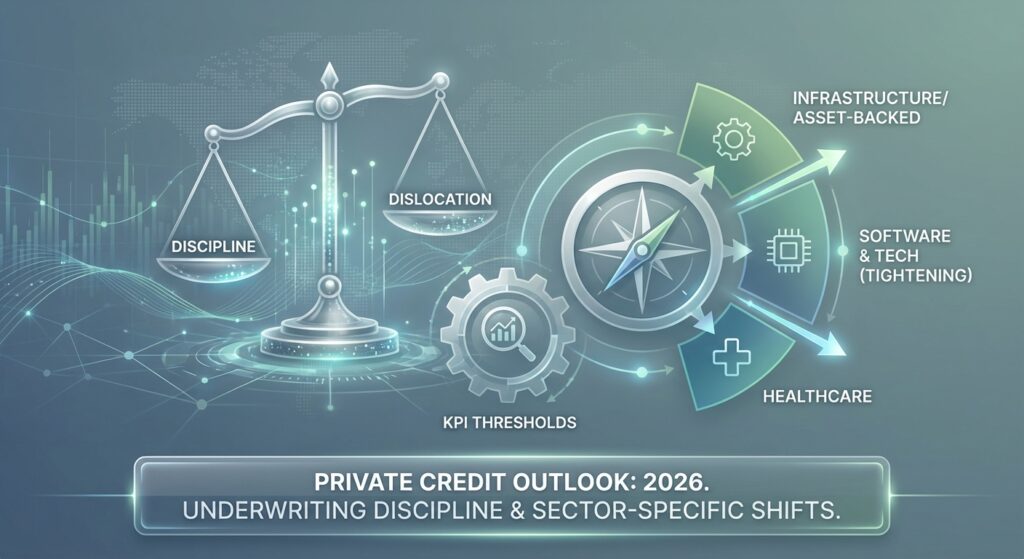
The Main Story: A Repricing of Discipline, Not a Dislocation
Credit markets entered Q2 2026 carrying the momentum of a surprisingly resilient 2025, but the narrative has quietly shifted. As KKR’s credit team noted in March 2026, spreads remain near historical tights on a relative basis, yet the macro backdrop is anything but calm. Tariff policy volatility, AI-driven software valuation reassessments, persistent above-target inflation, and a Federal Reserve still navigating a leadership transition have combined to produce a market that looks tight on the surface but is fundamentally repricing underneath.
The clearest signal: underwriting discipline is tightening selectively. This is not a broad credit contraction. It is, as Atlas Peak Research characterized it in March 2026, a liquidity, valuation-credibility, and underwriting-discipline repricing, concentrated in specific structures and sectors rather than systemic across the asset class. For institutional investors and operators navigating debt capital markets, understanding where that repricing is hitting hardest is the single most actionable intelligence question of the quarter.
Quantitative Market Snapshot
The table below consolidates key credit market metrics as of Q1–Q2 2026, drawn from publicly available institutional sources. Operators and investors should benchmark current transaction structures against these reference points.
| Metric | Current Level (Q1/Q2 2026) | Prior Period (Q3/Q4 2025) | Source |
|---|---|---|---|
| U.S. Leveraged Loan New-Issue Volume (Full Year 2025) | $709.0B (2025 full year) | $661.2B (2024 full year) | kpmg.us |
| Refinancing Share of Loan Volume | 44% (2025) | ~55–60% (2023–2024 peak) | kpmg.us |
| Global Private Credit AUM (Fed Q2-2024 framing) | ~$2.0T globally / ~$1.34T U.S. | Est. ~$1.7T globally (2023) | atlaspeakresearch.com |
| Global Private Credit AUM (BIS / IMF broader framing) | $2.5T+ (BIS) / $2.1T (IMF AUM + committed) | N/A (definitional variation) | atlaspeakresearch.com |
| Fed Funds Rate (Top of Range, post-Dec 2025 cut) | 3.75% | 4.00% (pre-Oct 2025 cut) | mondaq.com |
| Credit Spread Posture (Aggregate) | Near historical tights; rising dispersion | Uniformly tight (H2 2025) | kkr.com |
Note: Middle market direct lending spreads remain predominantly reported on a floating-rate basis (SOFR +). All-in yields in upper middle market direct lending were tracking in the 9.0%–11.0% range in late 2025 to early 2026, with tighter execution available for sponsored, investment-grade-adjacent credits.
Sector Analysis: Where Lender Appetite Is Moving, and Where It Is Pulling Back
Software & Technology-Enabled Businesses, Tightening Scrutiny: Software has been the defining pressure point of early 2026. As detailed by Atlas Peak Research, AI-related valuation reassessments are cascading into software credit underwriting. Lenders are revisiting revenue-quality assumptions, pushing back on ARR-based leverage structures that were permissive as recently as mid-2024. The KPI threshold shift is material: whereas ARR multiples of 5–7x were accessible in 2024 for high-growth SaaS borrowers, lenders are increasingly demanding demonstrated EBITDA conversion and FCCR coverage of at least 1.10–1.20x before underwriting senior leverage above 4.0x. Deals featuring AI-revenue dependency without clear cash flow documentation are facing expanded diligence cycles and spread premiums.
Sponsor-Backed Middle Market, Bifurcating: The BSL versus private credit competition identified by McDermott Will & Schulte for Q1 2026 continues to shape middle market dynamics. Larger, sponsor-backed upper middle market credits with strong EBITDA visibility can still access BSL markets at tight spreads. Below $100M EBITDA, private credit retains pricing power and structural control. Leverage multiples for quality sponsored credits are holding at 4.5–5.5x total debt/EBITDA, but lenders are requiring tighter covenant packages and more conservative add-back disciplines than in 2023.
Infrastructure-Adjacent and Asset-Backed Credit, Attracting Capital: Institutional lenders are actively rotating toward asset-backed and infrastructure-linked credit strategies. These sectors offer collateral depth, contracted revenue streams, and inflation-indexed cash flows that directly address lender concerns about valuation credibility in mark-to-model portfolios. Crescent Capital’s January 2026 market commentary highlighted the resilience and continued relevance of direct lending across the U.S. middle market, with particular emphasis on stability in sectors insulated from discretionary consumer or software-cycle risk.
Healthcare and Business Services, Selective Appetite: Healthcare services lending remains active but lender underwriting is increasingly focused on reimbursement concentration risk and regulatory exposure. Business services credits with recurring revenue and low customer concentration continue to attract competitive terms. FCCR requirements in healthcare are generally set at 1.15–1.25x minimum, with most lenders requiring maintenance covenant packages rather than cov-lite structures at this deal size.
Structural Shift: Vehicle Mismatch Risk Is a Systemic Watch Item
One structural issue deserving explicit attention from institutional allocators is the liquidity mismatch risk embedded in semi-liquid and wealth-channel private credit vehicles. Atlas Peak Research’s March 2026 analysis provides a granular taxonomy: closed-end drawdown funds retain low run-risk due to capital lockups matching loan duration, while semi-liquid perpetual BDCs and evergreen interval funds, which hold 10–40% liquid sleeves against predominantly illiquid loan books, carry elevated sensitivity to synchronized redemption pressure. This is not an industry-wide solvency concern, but it is a structural risk that institutional LPs should diligence carefully at the vehicle level, not just the strategy level.
Implications for Operators and Institutional Investors
For Borrowers: The market is borrower-favorable at the top of the quality spectrum: tight spreads, declining base rates, and competition between BSL and private credit lenders are all constructive for well-capitalized, cash-generative companies. However, borrowers in software or AI-adjacent sectors should expect expanded diligence timelines, more conservative EBITDA adjustments, and pressure to demonstrate at least 1.10–1.20x FCCR on a fully loaded basis. Operators pursuing acquisition financing should model conservative leverage scenarios (4.0–5.0x senior) and assume lenders will require meaningful equity cushions, typically 40–50% of total capitalization in the current environment.
For Investors and Allocators: The dispersion story flagged by KKR, stronger credits outperforming weaker ones, is the defining alpha opportunity of 2026. Allocators should prioritize managers with deep fundamental underwriting capability over those relying on spread carry alone. Semi-liquid vehicle structures warrant enhanced due diligence on liquidity sleeve composition and gate provisions. The 2028 refinancing wall, heavily concentrated in B-rated and lower credits, as flagged by KPMG, represents both a risk and a forward opportunity for distressed and special situations capital.
Key Market Insights
- Spreads tight, but dispersion is the real story: Aggregate credit spreads remain near historical tights, but the gap between quality and stressed credits is widening, rewarding disciplined credit selection over passive spread harvesting.
- Software underwriting is being repriced: ARR-based leverage structures are under pressure as AI valuation uncertainty cascades into credit diligence; FCCR minimums of 1.10–1.20x are becoming standard gating criteria for senior leverage above 4.0x in tech sectors.
- BSL vs. private credit competition benefits upper-middle-market borrowers: Sponsored credits with $100M+ EBITDA have genuine cross-market optionality; below that threshold, private credit lenders retain structural and pricing control.
- Semi-liquid vehicle liquidity risk is a structural watchpoint: Allocators in evergreen and interval-fund private credit vehicles should stress-test liquidity sleeve adequacy and gate mechanisms; this is a vehicle-level risk, not an asset-class-level risk.
- The 2028 refinancing wall is a calendar risk to begin positioning around now: Heavy B-rated and lower credit concentration in 2028 maturities creates execution risk; operators with debt maturing in that window should evaluate early refinancing options while markets remain open.


