
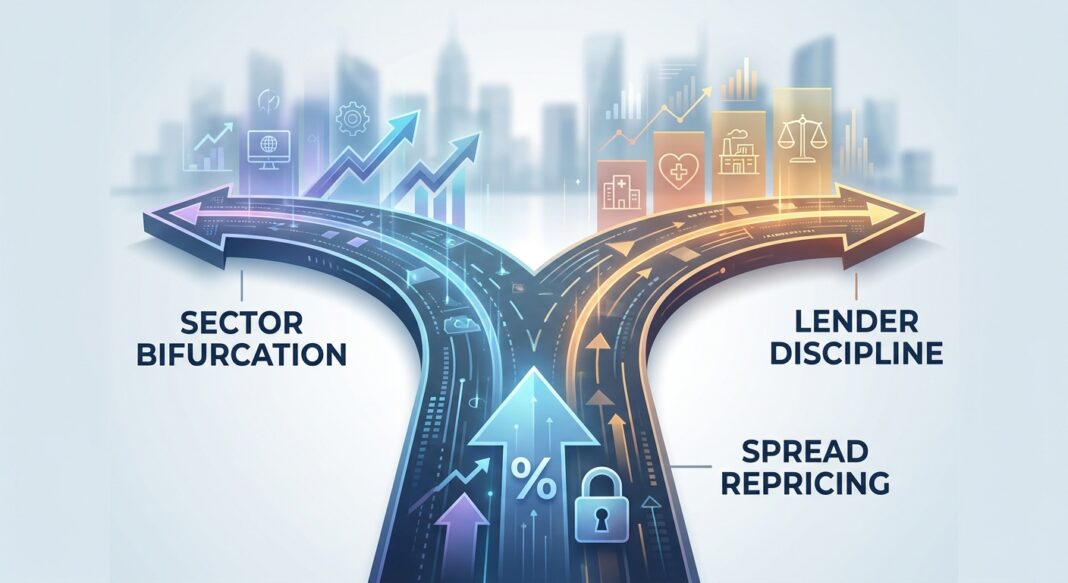
Market Headline: A Lender-Friendly Reset Takes Hold
The U.S. private credit market is navigating its most consequential inflection point since the post-GFC expansion began. After years of spread compression and covenant erosion that decisively favored borrowers, 2026 has delivered a coordinated repricing across middle-market and broadly syndicated lending channels. Three converging shocks (a U.S.-Iran military conflict in late February, an AI-driven reassessment of software and technology credit quality, and a wave of retail BDC redemption requests) collectively ended the momentum that had carried private credit to near-record origination volumes through 2025.
Heightened volatility in early 2026 pushed credit markets back into a renewed phase of price discovery, with secondary B-rated loan spreads approximately 67 basis points wider than year-end 2024 levels as of Q1. Private credit spreads have re-entered the 500 basis point context, a level last seen during prior stress periods, offering yield-enhancement to well-capitalized, selective lenders. Following the March shock, direct lending market conditions stabilized during Q2 2026, with lending activity remaining competitive particularly for higher-quality deals, even as expected yields increased approximately 50 basis points over the quarter. The net result is a market where lender discipline (in documentation, sector selection, and underwriting rigor) is once again the primary differentiator of long-term performance.
Quantitative Market Snapshot
The table below consolidates key rate, spread, and credit quality benchmarks as of August 2026, with prior-period comparisons where available.
| Metric | Current Value | Prior Period | Source |
|---|---|---|---|
| Overnight SOFR | 3.62% (Aug 7, 2026) | 3.68% (3-Mo Term SOFR, June 2026) | NY Fed via SOFRRate.com |
| Fed Funds Target Range | 3.50%–3.75% | 3.50%–3.75% (held steady Q1 2026) | SOFRRate.com Dashboard |
| 5-Year U.S. Treasury Yield | ~4.23% (June 2026) | 3.92% (March 2026) | VRC Q2 2026 Private Markets Report |
| U.S. HY OAS (ICE BofA) | ~273 bps (Aug 2026) | ~269 bps (Jul 21, 2026); 275 bps (Jun 30) | ICE BofA / FRED via Convex |
| Middle Market Private Credit Spreads | ~500 bps context (S+500) | Tighter multi-year lows, late 2025 | Hamilton Lane Private Credit Focus 2026 |
| Secondary B-Rated Loan Spread vs. Year-End 2024 | +67 bps wider (Q1 2026) | Baseline: Year-End 2024 | VRC Q1 2026 Middle Market Credit Spreads |
| Software Sector Secondary Spread Premium vs. B-Loan Index | +229 bps (June 19, 2026) | +245 bps vs. Year-End 2025 | PitchBook LCD via VRC Q2 2026 |
| Private Credit AUM (Corporate Lending) | >$2 trillion (2026 est.) | $2.3 trillion (2025 full year) | Moody’s U.S. Corporate Default Risk 2026 |
| Private Credit Fundraising H1 2026 | $262 billion (+30% YoY) | H1 2025 baseline | The Credit Crunch, H1 2026 State of Private Credit |
| Middle Market Borrower Interest Coverage Ratio (ICR) | ~1.6x (2025 avg.) | 3.1x (2021) | Angel Investors Network / Private Credit Fundraising Fatigue 2026 |
| BDC Median Non-Accrual Rate (Publicly Traded) | 0.33% median; 1.37% at 75th pct. (Q1 2026) | 0.00% median (2022) | Wellington Management Private Credit Outlook |
| Estimated Private Credit Default Rate (2025) | ~1.6%–4.7% (excl. distressed exchanges) | Sub-2% reported headline | Moody’s U.S. Corporate Default Risk 2026 |
Sources: NY Fed, VRC, Hamilton Lane, ICE BofA/FRED, Moody’s, Wellington, The Credit Crunch. Data as of dates noted.
Sector Analysis: Where Capital Is Flowing, and Where It Is Retreating
The most consequential structural story of 2026 is the deep bifurcation between sectors experiencing lender enthusiasm and those facing materially tighter credit conditions. This divergence is reshaping the deal origination pipeline and forcing underwriting teams to integrate AI-risk, geopolitical exposure, and energy cost sensitivity as first-order analytical inputs, not afterthoughts.
Technology & Software: Widest Spread Dispersion in a Decade
Software sector secondary spreads are approximately 245 basis points wider than year-end 2025 levels and roughly 229 basis points above the broader B-rated loan index as of June 2026, reflecting continued uncertainty related to AI-driven disruption. An AI strategy and an evaluation of AI’s potential risk on a business have emerged as critical analytical components both in underwriting a new transaction and in evaluating existing credits. Lenders are sharply differentiating between AI-native infrastructure enablers, which continue to attract capital, and legacy software-as-a-service businesses whose subscription models face competitive disruption risk. Morgan Stanley estimates private credit could supply more than half of the $1.5 trillion needed for global data center buildouts through 2028, underscoring the structural opportunity at the hardware and infrastructure layer even as application-layer software credit faces higher premiums.
Healthcare: The Defensive Anchor
Healthcare led all sectors in private credit activity in 2025, accounting for 19% of all direct lending deals, and was the only industry to not see significant year-over-year price tightening, according to Octus Data. Demographic shifts and non-cyclical service models continue to attract lenders seeking stable cash flows in healthcare. However, Morgan Stanley has flagged healthcare as a sector to watch for non-accrual exposure: healthcare has led all sectors in loans placed on non-accrual status over the last year, suggesting lender underwriting is becoming more selective within this otherwise-favored vertical.
Infrastructure, Energy & Industrials: Opportunity With Caveats
In infrastructure, private credit is being used to fund large-scale projects such as renewable energy developments that require significant capital investment. This is consistent with the broader European trend, where fund managers such as Apollo Global Management and Ares Management have cited a “substantial origination opportunity” in European infrastructure and defense spending over the next several years. However, energy-intensive industrial credits are facing elevated scrutiny: lenders have responded by tightening underwriting standards for energy-intensive industries and businesses whose leverage was predicated on stable energy costs following oil price volatility tied to the Middle East conflict.
Asset-Backed Finance and Hybrid Capital: The Emerging Growth Lane
Capital is increasingly shifting towards specialist strategies, including asset-backed finance, non-sponsor lending, and the selective use of leverage, per PwC’s 2026 Private Credit Survey. Asset-based financing is one area where profound increases in opportunity are expected in 2026. By Q1 2026, direct lending’s share of private credit fundraising had fallen to 31%, while fundraising activity expanded across infrastructure debt, real estate credit, special situations, and other asset-backed opportunities, a structural broadening of the asset class that reflects both investor demand for diversification and sponsor appetite for bespoke capital solutions.
Regulatory Forces & Underwriting Standards: A Market at an Inflection
The regulatory environment has shifted in ways that carry meaningful near-term implications for both bank and non-bank lenders. In December 2025, the OCC and FDIC jointly rescinded the 2013 Interagency Guidance on Leveraged Lending, allowing institutions to manage leveraged exposures consistent with general principles of safe and sound lending. This has the potential to give private credit lenders greater flexibility to underwrite a broader range of loans, including at deeper leverage levels that would have previously been constrained.
On the bank side, the July 2026 SLOOS reported basically unchanged C&I lending standards for firms of all sizes during Q2, while banks reported stronger demand for C&I loans from large and middle-market firms. Notably, for C&I loans, banks reported that current lending standards are easier than the midpoint of their historic ranges, a constructive signal for well-capitalized corporate borrowers. However, in Q1 2026, significant net shares of banks reported tighter standards for NDFI loans, including to business credit intermediaries and private equity funds, with the most cited changes being higher premiums on riskier loans, stricter covenants, and shorter maximum maturities.
From a structural credit quality standpoint, borrower stress metrics demand close monitoring. The aggregate interest coverage ratio (EBITDA/interest) across private credit’s middle-market borrower base has fallen from 3.1x in 2021 to approximately 1.6x in 2025, a compression driven by years of floating-rate debt at elevated SOFR levels. The opacity of private credit structures (including covenant-lite documentation, PIK income, NAV-based lending, and layered fund-level leverage) makes it difficult to estimate a market-wide measure of credit risk. Meanwhile, payment-in-kind (PIK) usage has risen notably, with public BDCs now receiving an average of 8% of investment income via PIK, a figure that analysts note as a leading indicator of potential forward credit impairment if it crosses the 10–15% threshold.
On the positive side, loan-to-value (LTV) ratios remain conservative across private credit segments, with stable LTVs indicating that lenders have not materially loosened underwriting standards over the last three years.
Strategic & Operational Implications
For Institutional Investors
The most durable advantage in the current environment may come from better documentation, more conservative leverage, and the time to conduct thorough stress analysis before capital is deployed. Manager selection has become a first-order consideration: the gap between stronger and weaker portfolios is expected to become more visible as 2026 progresses, with non-accruals, PIK usage, sector concentration, and 2021–2022 vintage exposure as the key indicators. Portfolio concentration risk is material: as of Q1 2026, only 39% of upper middle market issuers were unique to a single portfolio compared to 80% of lower middle market issuers, underscoring the diversification advantages of allocating to core and lower middle market strategies versus mega-lender platforms. The H1 2026 fundraising surge of $262 billion, up 30% year-over-year, confirms that Q2 2026 accounted for nearly 70% of H1 fundraising, suggesting a demand rebound after the Q1 shock, though this capital is increasingly concentrated among the largest managers.
For Operators and Borrowers
Periods of broader market disruption typically see banks and liquid credit markets retrench, with private equity sponsors turning to private credit for greater execution certainty. For middle-market companies, this dynamic remains favorable for accessing capital, but the terms of that capital are tightening. Borrowers in AI-exposed software, energy-intensive industrials, and businesses with elevated leverage predicated on pre-2024 rate assumptions should expect heightened scrutiny of their FCCR (fixed charge coverage ratios), net leverage multiples, and covenant packages. Companies with FCCRs below 1.25x and net leverage above 6.0x are increasingly encountering restrictive amendment requests, PIK conversions, or outright lender retreat. Operators should proactively model rate sensitivity and engage lenders early on maturity wall planning: as of mid-2025, just 15% of BDC-held debt investments were due in 2026–2027, down from 27% in Q2 2024, suggesting significant progress has been made but residual refinancing risk persists.
Forward-Looking View: Next 3–6 Months
The private markets environment continues to reflect a combination of heightened macroeconomic volatility, geopolitical uncertainty, and evolving credit dynamics, with the Federal Reserve’s policy path complicated by oil-driven inflation upside risks. Middle market private equity deal value has shown signs of improvement, with deal value increasing approximately 10.7% year-over-year and exit activity rising 14%, offering a constructive pipeline signal for direct lenders through year-end. The return of banks to the upper middle market in Q2 is compressing spreads in larger deals, which reinforces private credit’s natural advantage in the middle market and distressed situations, where speed, structuring flexibility, and certainty of funding remain unmatched. Regulatory tailwinds from the rescission of leveraged lending guidance may allow select platforms to compete more aggressively on leverage levels, but the dominant near-term theme will be disciplined underwriting in a market that has definitively moved from borrower-friendly to lender-friendly conditions.
Key Market Insights
- Spreads have repriced materially but stabilized: Middle market private credit spreads are back in the S+500 bps context, with secondary B-rated loans approximately 67 bps wider than year-end 2024, creating a yield-enhancement window for new capital deployed at current levels. (Source: Hamilton Lane; VRC Q1 2026)
- Borrower coverage ratios are at a cyclical low: The middle-market aggregate FCCR-proxy (EBITDA/interest) has compressed from 3.1x in 2021 to ~1.6x, identifying a cohort of borrowers at elevated refinancing risk and signaling the need for underwriters to stress-test rate sensitivity and covenant headroom rigorously. (Source: Angel Investors Network / Private Credit Fundraising Fatigue 2026)
- Sector bifurcation is sharp and structural: Software credits carry a 229-bp spread premium over the B-rated loan index; healthcare remains the defensive anchor at 19% of direct lending deal flow; infrastructure and AI-linked data center finance represent the highest-conviction growth verticals for 2026–2028. (VRC Q2 2026; Octus; Creative Planning / Morgan Stanley)
- Bank lending standards have stabilized at an accommodative level for C&I borrowers: The July 2026 SLOOS confirms C&I standards are easier than the historical midpoint for large and middle-market firms, with stronger demand emerging from corporates, but NDFI/private credit fund standards remain tighter, a key structural tension for leveraged platforms. (KPMG Q2 2026 SLOOS Analysis; Federal Reserve July 2026 SLOOS)
- PIK income and non-accrual trends are the leading indicators to monitor: BDC median non-accrual rates rose from 0% in 2022 to 0.33% in Q1 2026, with the 75th percentile at 1.37%. PIK income averaging 8% of BDC investment income is a critical watch metric, any individual fund crossing the 10–15% threshold signals imminent hard-default risk in the underlying portfolio. (Wellington Management; With Intelligence)


