
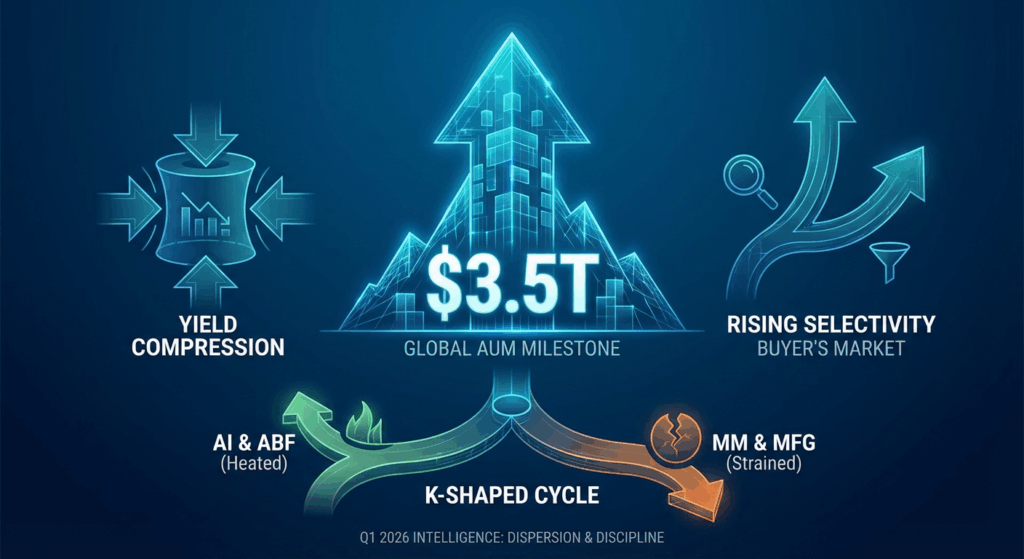
March 3, 2026 – The private credit market has breached a historic threshold, surpassing $3.5 trillion in global assets under management (AUM) as of early 2026. However, this milestone comes amidst a pivotal regime shift. After nearly two decades of benign conditions, the asset class is entering what industry leaders are calling its “first real stress test.”
The defining dynamic of Q1 2026 is the simultaneous collision of record capital deployment with tightening yields and rising default rates. While capital deployment surged 78% year-over-year in 2024 to nearly $600 billion, intensifying competition between direct lenders and a resurgent broadly syndicated loan (BSL) market is compressing spreads. For the first time in this cycle, power has definitively shifted from lenders to borrowers, creating a “buyer’s market” where selectivity, rather than scarcity, will determine returns.
Quantitative Snapshot: Market Conditions Q1 2026
| Metric | Current Level | Trend / Comparison | Source |
|---|---|---|---|
| Global Private Credit AUM | $3.5 Trillion | Mainstream adoption; Retail & Wealth channels driving growth | Private Markets Insights |
| 1st Lien Direct Loan Forecast Yields | 8.0% – 8.5% | Down from 10%+ peaks in prior cycle | Private Markets Insights |
| Middle Market Default Rate | 5.5% | Rising significantly; Headline default rates masking MM stress | Private Markets Insights |
| LBO Deal Volume | +40% YoY | Rebound in M&A driven by PE need for exits (3.8 yr avg hold) | Private Markets Insights |
| IG Private Placement Issuance | >$170 Billion | Record highs; Spreads tightened ~5 bps in Q4 2025 | SLC Management |
Sector Analysis: The K-Shaped Credit Cycle
The 2026 credit landscape is defined by dispersion. While aggregate demand is robust, specific sectors are diverging sharply based on capital intensity and exposure to macro headwinds.
Heated: AI & Infrastructure
Artificial Intelligence has evolved from a venture capital theme to a dominant credit supply driver. With hyper-scaler investment expected to exceed $2.7 trillion through 2029, the demand for capital has outstripped internal cash flows, forcing a pivot to debt financing. This “AI arms race” is creating massive issuance needs across investment grade (IG), private credit, and project finance, concentrating risk among large, AI-exposed corporates.
Growing: Asset-Based Finance (ABF)
As corporate direct lending faces margin compression, lenders are rotating into Asset-Based Finance. Approximately 65% of managers now identify ABF as having the highest growth potential, with estimates placing the total addressable market at $40 trillion. This shift represents a structural move away from pure corporate credit risk toward collateral-backed lending, offering a defensive posture against rising defaults.
Strained: Traditional Middle Market & Manufacturing
Conversely, the traditional middle market is showing cracks. The middle market default rate has climbed to 5.5%, significantly higher than the benign sub-2% rates seen broadly. Manufacturing and retail sectors are grappling with renewed tariff-driven uncertainty and supply chain friction, which have begun to erode profit margins. Lenders are becoming increasingly wary of non-sponsored manufacturing credits that lack the pricing power to pass on tariff costs.
Implications for Market Participants
For Borrowers:
Conditions have loosened significantly. The “scarcity premium” for private capital has evaporated. With traditional banks recommitting to the sector, evidenced by $96 billion in recent loan commitments to private credit vehicles, borrowers can drive competitive tension between BSL and private credit solutions. Investment-grade issuers, in particular, are benefiting from high demand, with recent deals seeing 5-10x oversubscription levels and pricing tightening inside initial guidance.
For Lenders & Investors:
The “yield tourism” era is over. With yields compressing to the 8.0-8.5% range and defaults ticking up, the margin for error is thin. The market is shifting from an asset accumulation phase to a “selection” phase. Managers can no longer rely on a rising tide; performance will likely show significant dispersion. Distressed and opportunistic funds, having raised over $100 billion in the last two years, are well-positioned to capitalize on the 5.5% default rate in the middle market, buying stressed assets from lenders forced to clean up portfolios.
Forward-Looking Intelligence
- Spread Compression Persists: Expect further tightening in Q1-Q2 2026 as record dry powder chases limited high-quality LBO deal flow.
- The “Great Dispersion”: Performance gaps between top-quartile and bottom-quartile managers will widen as vintage loans from 2021-2023 face refinancing walls under higher-for-longer rate structures.
- Bank Partnership Acceleration: Direct lending will increasingly morph into a hybridized model, with banks providing the leverage and private credit firms providing the origination, blurring the lines between private and syndicated markets.
- Retail Capital Risk: With wealth management channels now accounting for significant inflows, any retail liquidity crunch could trigger forced selling in semi-liquid funds, creating volatility in the secondary market.
- Regulatory Watch: As private credit becomes accessible to 401(k) markets, expect heightened regulatory scrutiny on valuation methodologies and liquidity mismatches.


